

This article was copublished with The Montague Reporter.
When business owners decide they are tired of running a business they often have a difficult decision to make: sell it, or shut it down. But some take a different path: converting their business to run cooperatively.
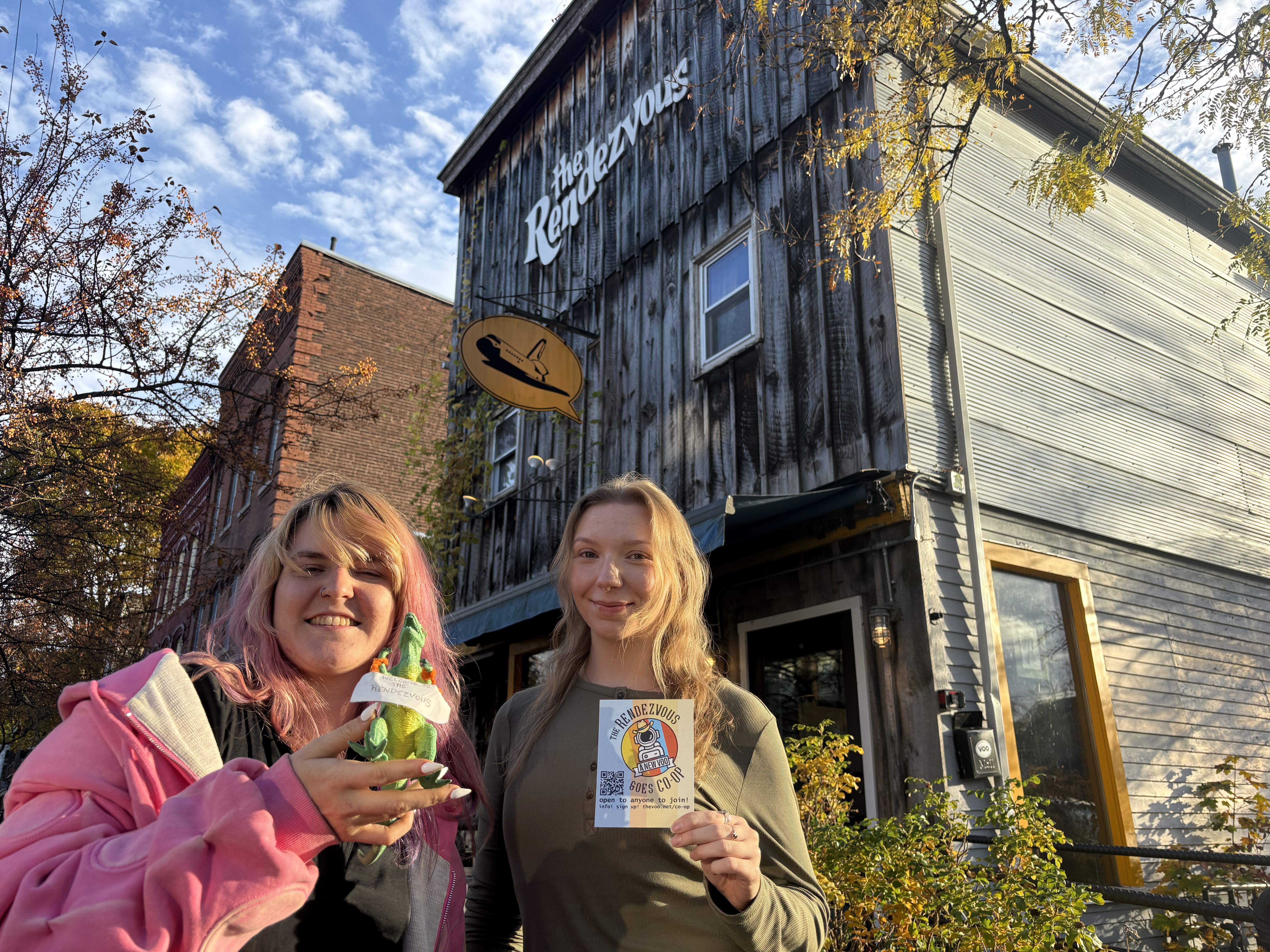
This week, the owners of the Rendezvous announced that they intend to do just that, selling their restaurant and bar in Turners Falls — known colloquially as “the Voo” — to employees and community members as a multi-stakeholder cooperative.
“These are people who have worked a very long time, doing very hard work, to produce quality food and drinks, and experiences for the community,” co-owner Chris Janke said. “We just want to see that work paid back.”
Employees will have the option to buy an ownership stake in the Rendezvous for $1,000 each, giving them the ability to vote and run for seats on a new board of directors, and have more of a say in how the business is run.
“I think it’s honestly incredible,” said Sage Thames, the Voo’s front-of-house manager. “There’s something about the culture here that is drastically different that I think allows for the co-op situation to blossom.”
An experienced restaurant industry worker from Louisiana, Thames says she enjoys the safe and inclusive vibe at the Voo and plans to work while paying off her ownership stake in the business.
“Transitioning a business to a co-op is a way for your work to become meaningful,” she said. “It gives us some sense of control over what we have to deal with as employees, when at most other jobs you just get told what to do.”
Collective ownership could help the business address common staffing and scheduling issues that tend to cause burnout in the service industry, Thames said. Keeping up with all the meetings and details associated with the change, however, has been a challenge while balancing the day-to-day management.
“It’s happening, we’re going through it, but that’s been one of the biggest struggles for me personally,” she said.
Discussions about how the Voo could become a cooperative began in 2018, though progress was sidelined by the COVID pandemic.
Cambrie Carme, a Rendezvous employee since 2017, said she plans to buy a stake in the business too.
“I have stayed with the Voo for this long because I work for great people,” Carme said. “The community and workers will get to keep a piece of history alive that has been there for so many years and not just sold off to someone.”
In its 130-year history, the bar on Third Street has served as a French-Canadian social club, a speakeasy, and a rowdy local dive bar. The first iteration named the Rendezvous opened in the 1930s, and from the 1970s to the ’90s it was owned by Cambrie’s cousin, Fran Carme.
Janke and his wife Emily Brewster bought, renovated, and reopened the Rendezvous as a restaurant with Mark Wisnewski and Jamie Berger in 2007. Open seven days a week for lunch and dinner, it regularly hosts live music, bingo nights, art exhibits, and other events.
“We’ve become a cornerstone of downtown Turners Falls,” Wisnewski said. “I think a lot of people wouldn’t like to see it change hands, which could mean a dramatic change in the business.”
Spreading the Equity
Creating a multi-stakeholder structure has been the Voo’s answer to one of the main hurdles small businesses face in converting to co-ops: employees left with significant debt after they borrow or raise funds to purchase the business.
The staff at Real Pickles raised half a million dollars to buy their Greenfield food-processing facility in 2013 and formed a worker-owner cooperative, and Dean’s Beans and the Regenerative Design Group have made similar transitions in recent years, but there are few cooperative restaurants; the nearest is the Flat Iron, a café in Bellows Falls.
In 2023 a new music venue, The Heavy Culture Cooperative, opened in Easthampton as a multi-stakeholder co-op after raising enough money from community members to renovate and open its space.
“The local metalheads and punks all knew there was enough of a crowd to support something like this, but convincing a bank or prospective landlord that a niche underground music venue will be viable is a different battle,” founder and board member John McLaughlin said. “A lot of people also just seem to be fed up with traditional corporate structures, where the people with the most money get to drown out the other voices.”
The Voo’s owners had the business and its assets – including the building, with a residential apartment upstairs – appraised for $690,000, and have agreed to sell everything to the co-op for $590,000. The Cooperative Fund of the Northeast (CFNE) may loan $390,000, leaving about $200,000 to raise from the community.
Of roughly 25 full-time and part-time employees, about 10 plan to buy a share of the business, according to Wisnewski. Employees who opt out will keep their jobs, but won’t vote on co-op decisions.
“Asking these workers to come up with the hundreds of thousands of dollars to buy the place themselves is an unreasonable approach,” Janke said. “We also see the community as one of the major beneficiaries here, so why not spread out the equity of that investment?”
Under the multi-stakeholder model, the Rendezvous would be overseen by a five-member board. Three members would be worker-owners elected by their colleagues, and two would be community stakeholders elected by fellow at-large members.
Anyone can join by contributing a one-time payment of $200, which comes with the ability to vote on major co-op decisions, serve on its committees, and receive occasional discounts on food and drinks. Nobody may own more than one share.
“We’ve always wanted to leave the workers with more power than community members, because it’s their livelihood,” Wisnewski said. “Our entire goal is to hand over a successful and profitable business to our workers. … To see it fail would be to fail at the entire reason for doing all of this.”
Breaking New Ground
Suzette Snow-Cobb, associate director of the Neighboring Food Co-op Association and one of the Voo’s first community owners, said she encouraged the owners to try the multi-stakeholder model, more commonly used by food co-ops.
“If we are invested in keeping businesses like the Rendezvous in our midst, it makes sense for us to have a little more commitment,” Snow-Cobb said. “Their goal is to not to make some other outside entity wealthier, their goal is to provide a service. It’s a very simple thing, but it’s a very significant thing.”
The approach has not been without obstacles. The owners recently spent several thousand dollars on lawyers to determine how to transfer the liquor license to the cooperative, and how tip pooling among co-owners would work.
“They are breaking new ground in figuring that out,” Snow-Cobb said. “They’ve been doggedly persistent.”
They have also been consulting with various cooperative development agencies, including CFNE, about how to finance the transition.
“It’s a trend nationally, it’s a trend in the region, and that trend in particular has momentum in western Massachusetts,” CFNE executive director Micha Josephy said. “What I love about this work is that it’s preserving something that’s successful, which is always easier than creating something new.”
Founded in 1975, CFNE manages a $50 million loan fund supporting 150 co-ops in New England and New York, including such local institutions as the River Valley Co-op, Collective Copies, Dean’s Beans, and Real Pickles.
“I think the rural, small-town nature of those areas is particularly well-suited for existing businesses that are successful at selling to their workers,” Josephy said. “When a small business closes, there’s generally not another small business coming in, so you’re seeing consolidation that concentrates power in corporations not based in the region.”
Another local CFNE loan recipient, Northeast Biodiesel, closed its biofuel manufacturing facility in Greenfield in 2024 after 16 years of trying to develop a sustainable multi-stakeholder business model.
Today, more resources are becoming available to support worker cooperatives. The Massachusetts Center for Employee Ownership announced a new grant program this month that would cover a portion of the cost for businesses to study the feasibility of worker ownership. CFNE is also part of the Northeast Transition Initiative, which works to promote co-ops as viable exit plans for aging business owners.
“Since so many businesses are owned by baby boomers, it’s having an impact on the small business landscape,” Josephy said. “And it’s happening at a time when co-op conversions are gaining traction.”
Managers and staff at the Rendezvous will continue to handle most of the restaurant’s day-to-day operations, and the current owners plan to stay on as long as necessary to ensure a smooth transition.
“We’re not in a rush to make ourselves scarce,” said Brewster. “We want to do whatever we can to get them to a place where they don’t need us anymore.”
Information sessions about the new cooperative will be hosted at the Rendezvous, at 78 Third St. in Turners Falls, next Thursday, Nov. 5 at 8 p.m. and Saturday, Nov. 7 at 2 p.m., with more yet to be scheduled.
Update: This story has been corrected to add Jamie Berger as one of the founders and original owners of the Rendezvous in 2007.

Sarah is a print and radio journalist based in western Massachusetts.
- Sarah Robertson
- Sarah Robertson
- Sarah Robertson
- Sarah Robertson
- Sarah Robertson
- Sarah Robertson
- Sarah Robertson
- Sarah Robertson
- Sarah Robertson
- Sarah Robertson
- Sarah Robertson
- Sarah Robertson
- Sarah Robertson
- Sarah Robertson
- Sarah Robertson
- Sarah Robertson
- Sarah Robertson
- Sarah Robertson
- Sarah Robertson
- Sarah Robertson
- Sarah Robertson
- Sarah Robertson


