

In early October, independent candidates Andrea James and Nadia Milleron held a town-hall in one of Holyoke’s trademark red-brick buildings. There was a steady stream of chatter, with pink and plum lights illuminating the stage where they were set to talk to voters about issues affecting their lives.
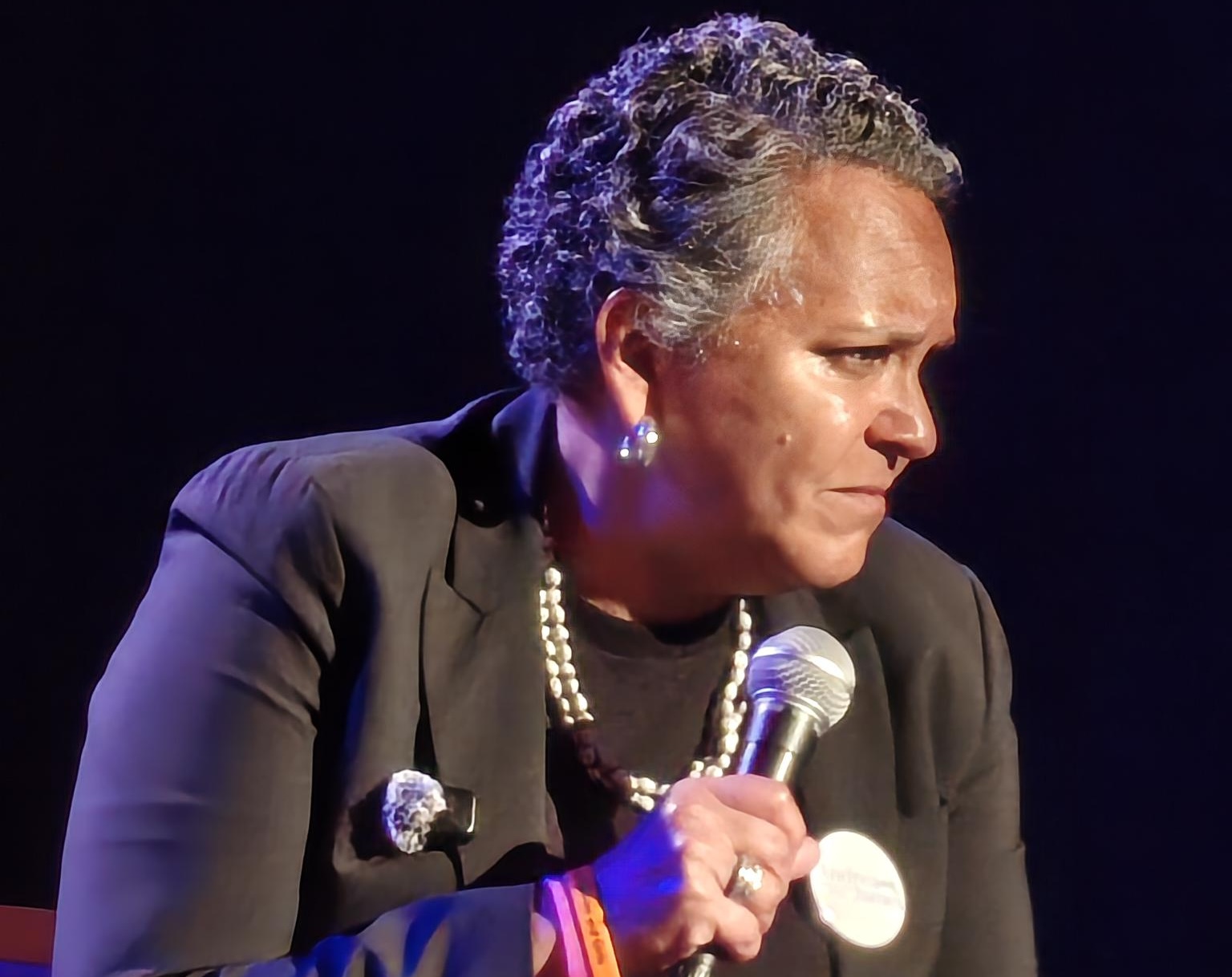
Andrea James arrived first, donned in all black and pearls that seemed iridescent under the lights.
James is running for governor against incumbent Maura Healey. A former lawyer who was incarcerated for two years for misusing her client’s funds, James founded Families for Justice as Healing while serving her sentence. The nonprofit organization fights for prison abolition, which informs much of her political platform.
Instead of spending millions of dollars on upkeeping or building prisons, James wants public money redistributed to meet the needs of Massachusetts residents. During her incarceration, she said she saw how ineffective state policy was in addressing the root issues that land women in jails and prisons — poverty, abuse, and mental illness, among other issues that she traces back to socioeconomic inequality.
And that inequality, she said, is due to corporate dominance of Massachusetts politics. So, after more than a decade of mobilizing to address those root causes and to fight prison development, she decided to take action in a different way.
“I just got tired of my vote being taken for granted,” she said. “I got tired of going up to that Statehouse session after session and pouring our hearts out about issues that directly impact the most vulnerable communities around the commonwealth. And actually, none of those things even ever [got] out of committee.”
James is one of several independent or third-party candidates western Massachusetts voters will see on their ballots this election season. At multiple levels of government, candidates are betting that voters are tired — tired with the two-party system, with incumbents that have been in office for decades, or even with the way that politics and the economy are set up entirely.
“We can do this,” Milleron, an independent who is running for a second time against incumbent U.S. Rep. Richard Neal in western Mass’ 1st Congressional District, told The Shoestring. She said her campaign is betting on a high number of independent voters in the region. “We can challenge the duopoly.”
Whether that’s a wise bet depends on who you ask. Early this year, the polling firm Gallup found that a record-high 45% of U.S. adults identified as political independents in 2025. Nationwide, independent candidates have made headlines — and gains in the polls — as they seek to win big victories at a moment when trust in the country’s two dominant political parties has declined.
However, electoral polling in deeply Democratic Massachusetts — and the recent past — suggest independent and third-party candidates still face steep challenges.
A recent University of Massachusetts Amherst/WCVB poll showed Healey holding a 25-percentage-point lead over Republican challenger Mike Minogue. James came in at just 6% in that poll. And although Milleron has put half a million dollars of her own money into her own campaign — and recently released an internal poll that her campaign said showed her trailing by less than 5 percentage points — the Democratic Party is spending even bigger money against her. And she has already lost this race previously after Neal defeated her at the polls in 2024 by a two-to-one margin.
For some independent and third-party candidates, running an electoral campaign is as much about furthering their other organizing aims as it is about potentially winning the race.
That’s the case for Joe Tache, a youth worker and community organizer who is running for U.S. Senate with the Party for Socialism and Liberation against longtime incumbent Democrat Ed Markey. He said he and his fellow PSL members see his electoral campaign as fitting into their broader goals — supporting people unionizing in their workplaces, for example, and helping socialist proposals gain traction across the state and country.
“Elections are a place where we can put our proposals directly side by side with the proposals — and really the lack of vision — coming from both the Democratic and Republican parties,” Tache said. “And explain why the messaging that those parties are putting forward actually won’t solve our problems.”
James is running on economic issues she’s hoping to highlight. She’s proposed creating universal childcare and healthcare, for example, and has said she’ll champion workers’ rights. She’s also campaigned on ending the state’s contract with Immigration and Customs Enforcement, protecting queer rights, combating climate change, and ending racial socioeconomic disparities.
To James, legislators lack urgency, transparency, and accountability. She said Healey has been an ineffective governor with little to show for her time in office.
In the candidate’s perspective, some of the actions that Healey has taken -– like her implementation of ChatGPT in the state workforce or her letter to the federal administration asking for the expediting of gas pipeline expansion in an effort to lower gas bills — don’t meaningfully address the cost-of-living crisis and the uphill battle of meeting the state’s climate goals.
James is billing herself as someone who has direct experience with policies she says aren’t doing enough to help people in Massachusetts.
“I’m going through that right now … I can’t get healthcare that I need fully covered by my insurance,” James said. “My health care premiums went up in 2026 and they’re going up again.”
But like many independent candidates, she has faced issues with fundraising absent a political-party infrastructure behind her.
Campaign finance records show that since the beginning of 2025, James has raised $52,000 from individual donors, with a median donation amount of $37. But without enough of those small donors, she said at the town-hall event earlier this month that she had to take out a loan to keep her campaign office open.
By contrast, Healey spent more than $4 million last month alone and still had $3 million left in the bank.
Tache has done a little better raising money. Around 18% of the $201,000 Tache had fundraised through the end of September — all from individual donors — came from software engineers at Google, according to federal campaign finance data. Other frequent donors to his campaign include teachers in the Boston Public Schools system and labor organizers.
Milleron, meanwhile, has loaned her own campaign $500,000 — money that comes from the nearly $50 million her family won after winning a civil lawsuit against Boeing. Milleron came onto the political stage after losing her daughter, Samya Stumo, in a Boeing plane crash in 2019. A niece of the renowned consumer advocate Ralph Nader, she began organizing after her daughter’s death, advocating with other families who experienced similar losses for increased aviation regulations.
Milleron ran unsuccessfully for Congress in 2024 against Neal, who is frequently one of the biggest recipients of money from corporate political action committees in the entire U.S. House. So far this election cycle, Neal has raised $3.1 million and spent more than $5 million, according to Federal Election Commission data. Of the money he’s raised during that time, 67% of it has come from PACs, nearly all of which represent big-business interests.
Money isn’t the only difficulty for independent and third-party candidates. Getting media attention to their campaigns can be challenging, they say.
Two weeks ago, WBZ hosted a debate between Healey and her republican challenger, Mike Minogue, a billionaire who is trailing Healey by double-digits in voter polls despite pouring more than $18 million of his own money into his campaign so far. James said that the network didn’t let her participate, despite multiple requests. According to her, WBZ told her campaign that their audience only wanted to hear from the establishment candidates.
WBZ did not respond to a request for comment on this article.
James said she doesn’t think that the outlet was speaking to the majority of Massachusetts residents, considering the high rate of unenrolled voter across the state. Data published by the secretary of state show that 3.5 million voters are unenrolled ahead of the general election, making up two thirds of the state’s registered voters.
“That is just a glaring example of voter suppression. You’re not giving voters an opportunity to be well informed,” she said. “And it’s racism as far as I’m concerned.”
Those are challenges that Tache has faced, too. He said that in order for him to qualify and be able to participate in a debate facilitated by Boston 25 News and WGBH, his campaign had to raise $250,000 and be on the ballot. That meant raising $150,000 in seven weeks.
“Our volunteers and supporters all across the state organized and dug deep, and scraped their pockets and their wallets and their bank accounts to raise that money,” Tache said. “And we actually did meet the threshold.”
However, Tache said the debate was abruptly canceled on Oct. 1. WBZ later held a debate between Markey and his Republican challenger John Deaton.
“We could have [had] the opportunity to share our message on the debate stage, side by side with Republican and Democratic candidates,” Tache said. “And I think that the corporate media establishment in the two-party system felt like that was too dangerous.”
Boston 25 News did not immediately respond to a request for comment Friday. In a statement, a WGBH spokesperson said the station did conduct an interview with Tache earlier this week.
“We know opportunities to hear directly from candidates are important to voters,” Nicole Boudreau said in the statement. “And we continue to focus on providing comprehensive political coverage through the election, including our Massachusetts U.S. Senate candidate interview series.”
While James and Tache faced hurdles trying to debate major-party candidates, Milleron faced off with Neal last Wednesday.
While Neal defended his stances in his debate with Milleron, she questioned his ability to meet the basic needs of his base, particularly around healthcare and social security benefits.
Milleron has been running on policies meant to increase the quality of living for working class voters. One of her proposals that attempt to address the cost-of-living crisis is no income tax for people making under $100,000. She has also proposed defunding the military budget and increasing taxes for the wealthy.
“We have to get money in people’s pockets, that’s their money. They shouldn’t be taxed on money they need to live on,” Milleron said. “It’s triage. It infuses money directly into households — it would be between $10,000 and $20,000 per household — that’s a significant amount of money for people who can’t afford their lives, they can’t pay their bills.”
Instead, she said, the government is spending money on endless wars, “bleeding our country”, and taking away resources from people.
Milleron said that her experience with mobilizing for the Aircraft Certification Reform and Accountability Act showed her that leadership means little without collective action and that politicians are unwilling to act unless heavy pressure is applied — a stark contrast, she said, compared to corporate lobbyists that have easy access to lawmakers.
To Milleron, if corporate-backed politicians — regardless of party affiliation — continue to believe that they are unchallenged, there will be no change. By voting independent, Milleron said that politicians will be more responsive to voter’s needs because they wouldn’t be guaranteed to win.
She plans strategically using her position as an independent to give her an “outsize power” to advocate for the basic needs of people in the district through forcing and withholding votes on issues.
If political advertising is any indication, the Democratic Party is taking Milleron’s campaign seriously. She’s been the target of an ad blitz by the Massachusetts Democratic Party, which has been trying to tie her to Donald Trump’s “Make America Great Again” movement.
Some of that flack has been because of her husband’s — Michael Stumo — position in the federal administration as the associate director of economic policy in the Office of Management and Budget, and because of his overall support of tariffs as an economic tool. Stumo has held the position since 2025. Milleron has gone on record saying that she does think tariffs can be implemented strategically, but that the Trump administration has not done so.
Many voters are going to the ballot with not just disillusionment with the two-party system, but with the economic system itself.
Tache is hoping to appeal to them.
Where he differs from other candidates — including independents like Milleron and James — is his explicit proposal of socialism as the solution to issues people are facing.
To Tache, the root cause of inequality is capitalism, which he said neither party is meaningfully contending with. He said that being a Party for Socialism and Liberation member is different from being part of the Democratic or Republican parties because becoming a PSL member requires a commitment to actively organizing and mobilizing over political issues.
“If we look at the history of our country, all of the most positive and progressive change has been made by social movements — movements of regular, everyday people coming together and taking collective action,” Tache said.
Tache has proposed different bills that are intended to address what he refers to as capitalistic crises — everything from the cost of living and anti-war measures to addressing the harms of climate change. Those include nationalizing the country’s biggest 100 corporations and converting them into public property, as well as imposing a 100% tax on income over $10 million. That tax money would be redistributed and used for basic needs like housing, healthcare, and food, among other needs, he said.
Tache’s campaign also plans to enact an education campaign “to debunk right-wing propaganda, to teach people the true history of our country, and to engender values of unity between people of different backgrounds.”
Tache has also voiced his support for reparations to Black Americans, honoring treaties with Indigenous communities, and abolishing ICE.
People are aching for alternatives because they’re seeing how the status quo is failing them, Tache said.
“So that, to me, gives me a great sense of optimism. The corporate media and the two-party system are trying to keep the lid on a boiling pot,” he said. “But the temperature keeps rising because the crisis in our society keeps deepening, and they’re only going to be able to keep that lid on for so long.”

divina is an independent reporter covering labor and social movements, pursuing a degree in journalism and social thought & political economy at UMass Amherst. They have worked for three years in legislation, policy, and research on education, child welfare, and race equity. Reach them at divina.cordeiro@proton.me or on Instagram and Twitter @divi_cordeiro
- divina cordeiro
- divina cordeiro
- divina cordeiro
- divina cordeiro
- divina cordeiro
- divina cordeiro
- divina cordeiro
- divina cordeiro
- divina cordeiro


