


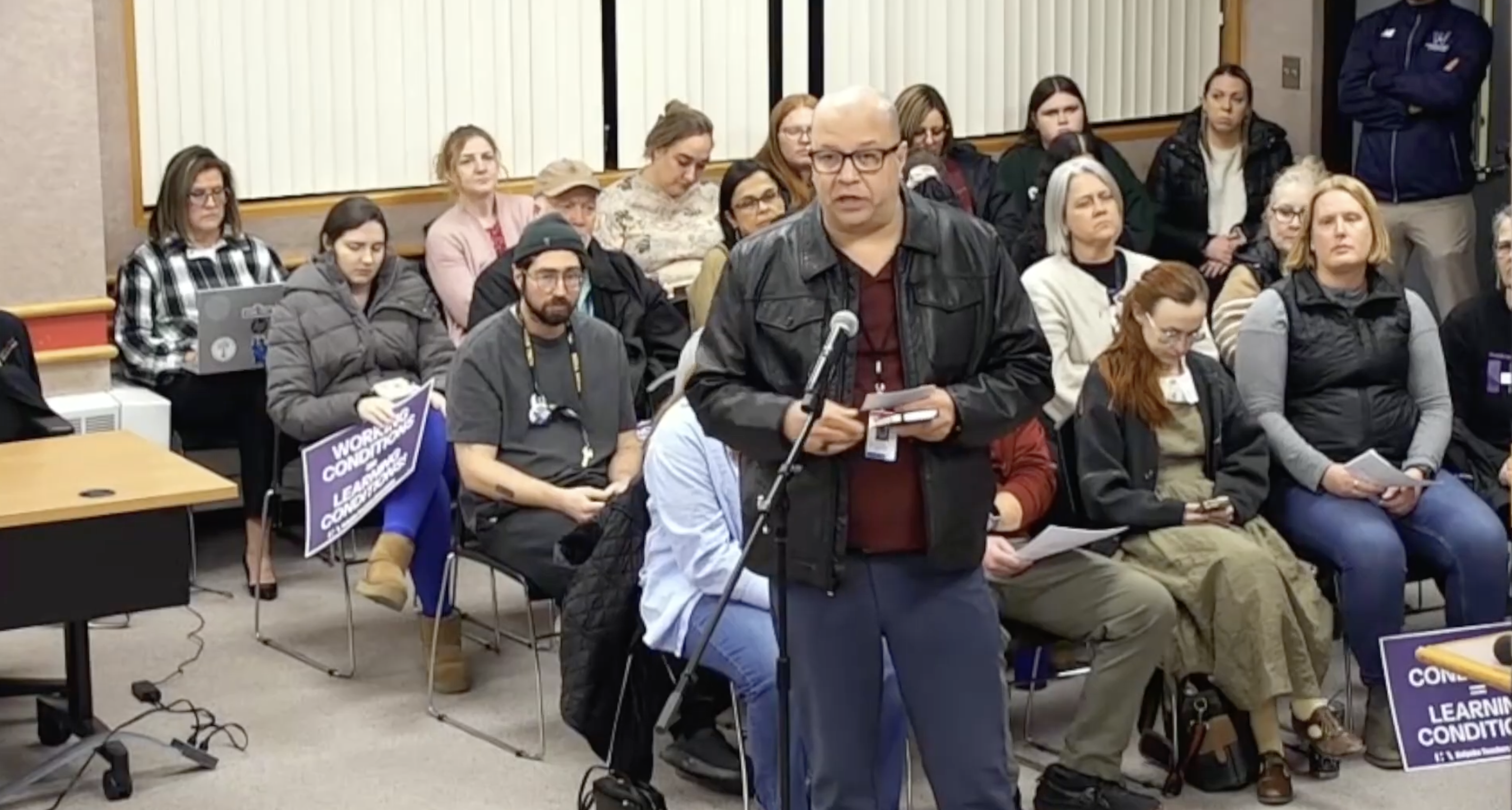
In 2015, state officials took over Holyoke schools. Ten years later, they announced they were giving control back to the community. However, unionized educators in the district say the impact of receivership continues to be far-reaching as they negotiate with the Holyoke School Committee for the union’s first contract since state receivership ended.
Disagreement over school year length, salary expectations, and other fundamental aspects of a tentative agreement has significantly delayed progress in negotiations, members of the Holyoke Teachers Association say.
Alex Cespedes, the vice-president of the HTA, said that the union is frustrated with the administration’s “surface-level” bargaining. They said that after nearly a year of negotiations, the union and the administration have yet to reach a tentative agreement — their first after a decade of unilateral state control over their contract and the district.
“It’s really disheartening,” Cespedes said. “People are leaving so frustrated because it just seems like total obfuscation at this point. Why are we a year in and management can’t agree?”
Mayor Joshua Garcia and several Holyoke School Committee members declined interviews for this article, citing the ongoing negotiations.
“This matter remains under active negotiation, and we are therefore not in a position to discuss it,” Yadilette Rivera-Colón, chair of the School Committee, wrote in an email to The Shoestring.
In an op-ed in The Springfield Republican in November, Garcia said the city is “eager to finalize a contract that keeps our students first and honors our teachers without jeopardizing the district’s future.” He pushed back against suggestions that the city’s bargaining team had misplaced priorities.
“We’re choosing sustainability, so every dollar serves our kids,” he wrote. “I’m proud of the School Committee taking its time through this process, doing exactly what we are supposed to be doing under local control and not caving into pressure.”
The HTA isn’t the only union that the mayor is at odds with. According to MassLive, Garcia has also been in dispute with Local 1459 of the United Food and Commercial Workers over contract negotiations for employees of the Department of Public Works.
In December, 86% of the educators’ union agreed to hold a vote of no confidence in the School Committee. Of those, 97% of those members voted “no confidence” in the body.
For Cespedes, the no-confidence vote came after a culmination of what the union saw as bad-faith negotiations compared to the effort that union members were putting into their proposals. They said that negotiations so far were intolerable and that the lack of movement towards an agreement with the district is a “complete injustice” to the Holyoke community.
In late August, Holyoke officials filed for mediation with the state’s Department of Labor Relations after the union rejected one of the district’s package proposals — a move Cespedes called premature.
After an investigation, the DLR said there were still “unresolved issues that would benefit from continued face-to-face negotiations prior to commencing the negotiation process.” The department added that it could make another decision on mediation, if either party requests it, after the negotiations have narrowed down and major differences have been reconciled.
“It is in the parties’ best interest to resolve as many core issues prior to mediation,” the department said.
Now, nearly four months later, little progress has been made, union leaders say.
According to Cespedes, the district’s current contract with the union, which was implemented under receivership when the state had the power to unilaterally alter it, doesn’t meet “normative” standards compared to districts that haven’t been under state control.
Cespedes said because of the union’s disorganized grievance process in the contract — a procedure that allows either party to hold the other to the terms of a contract and can be a tool for unions to hold employers accountable — there are restrictions on the union’s ability to organize. Cespedes said that the grievance process is a “huge part of what makes a contract enforceable.”
Cespedes said that the administration also has made the union’s proposal seem unaffordable, which Cespedes said isn’t accurate. State legislation like the Fair Share Amendment and Student Opportunity Act provides significant public funding for Holyoke’s school district, they said. To them, it’s a matter of prioritization and reallocation of funds.
“There’s absolutely no reason for them to not be getting the resources that they need in their schools,” Cespedes said.
For union members like Pete Duffy, restored confidence in the administration is possible, but not without effort. He said the management team needs to “do their homework” and show up to the meeting having reviewed the union’s proposals in order to make progress in bargaining. There also needs to be a “willingness to come down on truly egregious provisions in their proposals” — ones that Duffy says no other district in the state would accept.
According to him, the management team has canceled negotiation meetings because one person from the administration is unable to attend. He also told The Shoestring the administration had said they would likely not be able to review the union’s counterproposals before their next negotiation.
Nick Cream, the president of the HTA, said that the administration seems unwilling to make the same compromises that the union has. According to several union members, there are still proposals that the administration has yet to respond to. Cream added that for the proposals that the district’s bargaining team does respond to, they don’t often explain their reasoning for rejecting a proposal.
In the meanwhile, turnover continues to be a major issue for schools across Holyoke. In the six years prior to state receivership, the district’s teacher retention rate hovered between 83% and 93%, according to state data. In the year the state took over, though, the retention rate dropped significantly. The highest it has climbed since is to 77% in 2021.
Several union members said that their contract and poor working conditions are a cause of the high turnover.
“The thing that breaks my heart the most, and happens every single year that I’ve been in Holyoke, [is that] not one, not two, but many kids at the end of the year will ask you: ‘Are you going to be here next year?’” Duffy said.
He added that without a fair contract, high turnover is inevitable and affects everyone. While educators struggle to negotiate, Duffy said that the result is long-term disruption in students’ education. He wants Holyoke schools to be a district educators want to teach in — for the space to empower students when they’ve been historically disempowered. According to Duffy, a new contract could help do that.
For many union members, the vote of no confidence and the continued involvement of rank-and-file members in the negotiation process showcases the solidarity between Holyoke’s educators in the process of building a better district.
“You can’t wait us out,” Duffy said. “We’re not going anywhere.”

divina is an independent reporter covering labor and social movements, pursuing a degree in journalism and social thought & political economy at UMass Amherst. They have worked for three years in legislation, policy, and research on education, child welfare, and race equity. Reach them at divina.cordeiro@proton.me or on Instagram and Twitter @divi_cordeiro
- divina cordeiro
- divina cordeiro
- divina cordeiro
- divina cordeiro
- divina cordeiro
- divina cordeiro
- divina cordeiro
- divina cordeiro
- divina cordeiro


