


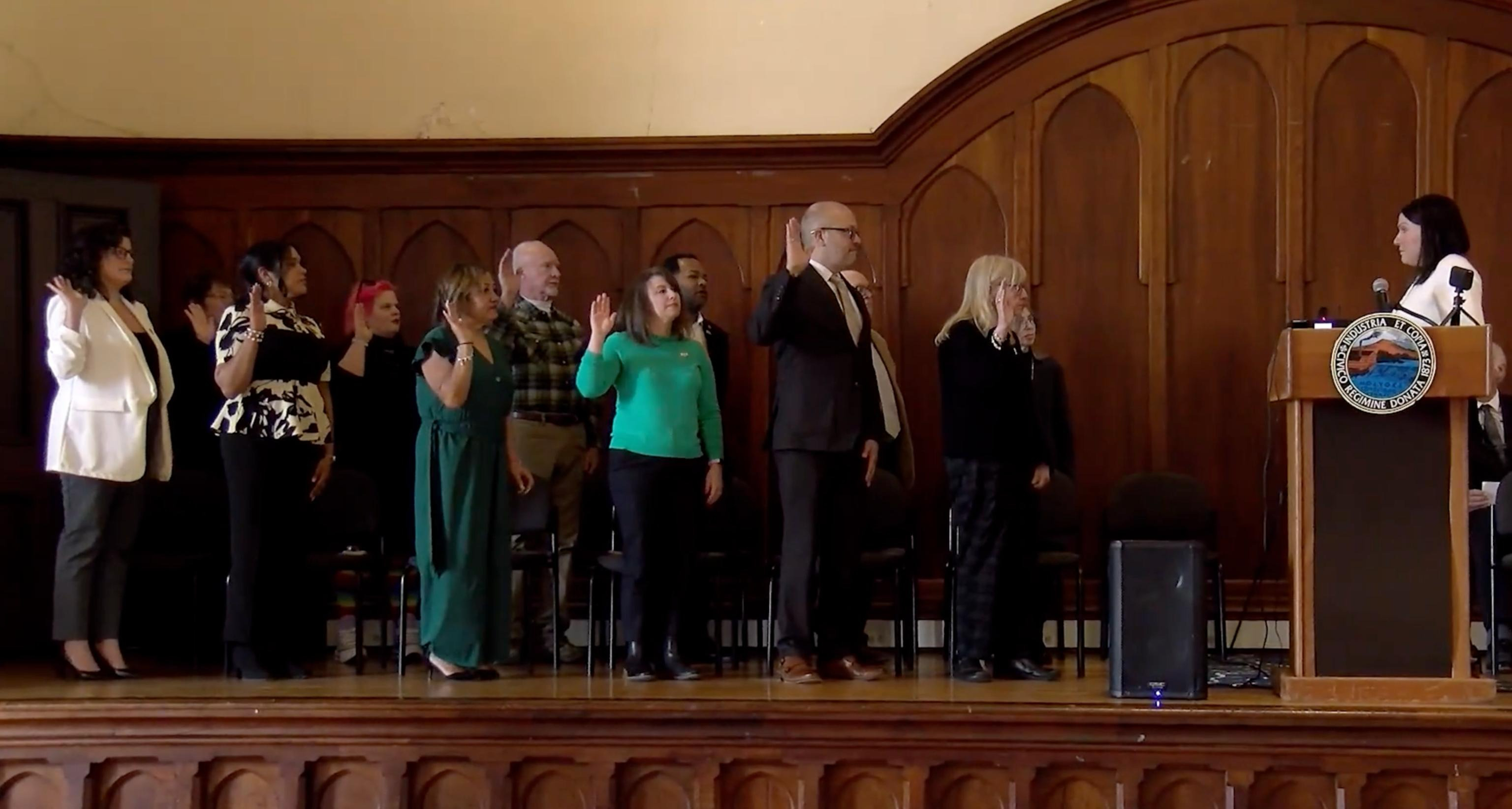
Early this month, Holyoke’s City Council took what Mayor Joshua Garcia described as a “giant step in Holyoke history” by passing the Municipal Finance Modernization Act.
“After more than a year of deliberation, and four years of me convincing the public why this is important, this reform will modernize our financial management,” he wrote on social media.
According to several members of the council, the act will “streamline” the process for the organization of the city’s finances — something many have felt has been in disarray for a long time. Late last year, the state froze funding to Holyoke after the city failed to submit financial reports dating back to 2023. The act makes changes that the state has long recommended, including creating a financial administration department to oversee the city’s finances.
It’s the first major change coming from a City Council that witnessed a transformation at the beginning of this year after Holyoke residents voted in several new councilors: Anne Thalheimer, Nicole Maisonent, Mimi Panitch, and Richard Purcell. The new members flipped several seats previously held by a more conservative faction that included longtime incumbents Kevin Jourdain and David Bartley, making the council more left-leaning in its politics.
For many council members, new and returning, the change presents an opportunity to improve Holyoke and the way it is governed.
“I want to change the reputation that our council has had in neighboring communities,” said Tessa Murphy-Romboletti, an at-large councilor who served as council president last term and was reelected to that position last month. “We created a mockery for ourselves over the last couple years, the way that we would argue. I want to change that because there’s such little hope right now in government.”
Screaming matches and a breakdown of decorum were frequent occurrences in recent years on the Holyoke City Council. Whereas the new councilors just passed a major reform during their first meeting, two years ago the newly elected body spent 45 minutes of its first meeting arguing about their seating assignments.
Murphy-Romboletti said that people need to be able to depend on local government. She said it’s the role of mayors and city councilors to help them navigate “weird, unprecedented times” through more public participation. When the City Council passed its municipal finance act, Murphy-Romboletti and others described it as a major win for the new council.
This term, councilors continue to tackle issues from the city’s finances, the affordability crisis plaguing the entire state, and ongoing conversations concerning community safety.
***
While passage of the Municipal Finance Modernization Act was a major step for City Council, it was not without dissent from the remaining members of the body’s conservative bloc, who expressed concerns about ballooning budgets and overall affordability.
In an interview with The Shoestring, Ward 5 Councilor Linda Vacon called the city’s budget growth “unsustainable.” On her Facebook page, Vacon — a member of the Massachusetts Republican State Committee and vocal supporter of President Donald Trump — has also referred to the act as the “big bureaucratic bill.”
She added that the increase in city government positions is “too big and too much” at a time where she said taxpayers are unable to support the increased costs to pay for the new positions.
Under the new law, the position of city treasurer will become an appointed position, rather than elected. According to Michael Sullivan, at-large councilor, winning an elected position doesn’t ensure that the person is qualified for the job
“That made no sense at all,” Sullivan said. “ That’s a pretty archaic way of doing things.”
Sullivan said that the mayor needs “good financial information” based on “true and accurate data” and that it’s not something that a mayor is always qualified to do.
Vacon was one of five councilors who thwarted the municipal finance legislation as recently as late last year over a majority of councilors in favor. Of those five, only Vacon and Howard Greaney, an at-large councilor, were re-elected. Bartley and Jourdain, meanwhile, were voted off the council, and Ward 2’s representative, Carmen Occasio, didn’t run for re-election.
Left-leaning politicians now make up a supermajority of the council, and may be able to pass more of their agenda as they did with the municipal finance act. In interviews in recent weeks, some highlighted what they described as a drastic shift of tone within council meetings, and several emphasized their commitment to newfound efficiency and civility — something they consider a major opening for the progression of the city.
Purcell, the Ward 4 councilor, told The Shoestring that the state has been telling Holyoke to pass the municipal finance act for years, and that councilors have “been trying to do it for years.”
“But, there’s been a lot of — I’ll just call it obstruction,” Purcell said. “There’s obstruction from a certain part of the City Council that, for whatever reason, decided they didn’t want this. They stranglehold the City Council, as far as I’m concerned, about updating it.”
But there are still a lot of constituent concerns that councilors brought up in conversations with The Shoestring, like affordability.
One of Purcell’s top priorities is establishing a tenants’ rights office. He said that the majority of residents in the city’s Ward 4 are renters.
Recently, Purcell said he and Garcia were in a meeting with a renter facing a rat infestation in her public housing apartment. The constituent wanted to move, but her landlord had allegedly denied her a copy of their signed lease, which is necessary to transfer housing vouchers.
According to Purcell, a tenants’ rights office is exactly the kind of place that would protect the rights of the resident and other renters like her. He said that he’s gotten the co-sign of many council members and local grassroots organizations, like Neighbor to Neighbor and the Chestnut Hill Community Association. In 2023, Garcia said that he would be working on establishing an Office of Tenant Protection, according to MassLive.
Affordability is on the minds of many councilors. Vacon, for example, said that one of her top priorities is the impact of affordability on renters in the city and increasing taxes. She said that renters indirectly pay their landlords for the increase on a landlord’s property tax bill. Vacon added that people often seek restrictions on how costs rise, but it’s the property owners who bear the burden of high taxes in a city that isn’t growing.
“The reality is, it starts with the city budget,” Vacon said. “If every year we are increasing the city budget by $2 to $3 million, it is creating increases for both the homeowners and the renters. It’s a cycle that we must address.”
Vacon thinks that the budget has inflated too much too quickly. She said the local city budget shouldn’t just stop increasing, but should actually decrease overall. According to her, the rest of the City Council doesn’t seem to have the same “appetite” for that.
***
There are plenty more upcoming decisions that the council will have to make regarding the city’s budget — particularly concerning policing.
In late 2023, after a stray bullet from a nearby shooting struck a pregnant woman and resulted in the death of her unborn child, Garcia released a public safety proposal — called Ezekiel’s Plan to honor the child — that the City Council didn’t pass at the time. It was a split vote, with seven councilors against, including Bartley and Jourdain, and six in favor. The package would have hired 13 new police officers, a crime analyst position at the department, spent a quarter million dollars on city-wide cameras connected to Holyoke’s gunshot detection technology, Shotspotter, and increased other parts of the police budget by another half million.
One of the major concerns some had about the proposal was the increased funding for the police department after members in recent years had called for more transparency about the officers’ overtime and spending. Several Council members also emphasized that they were not “anti-police,” but had major reservations about the plan’s emphasis on policing.
One of those who voted against the proposal at the time was at-large Councilor Israel Rivera. Rivera declined an interview for this article, but speaking on The Shoestring’s podcast in 2024 after voting against Ezekiel’s plan, he said he respected where the mayor’s proposal was coming from but would have done things differently. He also expressed concern about overpolicing in the city’s communities of color — the neighborhoods where he grew up.
Rivera is now at the center of controversy as the council is set to consider such issues again.
Holyoke’s two police unions have been calling for his resignation after his arrest for operating under the influence last month. Since then, Rivera has stepped down from his elected position as the council’s vice president. Murphy-Romboletti also removed Rivera from his post as the chair of the Committee on Public Safety.
The patrol officers’ and supervisors’ unions have filed an ethics complaint regarding comments that Rivera made during his initial arrests — among them that he’s “best friends” with Garcia and that he would cut the police budget. They’ve said he should not be involved with any police-related matters on the council.
It’s not the first time that the city’s police unions have waded into city politics, especially when it concerns their department’s budget. In 2014, patrol-officer union president wrote to the City Council to criticize two of its members for marching in a Black Lives Matter protest because of “anti-police rhetoric” at the rally.
In 2022, the supervisors’ and patrol officers’ unions called for another at-large councilor, José Maldonado Velez, to recuse himself from votes related to the department after he called police a “gang” during a debate about funding Shotspotter.
“They’re there to protect each other, to look out for each other, and to come out with force in our community,” Maldonado Velez, one of only a handful of Latino residents ever elected to an at-large seat in the city’s history, said at the time. “The police, for me, was used as a reminder to stay in my place. I am a Latino. You’re supposed to act a certain way, talk a certain way. That’s what police was for. It was not there to help me.”
The unions have also endorsed candidates for office, including Jourdain — a delegate to Trump’s Republican National Convention in 2016 — during the last election cycle.
Policing and gun violence continue to affect many residents in Holyoke, including members of the council. Anne Thalheimer is Ward 3’s new councilor, and a survivor of gun violence herself. She said that public safety is something she holds closely and that she would like to see more community-based resources that address the root causes of gun violence — ones that she already sees implemented, like the city’s emergency response teams. According to Thalheimer, she would like more evidence on the efficacy of technologies like Shotspotter and would prefer that they are used in conjunction with other resources.
Shotspotter, now known as SoundThinking, has been the subject of controversy. According to two years of records obtained by the Massachusetts ACLU, in about 70% of the system’s alerts in the city of Boston, police found no gunfire.
“In Boston, ShotSpotter microphones are installed primarily in Dorchester and Roxbury, in areas where some neighborhoods are over 90 percent Black and/or Latine,” the ACLU found.
Mimi Panitch, a newly elected at-large city councilor and the chair of the Committee on Charter and Rules, wants more community-centered dialogue around public safety. According to Panitch, she’s been getting questions from the public suggesting that “it’s time for another intense community conversation that will bring everybody in.”
She’s heard inquiries from people who want more police, those who are skeptical about the manner in which public safety services are delivered, and those who have doubts about police intervention in an emergency.
“The goodwill to have those conversations is there on all sides,” she said. “I’m ridiculously idealistic about this, but I think we can do it.”
Another of Purcell’s major priorities this term is implementing a community-run police commission.
According to him, Holyoke police are lacking an oversight committee — and is the only city department not to have one. In the past few years, there’s been a few votes to establish a committee. However, because those were non-binding referendums — meaning that city officials weren’t mandated to implement them — no such committee was established.
“It’s just the right thing to do,” Purcell said.
***
Councilors say that changing the rules of the City Council is another priority.
For example, in order for a community member to make a public comment during a City Council meeting, they are required to state their full name and address. During a full City Council meeting last month, one community member requested that the council reconsider this rule, citing the harassment they faced as backlash to public comments they’ve made in the past.
Council members will sometimes motion to suspend this rule. Councilors like Thalheimer are asking why there seems to be emphasis placed on some rules over others.
“The rules also say that we’re supposed to have a youth lead us in the Pledge of Allegiance once a month,” she said. “And I have never seen that happen in all of the years that we have been doing public comment.”
To Thalheimer, requiring residents to state their full name and address is an accessibility issue — one that feels like an “unnecessary hurdle” to public participation, given that some residents reported being harassed in connection to public comment and because she feels unhoused should be given the opportunity to participate. It’s something she says is important to break down if the council wants more constituent involvement.
“I’ll speak frankly: if people haul ass in the winter down to City Hall for uncomfortable seating in the dark in the wintertime to say two minutes worth of what’s on their mind — and two minutes is not a lot of time — I think we can extend this particular courtesy,” she said. “I think we can break down that particular barrier to participation.”
Thalheimer said that she believes the root is ensuring that commenters are Holyoke residents, but that there are other ways to verify that: commenters can state their ward or neighborhood.
Amidst federal agents’ shooting of protestors and activists like Keith Porter, Renee Good, and Alex Pretti — among others — and the Trump administration’s nationwide mass deportation efforts, concerns of Immigration and Customs Enforcement are prevalent in Holyoke. The city is known for its diversity and large Puerto Rican population.
Panitch said that she’s gotten “heartbreaking” notes from community members about their interactions with ICE. It’s part of the reason she ran for her seat.
“Privilege is real, and I can get away with it — I can say: ‘This is bad and we should not be inviting ICE to come into our community,’” she said.
Vacon and Jourdain, the former at-large councilor, filed a resolution last session that they said would re-affirm Holyoke’s position as a non-sanctuary city. The federal administration had released a statement recognizing Holyoke as a sanctuary city, though that term has no legal designation. A copy of the resolution would’ve also been sent to the White House and requested notification if there was anything in the city’s policy that would be considered “sanctuary city policies.” One of the stated concerns from the council’s conservatives was the potential loss of federal funding.
Vacon said that at the time she had filed the resolution, the context was different. She said that she requested it be removed from the council’s business but did not have the power to change when it was heard.
***
Though tension on the council remains, local officials are cautiously hopeful. In light of recent changes, many of them want more connectedness in Holyoke through building trust and community between residents and local officials.
For Murphy-Romboletti, it means getting more people involved, and getting them to stay.
“Apathy is the biggest threat,” she said. “It’s so easy to just say: ‘It doesn’t matter.’ And so if I can get more people to pay attention, if I can get more people to care, I’ll feel like I’ve done some good work.”

divina is an independent reporter covering labor and social movements, pursuing a degree in journalism and social thought & political economy at UMass Amherst. They have worked for three years in legislation, policy, and research on education, child welfare, and race equity. Reach them at divina.cordeiro@proton.me or on Instagram and Twitter @divi_cordeiro
- divina cordeiro
- divina cordeiro
- divina cordeiro
- divina cordeiro
- divina cordeiro
- divina cordeiro
- divina cordeiro
- divina cordeiro
- divina cordeiro


