


When it comes to solving the dominant issues of our time, from food production to climate change and the housing crisis, policy experts have proposed a wide range of solutions.
It’s not often, however, that the word “urine” enters those discussions.
Human urine is a potent source of nitrogen and phosphorus, which are the essential components in most agricultural fertilizers. However, these nutrients can become harmful pollutants when they accumulate in waterways, causing algal blooms, killing fish, and throwing ecosystems out of balance. Up and down the Connecticut River Valley, agricultural runoff, wastewater treatment plants, and septic systems all contribute to an overabundance of nitrogen and phosphorus in the watershed.
One organization is now trying to solve those problems, and more, by recycling urine in Franklin County. And they’ve just won funding to do so.
The National Fish and Wildlife Foundation developed the Long Island Sound Futures Fund in 2005, and recently awarded the grant to the Rich Earth Institute to help develop a urine recycling program in Franklin County. The nonprofit has been researching and developing ways to advance the use of human waste as a resource since 2012, and along the way founded a popular urine-based fertilizer business in Brattleboro.
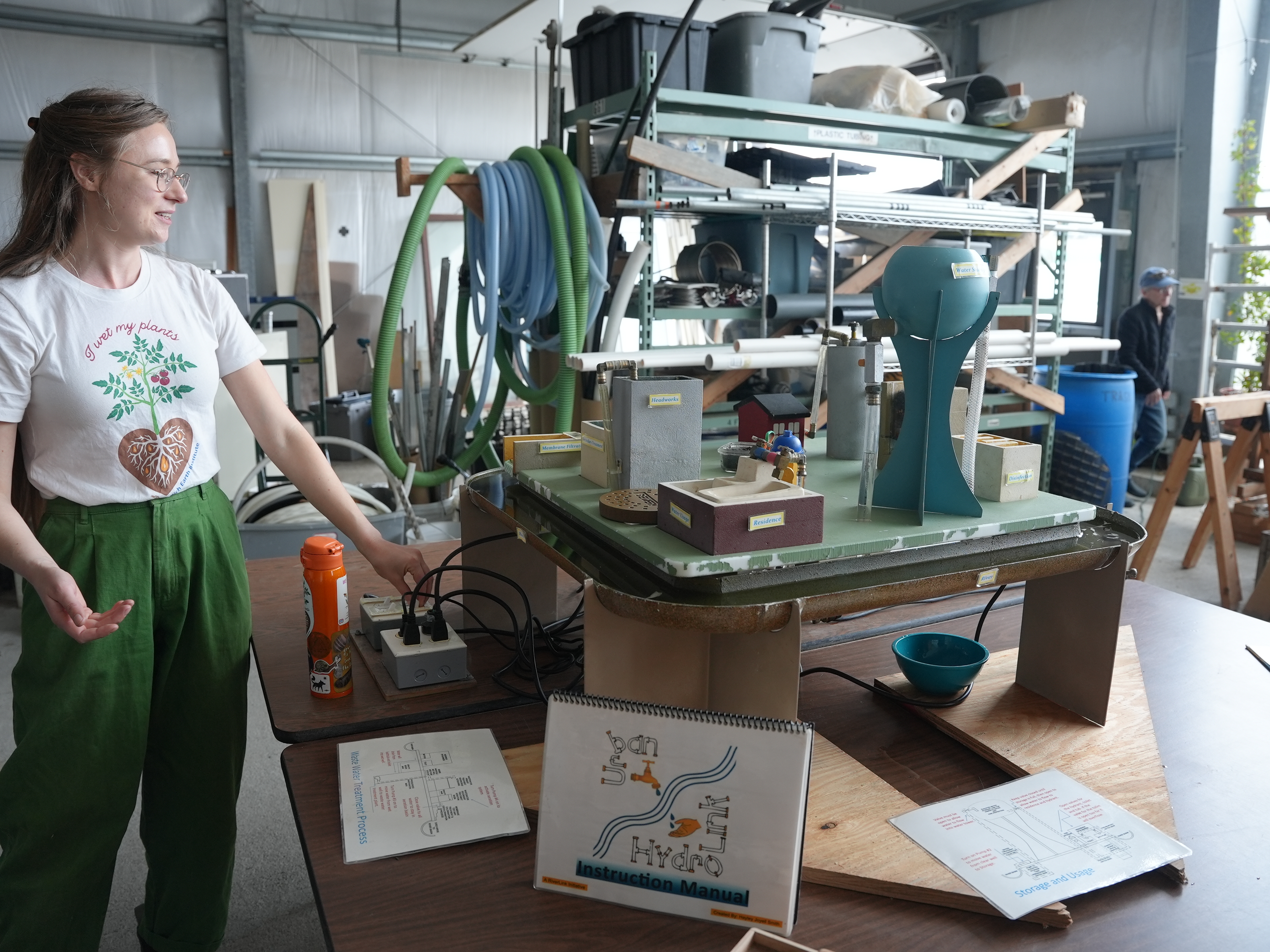
“What we’re doing at Rich Earth, and many other places around the world, is working to reconnect that linear nutrient flow back into the food nutrient cycle,” said Julia Cavicchi, the organization’s education director. “Where we can keep our waste out of our water so our water is cleaner and safer to use and live in, and our nutrients can be easier to reclaim and keep in our local food systems.”
The two-year $146,496 grant from the Futures Fund will cover the planning and implementation of new “peecycling” projects throughout the county. The Rich Earth Institute hosted a kick-off event at the Sunderland Public Library on April 8 to introduce the public to the concept and glean ideas from local farmers, waste management experts, and town officials about how urine recycling can fit into the region’s largely rural landscape.
Every year, Deb Habib, the co-founder of the Seeds of Solidarity Farm in Orange, invites the Rich Earth Institute to set up a urine collection booth at the North Quabbin Garlic & Arts Festival.
“Everything that we’re creating is going to end up somewhere. So why not connect ourselves with something positive rather than something polluting?” Habib said. “The fact that we’re connected by all these watersheds in this region really reminds people that there’s no such thing as ‘away.’”
Founded in 2012, the Rich Earth Institute claims to have established the first and largest community-scale urine recycling program in the country.
Demand for the Institute’s urine-based fertilizer, marketed to area farms as “U-Grow,” exceeds supply. Currently, nutrients are collected from 33 urine-diverting toilets in Vermont, and 260 individual “donors” who deliver their urine to collection stations located near the municipal transfer stations in Brattleboro and Bellows Falls.
Donors log their contributions, and the organization hosts an annual “Piss-Off Competition” to celebrate its “most prolific contributors,” Cavicchi said. The Rich Earth Institute currently provides U-Grow to nine farms, mostly to grow hay.
Chelsey Little — the superintendent of Montague’s wastewater treatment plant, the Clean Water Facility — attended the kickoff event at the Sunderland library after meeting with Rich Earth Institute staff last year.
“They did a little presentation for me during the meeting, and I just fell in love with the idea,” Little said. “It makes sense if we have people diverting the urine out of the waste stream, because that’s less of the nitrogen removal treatment that we have to do at the facility.”
Human urine makes up less than 1% of the waste sent to a typical wastewater treatment plant, but accounts for about 75% of the nitrogen and 60% of the phosphorus these facilities must process, according to a recent study from the University of Surrey in England published in the Journal of Environmental Chemical Engineering.
As a condition of its current wastewater discharge permit, the Montague Clean Water Facility must reduce the amount of nitrogen it releases into the Connecticut River. Little wants to install urine collection and treatment infrastructure at the plant to achieve this.
“It’s a win-win,” Little said. “To scale it up is pretty cost effective as well… if we did all of Montague, and then the smaller surrounding towns.”
Installing the equipment at the Clean Water Facility would be “cheap, easy and effective,” costing only a couple thousand dollars, Little said. Pasteurizing urine for agricultural use requires heating it to 80 degrees Celsius (176 degrees Fahrenheit) for at least 90 seconds, then keeping it in a sealed container to prevent the ammonia from off-gassing. Brightwater Tools, a spin-off company that operates at the Rich Earth Institute’s Brattleboro headquarters, has developed technology to do this, and has also been experimenting with freeze concentration to make U-Grow easier to store, transport, and apply to farm fields.
“Farmers are becoming desperate for alternatives from an affordability standpoint, and also to have more nutrients available,” Cavicchi said.
About 70% of farmers in the U.S. claim they cannot afford all the fertilizer they need for the upcoming growing season, according to a survey conducted earlier this month by the American Farm Bureau Federation. Factored into those costs is the U.S. and Israeli war with Iran, which has led Iran to block ships carrying fuel and fertilizers from leaving the Persian Gulf through the Strait of Hormuz. Nearly half of the global supply of urea, a synthetically derived form of nitrogen, and about 30% of the world’s ammonia supply are exported through the Gulf, according to the American Farm Bureau Federation.
In addition to providing potent fertilizer to farmers, proponents of peecycling say it also saves water. Every five gallons of urine collected prevents 100 gallons of water from being flushed down the toilet, according to Rich Earth Institute data analysis, which equals about 4,000 gallons of water saved per person each year.
“We use large amounts of clean potable water to just move these nutrients from one place to another,” Cavicchi said. “By doing a relatively small act, in terms of volume, of diverting our urine at the source, we can have a relatively big impact on preventing downstream nutrient pollution and procuring those nutrients for use in local agriculture.”
Andrea Donlon, a senior land use and natural resources planner for the Franklin Regional Council of Governments, said that peecycling in Franklin County could help municipalities address the increasingly expensive disposal cost of “biosolids” — the thick residual waste from treatment plants.
“I’m interested in learning more about the logistics of collecting urine,” Donlon said. “I’m thinking of all the aging wastewater infrastructure we have, and the need to build more housing in places that don’t have any infrastructure.”
Mariah Kurtz, a senior livability planner at the Franklin Regional Council of Governments, said that sewer and septic capacity issues are a common bottleneck to the development of new housing. Building a new septic system, or expanding an existing septic system, can be a complicated and expensive undertaking.
“Thinking creatively about our waste solutions can unlock new types of housing in new locations that can allow for more housing, and could potentially allow for more affordable housing,” Kurtz said. “I think that this is at the beginning of a conversation that could have interesting results in our area.”
With the right regulatory reforms, peecycling and other forms of onsite waste diversion could reduce the volume of waste flushed into septic systems. With the extra capacity, homeowners could build additional bedrooms or accessory dwelling units without having to make costly upgrades to their existing septic systems
After years of successful advocacy to develop state-level policies that allow for various types of urine collection systems in Vermont, the Rich Earth Institute has turned its sights southward. U-Grow was approved for use and sale in Massachusetts in 2025, and the organization is looking into how municipal and state governments could go about permitting urine collection and treatment facilities in the state as well.
“There’s a lot to figure out in terms of collaborating with state regulatory officials, and legislators and town government officials about all those questions and the concerns they raise,” Cavicchi said.
Partnering with academic institutions such as University of Michigan and Cornell University, the Rich Earth Institute has led studies on the soil health impacts of using urine as a fertilizer. They found that despite the presence of pollutants and pharmaceuticals in human urine, crops fertilized with it tend not to absorb the pollutants “at a significant human health exposure pathway level,” Cavicchi said. The nonprofit has been following other researchers investigating how various crops uptake and interact with potential pollutants found in urine.
At the Sunderland library kick-off event, some farmers expressed interest in using urine-based fertilizer on their fields, and perhaps even hosting collection and treatment facilities onsite. Others suggested partnering with local septic hauling companies to transport urine, or setting up portable toilets at public events to raise awareness about the benefits of peecycling. For the Rich Earth Institute, next steps include hosting on-farm fertilizer demonstrations, organizing toilet installation site visits, and partnering with schools and local groups for education events.
“We came away from the kick-off event feeling buoyed by the enthusiasm in the room, including from many who helped spark this effort and are now eager to collaborate on bringing the nutrient cycling vision into reality,” Cavicchi said.
The Rich Earth Institute will host an open house on Thursday, April 30 at its Brattleboro headquarters at 355 Old Ferry Road, located next to the Windham Solid Waste Management District. The event is open to anyone interested in its work in Brattleboro or the new project in Franklin County.
“There are many organizations all around the world, and also all across the country, working on compost toilet solutions, the use of urine in perennial agriculture, building-scale designs, and portable toilet businesses,” Cavicchi said. “We’re all kind of working together to figure out different ways that urine recycling can be practical, and fundable and enjoyable, in all sorts of different contexts.”
This article was copublished by The Shoestring and the Montague Reporter.

Sarah is a print and radio journalist based in western Massachusetts.
- Sarah Robertson
- Sarah Robertson
- Sarah Robertson
- Sarah Robertson
- Sarah Robertson
- Sarah Robertson
- Sarah Robertson
- Sarah Robertson
- Sarah Robertson
- Sarah Robertson
- Sarah Robertson
- Sarah Robertson
- Sarah Robertson
- Sarah Robertson
- Sarah Robertson
- Sarah Robertson
- Sarah Robertson
- Sarah Robertson
- Sarah Robertson
- Sarah Robertson
- Sarah Robertson


