

This article originally appeared in the May 16 edition of the Montague Reporter.
FRANKLIN COUNTY – “Technology is in hyperspeed ahead of us,” Cambridge fire lieutenant Christopher Towski told attendees at a symposium on lithium-ion battery safety hosted last October by the state Department of Fire Services. “The elephant in the room, if you will, is the thermal runaway aspect.”
Finding new ways to store energy from the wind and sun at a large scale may be crucial to a clean energy transition, but many lawmakers and first responders now say they worry the development of electrochemical battery storage technology is outpacing our ability to regulate it safely.
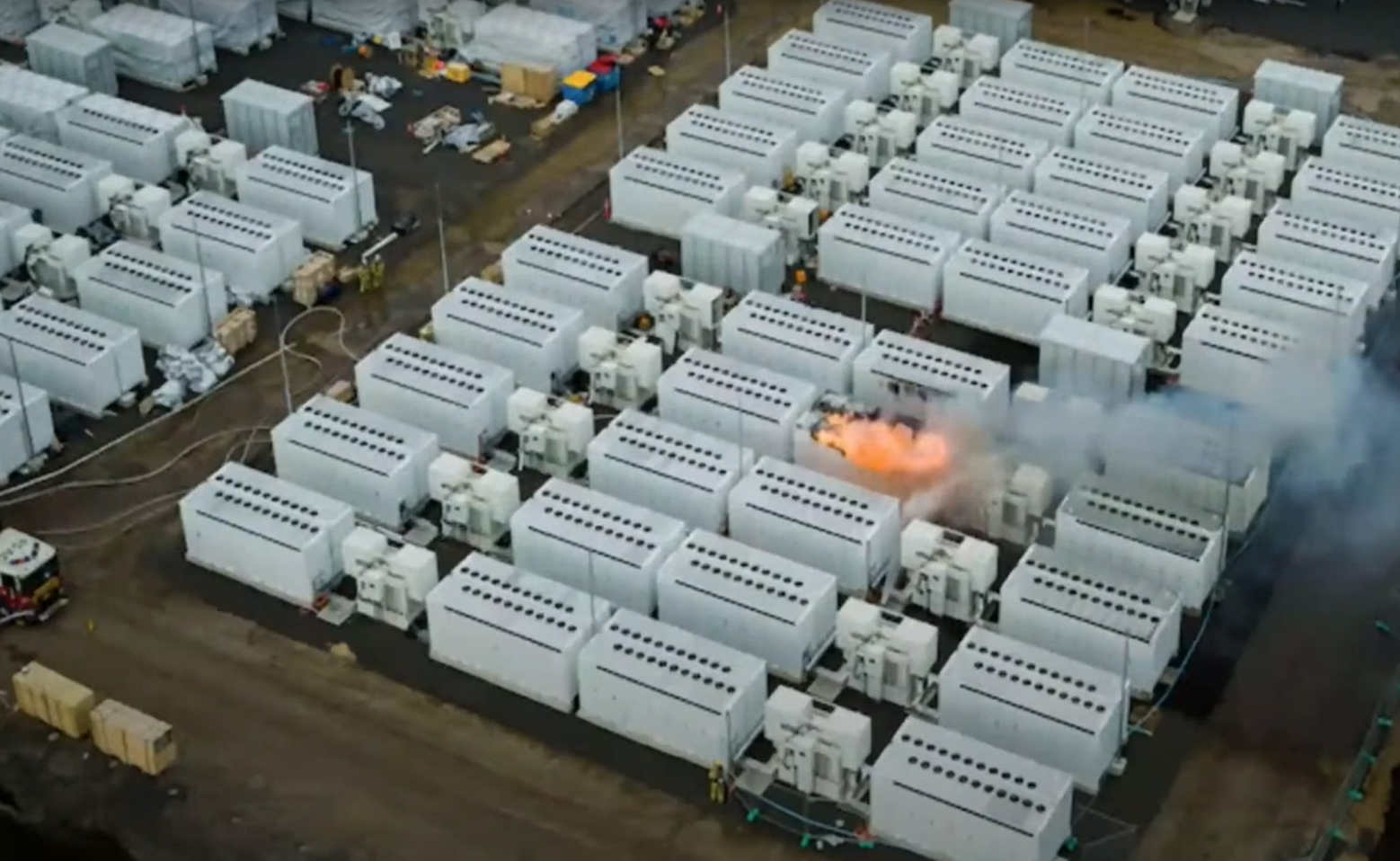
Of particular concern to the firefighting community is the risk of unquenchable chemical fires at utility-scale battery energy storage systems (BESS). Power surges, excessive heat, overcharging, physical damage, and manufacturing defects can all lead to explosive chain reactions in batteries known as “thermal runaway,” which release toxic gasses and cannot be extinguished with water.
“Lithium-ion battery fires are a problem we are only beginning to get our arms around,” state fire marshal Jon Davine said at last year’s symposium. “The regulations and legislation we see in the months and years ahead will depend on us documenting this problem today.”
Eight firefighters were hospitalized in 2019 when a defective battery inside a 2-megawatt (MW) lithium-ion BESS failed in Arizona, causing a thermal runaway reaction. In Beijing, two people died fighting a fire in 2021 at a 25 MW-hour vehicle charging station equipped with lithium iron phosphate batteries. And in 2023, the governor of New York appointed a special task force to look at BESS safety regulations after three fire-related incidents occurred in one year.
“Not all batteries go into thermal runaway – not even all lithium-ion battery technologies go into thermal runaway – but the predominant ones do,” Towski said. “And they’re causing us a lot of problems out there.”
Over the last decade, research into BESS fires has led to significant developments in national and state safety standards. As a member of the National Fire Protection Association’s (NFPA) technical committee, Towski helped draft the non-profit group’s first BESS safety standards between 2016 and 2019. These standards have since been incorporated into the Massachusetts Comprehensive Fire Safety Code.
“Code is like spaghetti on the wall to a lot of people,” Towski said. “[In] Massachusetts we’re doing a great job… we’re far ahead of other parts of the country, and other parts of the world, but we’re still lagging behind [the technology].”
Because thermal runaway fires cannot be extinguished with water, the only way to fight them is often to let them burn out and prevent them from spreading. It can take several hours, and tens of thousands of gallons of water, to contain a lithium-ion battery fire.
Under the NFPA standards, different types of BESS are subject to different spacing requirements, storage capacity limits, mandatory fire suppression systems, and other conditions, as the risks associated with batteries of different sizes and chemistries vary greatly.
Lithium-ion BESS stored outdoors must be separated by at least 10 feet from other units, and cannot exceed 600 kWh of storage capacity. There is no maximum storage capacity for lead-acid or nickel-based BESS. Zinc-ion batteries, meanwhile, are extremely unlikely to cause thermal runaway fires, and do not require heating or cooling in inclement weather as many lithium-ion batteries do, but come with other challenges.
The state Department of Fire Services also recently implemented a new tool to track fires caused by smaller lithium-ion batteries – ranging from home charging systems for electric vehicles to consumer products such as e-bikes and vape pens – and found these fires are much more common than an established national fire data reporting system suggests. In more than half of these incidents, the electronic item was not connected to a charger when it ignited.
Still, manufacturers – and at the utility scale, developers – are sometimes resistant to sharing information pertinent to public safety, Towski said.
“Some things they might not be able to tell you, especially certain chemistries,” he said. “They’re holding things close to their chest that they’re not going to release – the system storage manufacturer won’t have that info, because it’s been retained by the battery manufacturer.”
“You want to know how to shut down [a facility],” he added. “Especially on the utility side, they’re going to have a lot of proprietary info that they’re not going to be able to share, because if anybody got that info they’re going to know how to shut down a utility, and that’s one of the things we don’t want to happen.”
Many BESS installers have responded to adverse events by documenting potential risks up front and including hazard mitigation plans and other supplemental information in their project applications. However, these documents are not universally required by state or local governments, the online energy industry magazine UtilityDive reported last November.
“Community awareness of battery storage is increasing as media coverage of battery fires increases,” fire engineering professionals Noah Ryder and Mishaal Syed Naveed wrote, “which means the public is seeking more information about the technology during the planning stages of projects.”
Whose job it is to adopt into law and enforce the emerging safety standards, however, is still being decided in Massachusetts.
Locally, the towns of Wendell, Shutesbury, Sunderland, and Hadley all passed bylaws regulating BESS within the last month, and Northfield voters imposed a one-year moratorium on new facilities as they work to draft a bylaw.
The Wendell and Shutesbury bylaws both prohibit BESS over 10 MW, and require installers of smaller projects to provide an annual training plan for local first responders, as well as a description of all the battery components and their specific chemical and physical makeup.
The NFPA’s standards also recommend that each BESS owner be required to produce a plan detailing how the facility will be decommissioned and disposed of at the end of its life. Several of the recent bylaws take this a step further by requiring the owner to set aside the funds in advance to dismantle the project.
Some of these local bylaws, however, are expected to be rejected by the state attorney general on the basis that they amount to “unreasonable” obstacles to solar development, which is protected under state zoning law.
Motivated by the state’s official goal of “net zero emissions” by 2050, there has been a push to speed up the deployment of renewable energy infrastructure. This includes proposals to consolidate the permitting process for utility-scale battery systems at the state level, superceding local zoning and municipal regulation.
H.4501, a bill titled “An Act to expedite permitting for electric decarbonization infrastructure projects” would take away municipalities’ powers to enact any bylaws, ordinances or regulations affecting qualifying energy projects, was reported favorably to the House Ways and Means Committee last month.
Also last month, the state Commission on Energy Infrastructure Siting and Permitting released an official recommendation that jurisdiction over all battery, solar, wind and other energy infrastructure permitting should be held by the Energy Facilities Siting Board.
Regardless of whether they will ultimately be enforced at the municipal or state level, safety standards for BESS are largely under development, and the risks of some emerging battery technologies still being tested. If local communities fear regulators on the far side of the state will make them shoulder the risk of catastrophe, the form these standards take – and the tools provided to local first responders – will be of central importance to decisions over battery siting.
“Development got delayed 18 months because of utilities,” Towski told the Montague Reporter this week of the NFPA’s effort to draft its original standards. “They didn’t feel there was enough representation for the utilities…. They either didn’t get the word, or the word they were getting was ‘it doesn’t apply to us, because we march to a different drum, and we’re regulated in a different way.’”
Making sure that local firefighters are well-equipped and adequately trained to respond to BESS fires is critical, Towski said, and they should have a say in how these systems are regulated.
“It’s in their jurisdiction,” he said. “This is the first line of defense, once it’s up and running. They need to know and have input, and be a stakeholder, so if there is going to be [a malfunction] we don’t have a surprise Arizona event. They need to be in tune with how it’s being laid out, and what their needs are.”
Sarah Robertson is an independent journalist living in western Mass.
The Shoestring is committed to bringing you ad-free content. We rely on readers to support our work! You can support independent news for Western Mass by visiting our Donate page.

Sarah is a print and radio journalist based in western Massachusetts.
- Sarah Robertson
- Sarah Robertson
- Sarah Robertson
- Sarah Robertson
- Sarah Robertson
- Sarah Robertson
- Sarah Robertson
- Sarah Robertson
- Sarah Robertson
- Sarah Robertson
- Sarah Robertson
- Sarah Robertson
- Sarah Robertson
- Sarah Robertson
- Sarah Robertson
- Sarah Robertson
- Sarah Robertson
- Sarah Robertson
- Sarah Robertson
- Sarah Robertson
- Sarah Robertson