


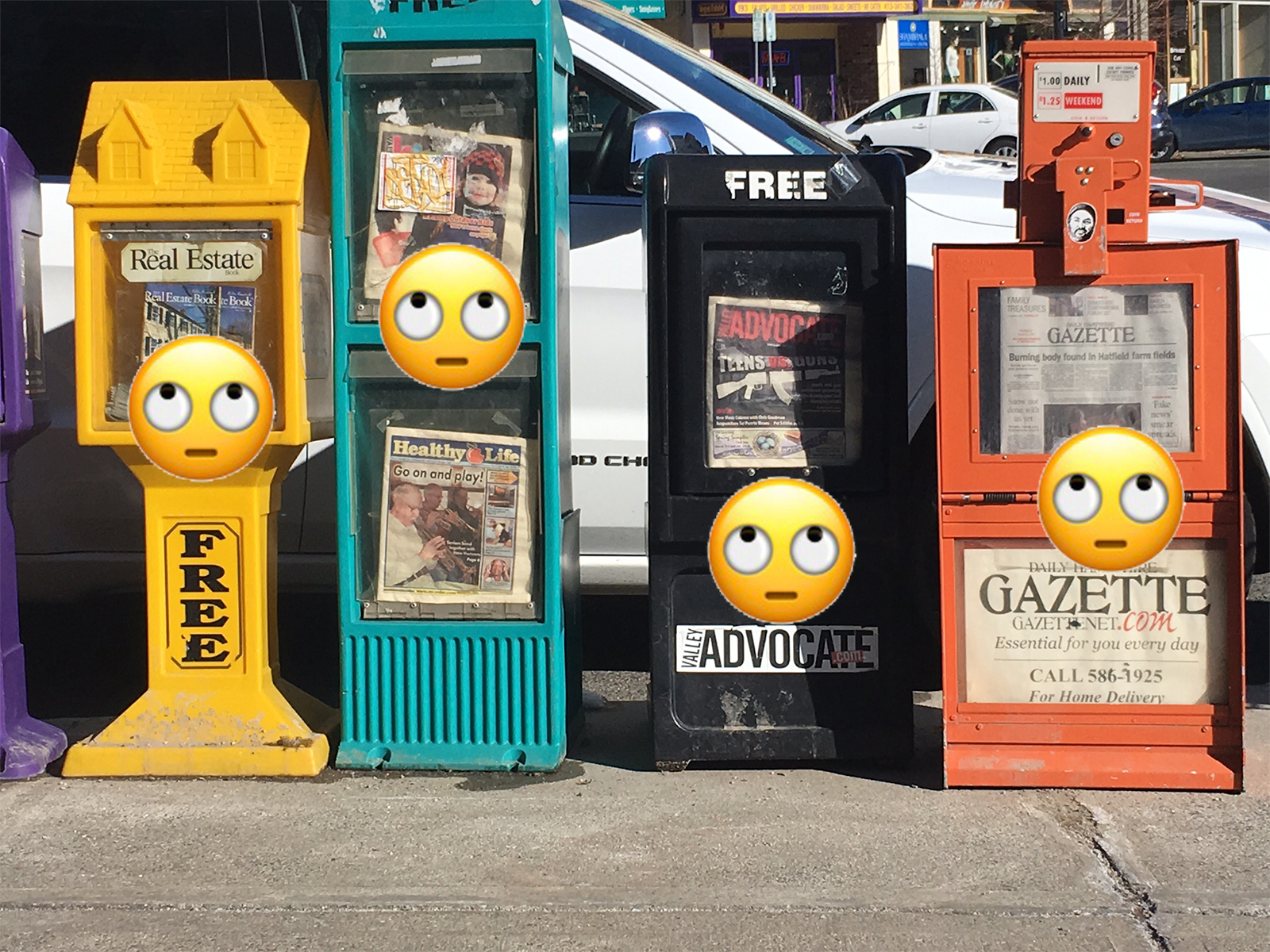
“See Something Say Something” is The Shoestring’s longstanding media criticism column. Have you seen any troubling news coverage of western Mass? Report it to The Shoestring at info@theshoestring.org.
Logan Cottonwood Kinney has lived in western Massachusetts his entire life, and has been out as transgender since 2007. Growing up, Kinney said that he faced harassment from people in his life — like authority figures in schools.
But as of late, he said it’s his local newspaper that has been promoting attacks on him and his community.
“It really is a frustrating and terrifying repeat of the Lavender Scare,” Kinney said, referring to the moral panic in the mid-20th century that targeted gay men and lesbians working in the federal government.
Kinney has grown frustrated amid a controversy that is, once again, swirling around articles that the Daily Hampshire Gazette has published on its opinion page. In the last few months, residents across western Massachusetts have been signing a petition to call on the Daily Hampshire Gazette to, among a few other demands, apologize for and rescind transphobic opinion pieces that its editors published in the paper.
Local resident John Mark Lampley is behind the petition. Kinney found Lampley’s petition “doomscrolling” on social media and quickly signed, as have more than 200 others. Kinney said that he appreciated that Lampley had created the petition after years of reading hateful content in opinion columns in the Gazette and the Greenfield Recorder, which is owned by the same company.
Lampley has lived in the valley for the past few years and said that he chose the area for the same reason many do: for community. “It’s an affinity space for queer people,” he said. “It’s a cultural refuge.”
On July 9, Karen Bercovici wrote a column for the Gazette. The opinion piece was filled with transphobic rhetoric, saying that trans women and girls should not be included in sex-based rights for people who were assigned women at birth and that their inclusion endangers women.
Lampley said that he was initially surprised — and angry — when he read the piece.
Bercovici set off a flurry of responses, both in agreement and disagreement. Several of the articles, if not outright stating that trans people shouldn’t exist, question when, how, and in what parameters it’s acceptable for trans people to be public with their identity.
“It really struck me because those aren’t questions for debate,” Lampley said. “Those are real people that kind of language seeks to erase.”
Lampley said he learned from his friend and other community members that this isn’t the first time that the Gazette had published transphobic pieces. So he started a petition demanding that the Gazette apologize for publishing the pieces, rescind them, and implement a hate speech policy. Lampley did not share the names of any people or organizations that signed the petition because some responders requested their information not be shared.
“When people are speaking up and saying, ‘I am being harmed by this,’ we need to be sensitive enough to listen and to really drive the conversation about what repair looks like,” Lampley said. “I think repair could look like having a commitment from the Gazette to not publish hate speech.”
Bercovici is part of a larger historical trend of the Gazette and Greenfield Recorder publishing transphobic and homophobic content. In 2023, for example, the Gazette published a column in which writer J.M Sorrell compared drag to blackface, then kept her as a columnist after the piece drew condemnation. One of her next columns described “gang rape” a “trans tactic towards feminists of all kinds.” There are plenty of other examples, from more recent pieces to a letter the Recorder published a decade ago implying that trans women are faking their identity to gain access to women’s bathrooms.
The Daily Hampshire Gazette’s editors did not respond to multiple requests for comment for this article.
Many journalists, including myself, see journalism as an integral and foundational cultural institution to hold the powerful accountable. But the key piece missing in that sentiment is understanding that journalism is a political process that always carries the potential to amplify or erase particular perspectives.
The political influence that journalism can have to inform people about their representatives, for example, can change a voter’s perspective or understanding of a candidate. But we must also extend that understanding of language as a political tool — not only to advance and justify harm, but to enact it as well. We’ve seen this time and time again, from the use of the press to justify Jim Crow laws to the U.S. invasion of Iraq.
When the Gazette and the Recorder make the decision to publish these pieces, they are engaging in the empowerment of dangerous and harmful rhetoric like Bercovici’s, and in the the continued disempowerment of trans people — a population that is already incredibly vulnerable.
***
Last year, the Northampton City Council passed a resolution declaring that Northampton is a sanctuary city for trans people. The resolution says that city resources cannot be used to detain someone who’s only seeking gender-affirming care and that the city will not cooperate with any individuals or out-of-state agencies to share information about gender-affirming medical care received in Massachusetts.
It’s not the first resolution of its kind. The city has passed several resolutions to strengthen anti-discrimination laws and protect gender-identity as a class in the past decade. But Lampley said that there’s a “pretty palpable contradiction” between the city’s claims and its actual commitment to the safety of trans people.
In mid-August, Lampley went in front of the Northampton City Council to invite them into being part of the conversation about harm and repair. He said he spoke to several councilors, including Ward 3’s Laurie Loisel.
Loisel, who previously worked as an editor at the Gazette, published her own guest column in the Gazette responding to the transphobic articles, which she criticized as “riddled with bigotry, false claims and animus towards transgender individuals.” In her newsletter, Loisel circulated Lampley’s petition after a conversation with him, though she said she does not agree with all of the petition’s demands.
“As a journalist and former longtime employee of the Daily Hampshire Gazette, I have always — and will continue to — defend the right of the paper to publish columns that evoke strong reactions,” Loisel wrote in her column. “At this point, I’ll simply say, haven’t you given Bercovici enough space to spout her falsehoods and hateful ideas? It’s getting repetitive, and I seriously question the news value or the adding to community discourse value.”
Lampley said that he also had conversations with city councilors Rachel Maiore and Meg Robbins, both of whom support the petition. He also had a conversation with state Rep. Lindsey Sabadosa, D-Northampton, who directed him toward local organizations. He said he attempted to reach out to state Sen. Jo Comerford, D-Northampton, but that he has not heard back from her yet.
Robbins has known about the petition since the beginning, being Lampley’s neighbor, and agrees with the demands the petition has made.
“We actually have a City Council resolution that says we’re a safe place for a trans community,” Robbins said. “And then we have letters like this in our local newspaper — completely opposite of what we’ve declared as a community. This is a critical criteria for how we see ourselves, how we conduct ourselves, who we protect, and who we hold close from harm.”
To Robbins, there has been immense harm caused by the publication of the pieces. She’s spoken informally with trans members of the Northampton community who have expressed feeling unsafe and unwelcome in the city. She said that she would like the Gazette to be more transparent about the editorial process and take initiative in facilitating a community discussion on what a code of conduct or hate speech policy could look like, reflecting one of the demands of Lampley’s petition.
Maiore originally found Lampley’s petition on social media, and said that it struck a chord with her. She said she’s observed the Gazette’s publishing of what she views as hateful content for several years.
“What I see is — in terms of the people who are writing these — is people who have not done any research,” Maiore said. “It’s fine to have concerns. I get that. [But] then you do your homework. And these are people who have not done their homework … The data does not support anything they are saying.”
Maiore said that the writers of the pieces have the right to free speech, including ones that are hateful, but that doesn’t give them the right to be published in a newspaper. She said that the Gazette has the ability to practice discretion, which is what those who have signed the petition are asking the outlet to do.
“This kind of speech in the paper normalizes discrimination, if it’s a regular trend in a paper,” she said. “I think it gets us used to questioning the basic rights of other people.”
One organization that has picked up the petition is the Western Massachusetts Communist Party. Karla Carruth, the co-chair of the group, has lived in the area for about a decade after moving north from Texas.
“I follow it as part of my political work, but most people I know who are queer don’t get news from the Daily Hampshire Gazette unless something controversial happens or there’s some big thing,” Carruth said, “Because even if you do go past the paywalls, it’s not really written for trans people or the queer community locally. It’s very much aimed at the establishment community in town and their concerns.”
Like Maiore and Robbins, Kinney said that much of the information featured in the articles doesn’t hold up to fact-checking — something that both the Gazette and the Recorder prioritize. For many, the discretion that the outlets practice seems inconsistent.
Kinney said that he’s worried he’s a “jaded asshole,” but he doesn’t expect either of the outlets to respond to community concern.
The Gazette is among many news outlets to receive criticism for its coverage of trans people. Several years ago, for example, The New York Times faced backlash from organizations like the LGBTQ+ advocacy group GLAAD, as well as from some of its own contributors and subscribers, for its reporting on transgender, non-binary, and gender non-conforming people.
Kinney said he remembers that organizing.
“Not a whole lot happened,” he said.
***
All issues become local at one point or another. The decision of The New York Times’ and other legacy outlets to platform transphobic and trans-exclusionary rhetoric normalizes that same stance for other news outlets like the Gazette.
By treating an issue of dignity and liberation as a “wedge issue,” both the Recorder and the Gazette have positioned trans people as an acceptable topic to “debate” the existence of.
Both outlets have treated trans people as disposable.
For the past several campaign cycles, even candidates who consider themselves liberal or progressive have abandoned trans people. Look no further than the recent primary election between U.S. Sen. Ed Markey and his challenger, U.S. Rep. Seth Moulton, who in 2024 decided it was important that he publicly attack trans girls who dared to play sports with their peers.
And making trans people politically disposable leads directly to violence against them.
The writer and critic Andrea Long Chu, who is herself trans, has argued in her writing that in the ongoing discourse about trans issues, people often ignore the negative role that liberals play. She explains that “trans-agnostic reactionary liberals,” as she calls them, often see themselves as concerned citizens rather than someone motivated by ideology.
“The TARL’s primary concern, to hear him tell it, lies in protecting free speech and civil society from the illiberal forces of the woke left, which, by forcing the orthodoxy of gender down the public’s throat and viciously attacking anyone who dares to ask questions, is trafficking in censorship, intimidation, and quasi-religious fanaticism,” Chu wrote. “On trans people themselves, the TARL claims to take no position other than to voice his general empathy for anyone suffering from psychological distress or civil-rights violations.”
Ultimately, the silence from the Gazette on this issue comes from both an unwillingness to engage with the power that news outlets hold in communities and a dismissiveness to the concerns of the people most harmed by the rhetoric it chose to publish.
We are living in a moment in which powerful people are denying trans people access to necessary, and life-saving, medical care access, when trans people are facing disproportionate violence and severe socioeconomic disparities. It’s difficult to see how progress is made through the Gazette’s discourse.
Sure, it’s discourse.
The discourse has hate speech in it.
The discourse hates trans people and thinks they shouldn’t exist — and even if they do, only under policing.
The discourse is violence.
Update: This story has been corrected to update the spelling of John Mark Lampley’s name.

divina is an independent reporter covering labor and social movements, pursuing a degree in journalism and social thought & political economy at UMass Amherst. They have worked for three years in legislation, policy, and research on education, child welfare, and race equity. Reach them at divina.cordeiro@proton.me or on Instagram and Twitter @divi_cordeiro
- divina cordeiro
- divina cordeiro
- divina cordeiro
- divina cordeiro
- divina cordeiro
- divina cordeiro
- divina cordeiro
- divina cordeiro


