
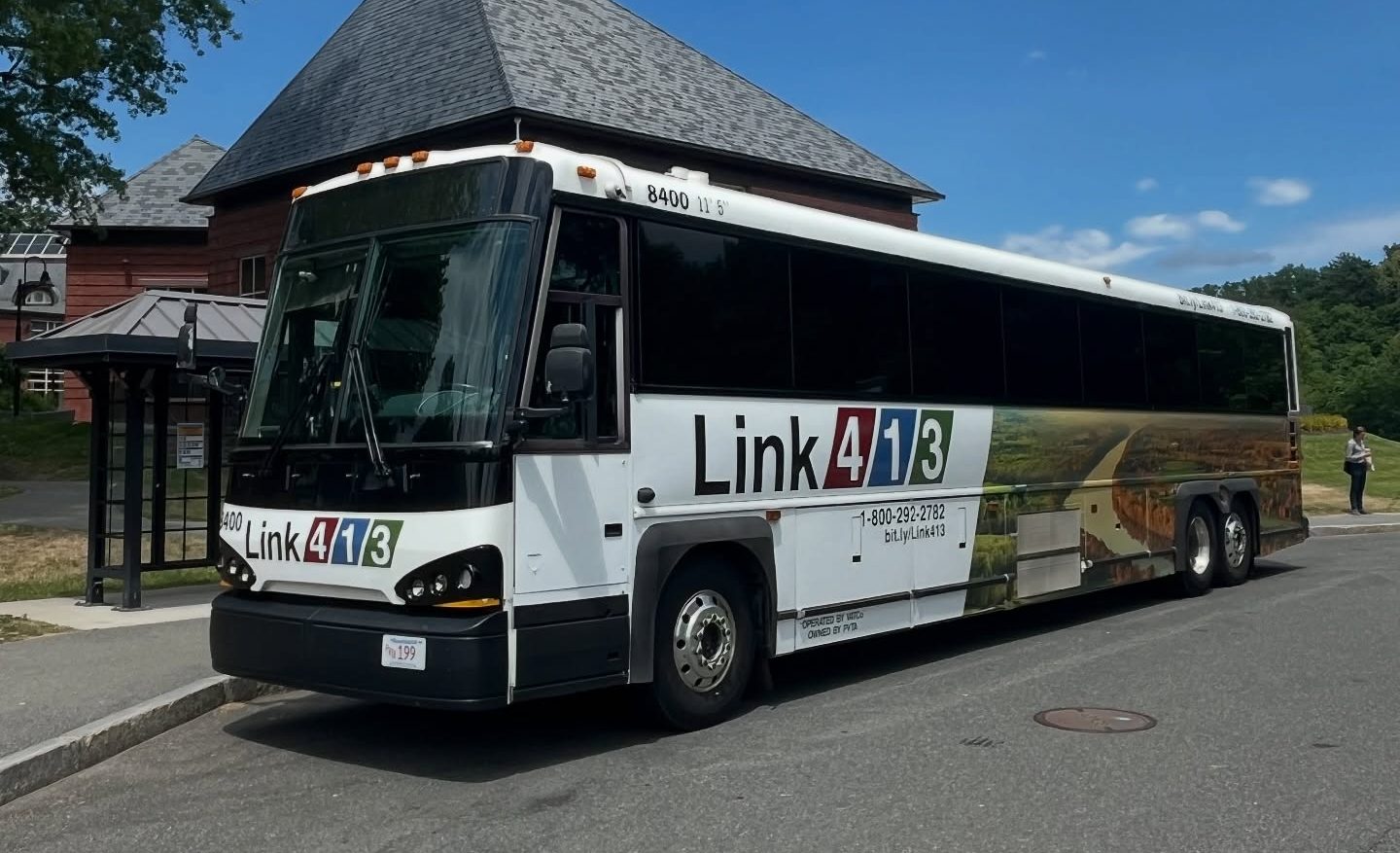
Blink, and you might miss it — a 50-passenger coach rolls up to its temporary stop at the corner of Main and Masonic streets in Northampton exactly four times a day. Berkshire County native Marguerite Riopelle boards, takes her pick of almost entirely empty seats, and settles in for an often overlooked ride.
“People rely on this kind of transportation,” Riopelle told The Shoestring. “I lost my car, so you know, this is what works.”
Link413 is the region’s newest intercity bus program, not quite a year old. It’s also a service you’ve maybe never heard of. The state-funded pilot program launched in January as a way to link parts of western Massachusetts along reliable public transit routes. Since then, it’s garnered a small but loyal group of frequent riders, like Riopelle.
“I heard about it since before it started,” she said. “I’ve been following, waiting for it to run.”
Riopelle was one of two other passengers taking the Link413 to Pittsfield on a Friday morning, a route she’s ridden about 30 times since its launch. Now residing in Easthampton, Riopelle said she often uses the Link413 to visit friends and family up in the Berkshires. That morning, she got off at Windsor, one of several smaller hilltowns where the Link413 has a stop.
The only other rider on board, Northampton resident Sal Ramos, rode the whole way to Pittsfield. He said he frequently uses Link413 to pick up his son.
“Beats paying $240 for a Lyft,” he said. “It helps a lot.”
But almost a year into the program, Link413 has become synonymous with low ridership — a handful of passengers on a big, diesel-fueled 50-seater — and loyal riders like Ramos fear it won’t last long unless something changes.
“People don’t know about this. When I ask around, people don’t even know what this is,” Ramos said. “I hope it stays, but it’s going to need a lot more people.”
The Link413 program launched in January as a collaboration among the region’s three main transport authorities: the Pioneer Valley Transit Authority, the Berkshire Regional Transit Authority, and the Franklin Regional Transit Authority. By far its most popular route is a 90-minute trip from Northampton to Pittsfield, and buses also serve routes from Pittsfield to North Adams and from North Adams to Greenfield.
Rauley Caine, general manager at the PVTA and a driving force behind the program’s launch, said the impetus for the Link413 was the need for greater cross-jurisdictional connectivity among each regional transit authority’s respective service area.
“It’s filling a gap that has been inconsistently available to the general public for the better part of 100 years,” Caine said.
With doubts about its longevity looming, The Shoestring rode the Link413 to hear from passengers and drivers. And while all saw the service as filling a genuine need in the region, many worry it’ll peter out before people finally realize it.
One Link413 driver, who declined to give his name, described a moment when a Pittsfield resident knocked on his bus door and asked, “Do you really go to Greenfield?”
“That lady is a regular rider now,” the driver said. “So how many others like that are out there?”
“Now she’s more connected, no pun intended,” the driver added. “She can go visit her family without having to pay for an Uber or a Peter Pan bus that costs $80 and takes twice as long to get there.”
Based on Link413 rider surveys — 34 responses through the end of October — 68% of riders cited social visits or entertainment as their reason for travel, followed by work and job access at 27%.
Tim, a Link413 driver who chose not to give his full name, said he mostly meets a mix of commuters and those visiting family, but also described one passenger who was making his way home to Pittsfield after meeting up with friends at Springfield’s casino. Still, Tim said he sees an average of two to six passengers a trip.
“For people who can actually benefit from the service, I don’t think there’s enough widespread awareness of it,” he said.

Based on ridership data obtained by The Shoestring, across all three routes, Link413 has averaged about 216 passengers per month through October. However, ridership has also steadily risen since its inception, reaching a total of 310 last month. Most recently, though, Link413 had its highest ridership week yet in the first week of November with 105 passengers. This followed a Nov. 1 fare reduction, which halved the cost of a single ride to $5.
Caine said Link413 was made possible through the state’s transit connectivity grant program, meant to bridge gaps between existing public transportation networks. The region’s three regional transit authorities applied jointly and were initially awarded $1.57 million for the two-year pilot program. Since then, Caine said they’ve already been awarded funding for another year and have recently reapplied for another two.
“Without this discretionary money to provide a service that is inter-jurisdictional, it probably wouldn’t exist,” Caine said. “It’s just not enticing or profitable to take up. These communities would still be without a public transportation option between some of the larger metropolitan areas of the state.”
According to Caine, the Massachusetts Department of Transportation selects eligible projects based on a limited set of criteria, including opportunities to increase ridership and single-trip mileage, geographic equity, and service to low-income people. While not stated directly by MassDOT, Caine said he assumes success measures like ridership would also be taken into account for projects seeking renewal.
Those who spoke to The Shoestring said a lack of advertising by Link413 is partly to blame for its low ridership.
“They don’t advertise that much,” Ramos said. “I don’t know why. They should be advertising; it shouldn’t be so empty.”
The driver who declined to give his name agreed.
“It could really be symbiotic with route towns, helping each other grow and work,” he said. He proposed that the service should be cross-advertised with local attractions and businesses, especially during tourist seasons.
Link413 ridership notably peaked in the summer. July has been by far the busiest month to date, with 352 passengers. There’s been a recent similar but smaller uptick, Caine said, perhaps due to fall foliage.
Caine said that because most of the grant funding was used for Link413’s operational costs, there’s been little left over for advertising. He said marketing on social media and the intentional branding of the vehicle are their main advertising efforts. Link413’s name and logo are branded on all sides of every coach, alongside pictures of iconic western Massachusetts destinations and landscapes like the Connecticut River and Mount Greylock.
“We branded the vehicles specifically and deliberately to be their own advertisements,” Caine said. “We joke that the buses are rolling billboards.”
Ultimately, Caine told The Shoestring that ridership numbers so far for Link413 have been “in line with expectations.”
“For a service as infrequent as this is, covering as large of a geographical area as it does, we’re doing quite good in our opinion,” he said, adding that while less than a year’s worth of operation isn’t enough data to make a statistical case, what they’re seeing right now is encouraging.
Caine said the positive feedback they’ve received from customers is also a much stronger measure of success than strictly numerical metrics, given the demographics of the areas the buses serve.
“We’re talking about communities with very small populations, some that are fewer than a thousand residents,” he said. “We are moving people, and so far that seems to be a great measure of success.”
Responses to the same Link413 ridership survey do show primarily positive feedback from riders, many of whom said they were unaware of the service prior to their trip.
“Link413 is amazing & awesome & the best!” one rider wrote. “Can’t believe this incredible service existed & I didn’t know about it. … I will be traveling to the Valley a lot more with Link413!”
“Exceeded all possible expectations,” another rider wrote. “Just wish the amazing service was more publicized? We really need this service, these buses would be very busy if everyone knew.”
Some riders griped about the fare and about issues with the ticketing system. Many also wished buses ran on weekends and more frequently, particularly during midday.
Presently, riders who take one of two morning trips out to Pittsfield, for instance, have to wait until 5:30 p.m. for the first return trip to Northampton, followed by the final return trip at 7:30 p.m.
Caine said the region’s transit authorities are actively working to address gaps in midday and weekend service and recently expanded eligibility for reduced-fare tickets, which are $2.50 as of Nov. 1, to include K-12 or college students with a student ID and school staff with an employee ID.
“It’s not in its final form,” Caine said. “We hope to keep growing the program and evolve it a little bit, and we’re hopeful it will continue existing. But we need folks to ride it.”

Dylan Vrins is an independent reporter and recent graduate of Amherst College with a B.A. in environmental studies. Reach him at dylanvrins@gmail.com or on Instagram @dylan.vrins