


With primary elections approaching earlier than usual this year, on Sept. 1, one of the most competitive local races is one many people have likely never heard of.
A heated rematch is scheduled for the seat representing western Massachusetts on the Governor’s Council, a body primarily in charge of giving final approval on all state-level judgeships, clerk magistrates, and members of the Parole Board.
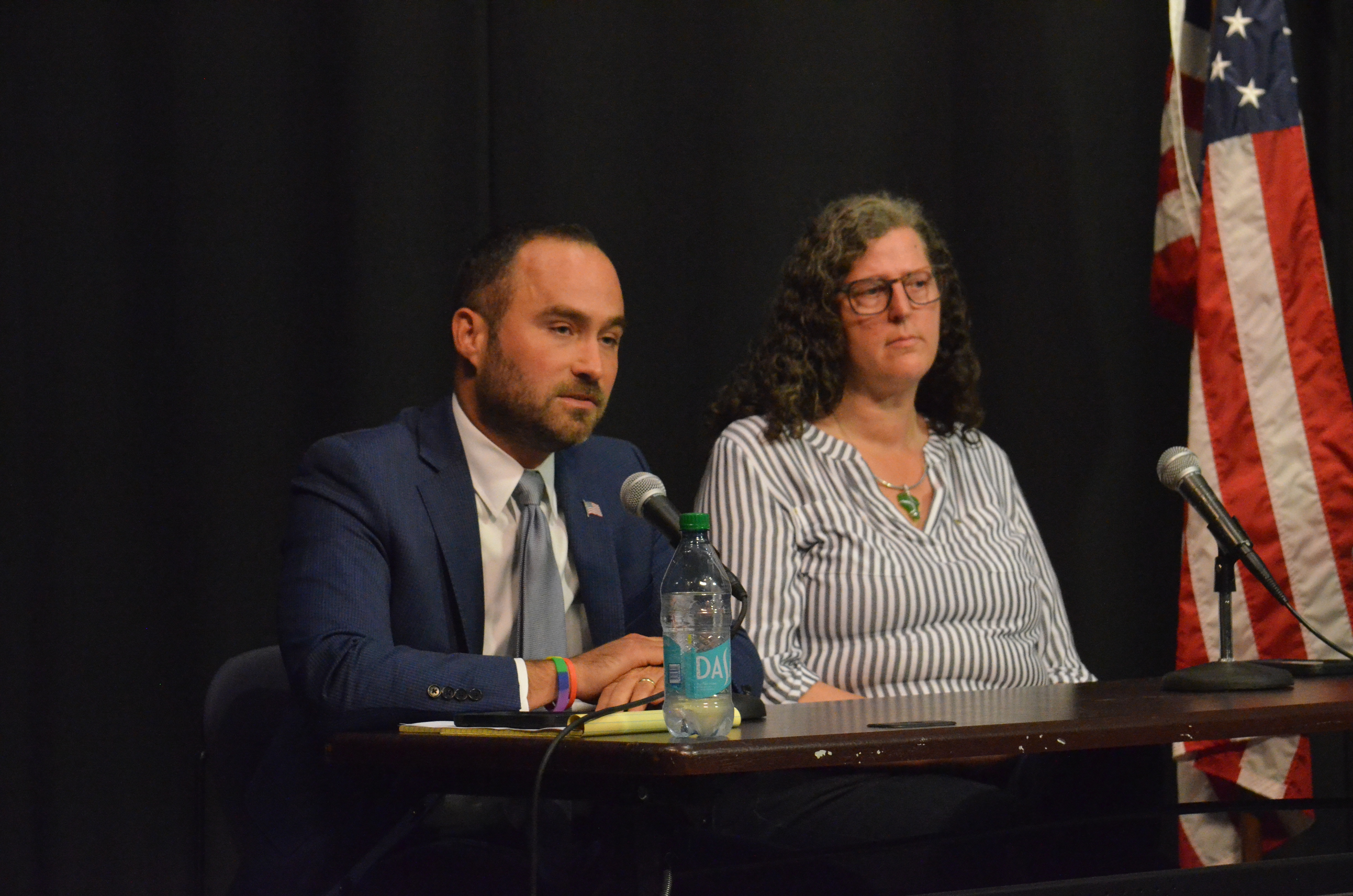
Incumbent Tara Jacobs, who has built a progressive reputation through challenging the governor and even taking judges on her visits to state prisons, is facing a challenge for a second time from former Springfield City Council president and attorney Michael Fenton. Jacobs beat Fenton in the 2022 Democratic primary race by a mere 2,300 votes after long-time incumbent Mary Hurley left the seat open following her retirement. This time, Fenton has returned with a base of political endorsements and financial backing from local Democratic officials.
“It’s the most important race no one’s ever heard of,” Lois Ahrens, the director of the Real Cost of Prisons Project, told The Shoestring. The Governor’s Council “flies under the radar. Nobody even knows that it exists, let alone what it does.”
Dating back to the colonial era, the Governor’s Council has long been one of the most opaque parts of the Massachusetts criminal legal system. Councilors, the majority of whom are attorneys, must approve all state judges, clerk magistrates, and Parole Board members. The council also approves or denies all requests for pardons and commutations.
Of the eight districts on the Governor’s Council, District 8 is the largest geographically, covering all of Berkshire, Hampshire, Hampden, and Franklin counties.
Jacobs, now in her fourth year representing the district, ran unopposed in 2024. After her narrow win over Fenton in 2022, Jacobs went on to lead a comfortable victory over Republican nominee John Comerford, another attorney. Since there are no Republican candidates in the running this year, the primary winner will almost certainly assume the District 8 seat following the November general election.
***
39-year old Michael Fenton, who has spent 15 years practicing law and eight terms on the Springfield City Council (five of them as president), said his professional background as an attorney and local government official is what is required to be effective on the Governor’s Council.
Fenton said his experience spearheading several justice-related initiatives on City Council, including the creation of an ordinance for a civilian police commission in Springfield, is proof of his effective work as a public advocate that would translate well to a role on the Governor’s Council.
“My track record in fighting for progressive causes and social justice on the City Council, as well as knowing how to effectively fight for western Mass on a statewide scale, is really what I’ve gained from my time on the City Council,” Fenton said.
Hampden County Clerk of Courts Laura Gentile called Fenton “one of the most recognized attorneys in the area,” which she said also makes him the perfect fit for the job.
“I’ve been a big proponent that in order to select a judge, you have to have experience practicing in front of a judge,” Gentile said. “You need to be able to learn what the temperament of those judges is and what’s necessary as far as a temperament goes.”
The Shoestring relies on reader support — not corporate owners or paywalls — to make independent news for western Massachusetts possible. If you value independent local journalism, please consider making a tax-deductible donation.
As a transactional lawyer rather than a litigator, Fenton rarely appears in court before a judge. When asked about this at an Aug. 11 candidate forum, Fenton said his work still involves interacting with judges and courts daily. He added that his non-litigation work means he wouldn’t have any conflicts of interest if elected to the council, as he would never appear before someone whom he has appointed as a judge.
Regarding his plans for the seat, Fenton said one of his main priorities would be to address the underrepresentation of western Massachusetts on statewide boards and in judicial court positions.
Right now, the Massachusetts Supreme Judicial Court, Parole Board, and Appellate Tax Board, all of whose members are appointed by the Governor’s Council, have no members hailing from or residing in western Massachusetts.
“We need an advocate who will fight for the region, because we’re regularly otherwise ignored by the eastern portion of the state,” Fenton said. “I would insist and work with the governor on finding representatives from western Massachusetts so that we can have some regional equity and representation on these boards.”
Fenton also said he plans to proactively address problematic vacancies in state judgeships before they stack up, like they have in recent years. Last year, five of the 11 Superior Court seats for western Massachusetts were vacant, putting pressure on local courts and sitting judges to cover the workload. Those seats have all since been filled, but it’s something Fenton argues never should have happened.
“The fact that we even ended up there in the first place is a reflection that we don’t have an active advocate on the Governor’s Council who’s identifying vacancies before they happen and creating pipelines for lawyers to the bench,” he said.
The majority of judicial vacancies result from retirement — mandatory at age 70 — which, Fenton said, allows the opportunity to identify and vet candidates far in advance, potentially avoiding vacancies entirely.
When asked about last year’s Superior Court vacancies, Jacobs said western Massachusetts has always struggled with filling judicial positions, partly due to its tiny applicant pool.
“The eastern part of the state has hundreds and hundreds of applications to consider, and we have single digits at any given time,” Jacobs said.
Given these challenges, Jacobs said she is proud of the work she’s done to fill judicial vacancies in the region.
“We currently have no vacancies in the Superior Court circuit in western Mass, and that’s a historic accomplishment that I’m very proud of,” she said.
When vacancies in the region piled up last year, Jacobs and state lawmakers called on Gov. Maura Healey’s administration in March to ramp up judicial nominations and address the growing backlog. Jacobs said she also did community outreach to recruit judicial applicants and push promising candidates to apply. It’s work, she said, that is technically not part of the job, but the nature of her district calls for it. Jacobs said some councilors — mainly from eastern districts — rarely do any outreach, since their applicant pools are already large enough.
“I challenge anyone to be more productive in filling judicial vacancies than I have been,” she said.
Still, according to Fenton, last year’s vacancies caused an “uprising” in the legal community, enough so to encourage him to join the race and address growing problems. Fenton said he’s secured the support of several big names in the region’s legal community, including Hampden District Attorney Anthony Gulluni and Berkshire District Attorney Timothy Shugrue.
“Endorsements don’t come in a Democratic primary against an incumbent unless there’s a serious problem,” Fenton said.
Fenton’s campaign has also been bankrolled by many other high-profile Democratic officials, both at the local and state levels, and much more so than his previous campaign for the seat in 2022.
State campaign finance records show contributions from Springfield Mayor Domenic Sarno, U.S. Rep. Richard Neal, state Rep. Thomas Petrolati, and former Easthampton Mayor Nicole LaChapelle. And as a well-known Springfield city official, Fenton also has the support of many more Springfield Democratic officials.
Jacobs’ campaign contributions show much less support from major local politicos; however, Northwestern District Attorney David Sullivan and Jeromie Whalen, the public school teacher challenging incumbent Neal in the 1st Congressional District this September, both have listed donations to Jacobs’ campaign.
Some of Jacobs’ supporters who spoke to The Shoestring said it was clear that political support could make a huge difference in the race.
Northampton civil rights attorney David Hoose, who has written letters in support of Jacobs’ candidacy, called Fenton “the candidate of the Springfield Democratic elite.”
“And I don’t even say that in a pejorative sense,” he said. “This is what you do when you have a good party caucus in a Democratic city like Springfield.”
Fenton’s close association with Springfield is also among the reasons Hoose and many others are supporting Jacobs’ re-election this year, noting that strong caucus support can be tied to vested political interests, especially when deciding on judgeships.
“Mike’s not a bad guy, but I want someone who’s independent and who cares about people outside of Springfield, and Tara has shown that,” Hoose said.
***
It’s that promise of independent thinking that has primarily defined Jacobs thus far on the Governor’s Council, in what can only be described as a uniquely progressive approach compared to her predecessors.
Jacobs, a North Adams resident, said she’s voted “no” on judicial and gubernatorial appointments more than any of the eight members currently on the Governor’s Council.
The Shoestring filed a public records request for Governor’s Council voting records since December 2025 to fact-check that claim, though the state did not respond within the legally mandated 10 business days.
Ahrens, from the Real Cost of Prisons Project, praised Jacobs for acting as more than a “rubber stamp” for the governor. She said the Governor’s Council could play a more important role than normal.
“The more Governor’s councilors who see their role as actually reviewing the nominees of the governor, and maybe approving them or maybe not approving them, the better off people in Massachusetts will be,” she said.
When vetting nominees, Jacobs said she meets with each of them face-to-face for hours-long, in-depth conversations. Drawing on her undergraduate degree in social psychology, she said she prioritizes understanding who they are as humans, not just their qualifications.
“What they’re saying in response to my questions is important, but their body language and facial expressions are also highly communicative for me,” she said.
Jacobs said she reviews every nominee diligently and has often voted “present” at Governor’s Council meetings when she feels she hasn’t had enough time to reach a clear decision. This often happens, according to Jacobs, when other councilors attempt to rush the vote rather than allowing time for public input following a nominee’s initial hearing.
When she receives a nominee from District 8, Jacobs said she often holds local hearings to make the process more transparent for communities in western Mass.
“I would rather vote ‘no’ if I’m seeing red flags, even if I end up being the only person who votes ‘no’ and the person still gets confirmed,” Jacobs said.
In 2024, Jacobs cast the lone vote of dissent on Healey’s appointment of Supreme Judicial Court nominee Gabrielle Wolohojian — an appointment that drew public scrutiny because of Wolohojian’s previous romantic relationship with Healey. The appointment was one of two Healey made after the retirement of two SJC judges in close succession.
When asked about her reasoning behind her dissent, Jacobs said it was primarily procedural, citing frustration with the lack of regional equity in Healey’s picks for the two open court positions — one of which went to Wolohojian and the other to Elizabeth Dewar, whom Healey, when she was the state’s attorney general, appointed as state solicitor in 2016.
“I objected structurally to the lack of representation for western Mass on that higher court,” Jacobs said. “You had two shots at this, and you ignored western Mass utterly to go within your internal network of Boston people.”
Jacobs also cited a smaller reason behind her objection to Wolohojian’s appointment, which arose after many in-depth conversations with the nominee.
“She is incredibly smart, but there was definitely a whiff of being disconnected from the community that struggles,” Jacobs said. “Really from birth forward, she’s been very privileged, and kind of in a bubble of privilege, which felt disconnected in my mind.”
Jacobs’ vote drew criticism from others, though.
Vice-chair of the Northampton Democratic City Committee Elizabeth Silver, for example, said Jacobs’ rationale behind her dissenting vote had nothing to do with Wolohojian’s qualifications. Silver, who is also a retired legal services attorney and a supporter of Fenton, said it highlights the importance of having a governor’s councilor with legal experience.
“Lawyers, on the other hand, inherently understand the positions judicial nominees would fill, which requirements are necessary, and which clearly are not,” Silver said in a statement to The Shoestring.
Wolohojian’s nomination isn’t the only time Jacobs and Healey have butted heads over a contested appointment. In May, the Governor’s Council rejected the nomination of Vincent Demore to the Parole Board by a vote of 4-3, despite a letter and in-person plea from Healey urging his appointment.
Jacobs said she opposed the nomination because Demore, who is a former prosecutor, lacked experience or interest in parole, adding that she would rather have someone with a background in parole.
Fenton criticized the decision.
“I think it speaks to a damaged relationship with the governor’s office, and as a result, our region has suffered with prolonged vacancies and a lack of representation on statewide boards and commissions,” he said.
Following Demore’s rejection, Healey quickly pushed forward a second former prosecutor as a nominee to the board, Kaitlyn O’Leary. And last week, the Governor’s Council approved O’Leary’s nomination by a vote of 6-2, with Jacobs again voting against the nomination.
At the same Aug. 11 forum in Greenfield, Fenton again criticized Jacobs for her voting decisions and disconnect from the Governor. Jacobs denied Fenton’s claims, calling her rapport with Healey an “affable working relationship.”
Jacobs also made it clear that she stands by all her voting decisions, which steered the conversation towards each candidate’s views on what matters most when evaluating a judge or Parole Board appointment. While Fenton emphasized experience and reputation, Jacobs highlighted the importance of appointees who understand the experience of people who are incarcerated.
That is a large part of what Jacobs says is her unique approach to vetting nominees, and ultimately tied to the mission of change that led her to run for the Governor’s Council in the first place.
“In my role, the progress is specifically around shifting our justice system to be more fair, and actively working to dismantle what we know have been systemic injustices baked into our system from the onset,” Jacobs said.
After working on the anti-tobacco Truth Campaign, Jacobs’ forays into public service on North Adams’ school and library boards led her to an interest in racial justice issues.
“I saw Governor’s Council as an opportunity to have a voice that could actually effect change, not just for western Mass, but the entire state, in working towards shifting racial disparities in our justice system and working towards a justice system that really serves us all,” Jacobs said.
Jacobs’ background in community work caught progressive attention during her first bid for the seat in 2022. Those who have been following Governor’s Council elections for decades saw her non-attorney background as a sure-fire way to lose the election, given the longstanding status quo of electing lawyers to the council.
But it was Jacobs who shocked onlookers with her narrow victory over Fenton in the Democratic primary. Hoose, the Northampton attorney, chose to support candidate Jeffrey Morneau in the 2022 primary and remembers saying Jacobs had zero chance of winning. Now, he’s choosing to support her re-election this year.
Likewise, Ahrens said Jacobs has “expanded this role in a very important way so that she can make her decisions much more informed and much more tied to people in the criminal legal system.”
Jacobs said she often observes court and parole hearings to talk with members of the legal community, like probation officers and judges, and nonprofits working within the justice system. When touring local prisons, Jacobs said she often brings judges along to see what it’s like.
“Having an understanding of where it is you’re sentencing the person to and what their experience will be like versus whatever assumptions you might have about the rehabilitative aspects of a prison is really important in my mind,” Jacobs said.
Governor’s councilors are among the select few legally allowed to visit and tour prisons freely, and it’s something Ahrens said those involved in the penal system don’t do enough.
“They’re operating completely in their own little bubble, outside of how huge the criminal legal system is,” Ahrens said. “Tara had a very steep learning curve, but she has learned an enormous amount because she actually cares.”
Dylan Vrins is a summer 2026 intern at The Shoestring with support from the Nonprofit Newsroom Internship Program created by The Scripps Howard Fund and the Institute for Nonprofit News.

Dylan Vrins is an independent reporter and recent graduate of Amherst College with a B.A. in environmental studies. Reach him at dylanvrins@gmail.com or on Instagram @dylan.vrins
- Dylan Vrins


