

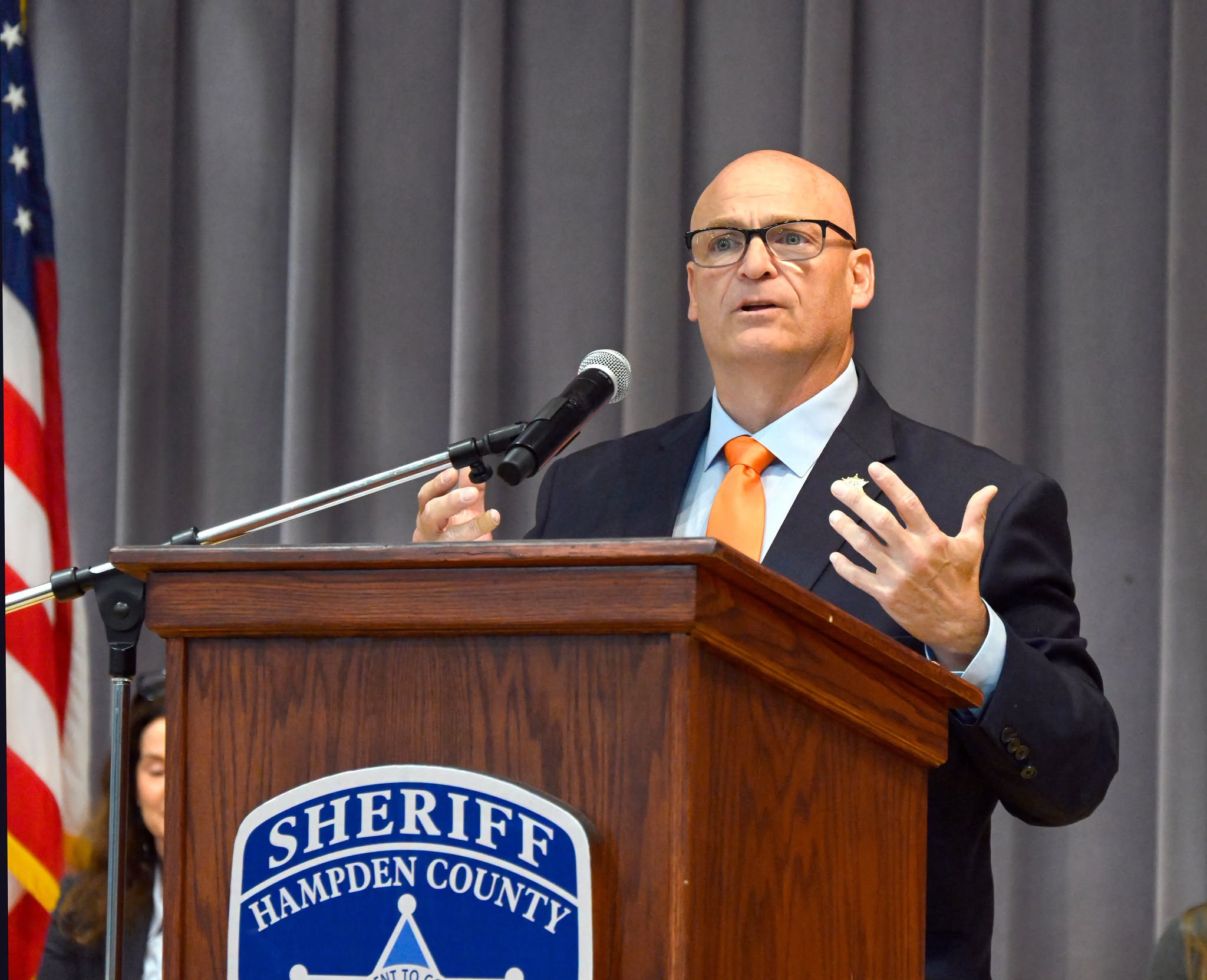
The Hampden County Sheriff’s Office says it has stopped sending daily lists of everyone it holds in custody to Immigration and Customs Enforcement deportation officers.
Emails reviewed by The Shoestring show that for more than two years, Sheriff Nick Cocchi’s office routinely sent ICE agents the name, date of birth, place of birth, race, home address, and other sensitive personal information of people held by the sheriff. ICE was given this information even for those who had not been convicted of a crime, including some held at Stonybrook Stabilization & Treatment Center, which provides court-ordered treatment for substance use disorder under the state’s Section 35 civil commitment law.
“It wasn’t done for any purpose or [with the] intention to alert ICE as to who’s in our custody necessarily,” the sheriff’s office’s general counsel, Theresa Finnegan, told The Shoestring. When asked how long Cocchi’s office has shared information with ICE, Finnegan didn’t provide an exact number. “They’ve just always been on the list. They used to conduct interviews here years ago. And I think that’s maybe when it started.”
The disclosure of the emails comes at a time of heightened scrutiny of law enforcement’s sharing of information with ICE in Massachusetts. In September, provisions of the PROTECT Act — a newly passed law intended to limit cooperation between local law enforcement and federal authorities engaged in civil immigration enforcement — went into effect. Among other things, the act prohibits state and local law enforcement from knowingly providing a federal immigration authority nonpublic personal information, advance notice of release, custody status, or advance notice of a court appearance.
The law already appears to have had an effect. Finnegan said that the sheriff’s office has now ended the practice of sending rosters to ICE in order to comply with the PROTECT Act. The office has even stopped, “in an abundance of precaution,” sending those rosters to one of its own employees who is on a Homeland Security Investigations task force.
However, the emails also seem to show the limits of the PROTECT Act. Finnegan, for example, said that there is another way that federal agencies learn about the arrest of somebody ICE wants to deport: fingerprints that the state shares with the feds after somebody is booked into custody.
Cocchi did not respond to an interview request for this story. A spokesperson for the sheriff’s office didn’t respond to a request to make him available.
In August, Gov. Maura Healey signed the PROTECT Act into law. In addition to limiting the ability of local law enforcement to share information with ICE, it prohibits civil arrests from taking place on non-public areas of state property, schools, and medical centers without a judge-signed warrant. A separate section of the act preventing civil immigration arrests from taking place at state courts does not go into effect until November.
The PROTECT Act has several carve-outs. One exempts the state’s Department of Corrections from a prohibition against law enforcement agencies entering into 287(g) agreements — arrangements that allow ICE to deputize local law enforcement for immigration purposes. Another allows agencies to “enter into or fulfill an inter-governmental services agreement with a federal agency to provide detention services for persons in federal custody.”
These carveouts exempt both the state Department of Corrections, which is the only law enforcement agency in Massachusetts that has a 287(g) agreement with ICE, and contracts between the federal government and the Plymouth County Sheriff’s Office to hold federal detainees on behalf of ICE and the U.S. Marshals Service.
The Hampden County Sheriff’s Office has its own agreement with ICE’s Homeland Security Investigations, which is limited to criminal investigations, not civil immigration enforcement. Under this agreement, a member of Cocchi’s law enforcement division, Capt. Tara Kelliher, serves as a full-time deputized task force officer.
Homeland Security Investigations is one of ICE’s two law-enforcement components, together with Enforcement and Removal Operations. HSI has, in the past, been separate from the mission of ERO, which is the arm of ICE that handles all “identification, arrest, detention and removal of aliens who are subject to removal or are unlawfully present in the U.S.”
However, after President Donald Trump took office in January 2025, he issued an executive order directing HSI to aid in his campaign of mass deportation. A federal watchdog report published in August showed that HSI agents have begun spending a significant amount of time on immigration enforcement instead of their typical purview, such as investigations into fentanyl trafficking.
The month after Trump’s executive order, on Feb. 6, 2025, an email came into Kelliher’s inbox from Anthony Ruffule, the resident agent in charge with HSI Springfield. He wanted the Hampden County jail to provide “a list of foreign-born individuals” on a weekly basis, as well as 24 to 48 hours’ notice of their release so that he could “arrange to have agents there to take custody of the individuals prior to their release.” He also requested “any type of notice” regarding foreign-born individuals released on bail.
Kelliher forwarded that email to Chief Deputy Frank Ott of the Hampden County Sheriff’s Office.
About six or seven weeks later, Kelliher’s state employee email address, which is set up to automatically forward to her federal email address, was added to the list of people to whom the jail roster was distributed.
The records obtained by The Shoestring do not show Kelliher participating in any civil immigration enforcement or arrests.
“She is not an ICE agent,” Rob Rizzuto, a spokesperson for the sheriff’s office, said in a statement. “She is a Hampden County Sheriff’s Office deputy assigned to a federal task force whose responsibilities involve criminal investigations, not civil immigration enforcement.”
For that reason, Finnegan said that the sheriff’s office is “comfortable with our decision at this point to have her remain on the task force until we are advised otherwise.”

Despite that decision, however, Cocchi’s office says it has removed Kelliher from the email distribution lists.
“We are, in an abundance of precaution, no longer going to send her the list. She’s just coming off of the list,” Finnegan said.
Finnegan also pointed out an additional loophole in the PROTECT Act. Because of information sharing with the federal government, she said federal immigration authorities learn about immigrants’ presence in the jail once they’re booked.
“My understanding is that through the fingerprinting system, they’re able to identify anybody with a detainer through fingerprints that get sent by the state,” Finnegan said.
However, Ruffule, the HSI agent in Springfield, asked for more information than that. He had requested advanced notice of when foreign-born people make bail or would be released from custody. And the emails obtained by The Shoestring show the sheriff’s office sending that kind of information to ICE at least once.
In an email this March with a subject line that included “immigration detainer,” an intake supervisor with the jail emailed Devin Vendetti, a person with an ICE email address, that an inmate “will be posting bail this weekend on her Massachusetts case” and that she would be sent to Chicopee District Court.
The emails also show an HSI agent asking the sheriff’s office to send him information as part of an immigration enforcement action.
On July 16, 2025, HSI Special Agent Daniel Yon sent an email to the sheriff’s office with the subject line “HAR-ERO-FL05-RicohIMC6500.”
(The Shoestring has previously reported that Yon was one of several agents who spent weeks staking out the apartment of a Turkish college student in Amherst.)
That subject line appears to reveal the reason for the email. The Ricoh IM C6500 is a multifunction color laser printer, scanner, copier, and fax machine. ICE has a contract with Ricoh to lease multifunctional printers and copiers for its Hartford location, where ERO has an office on the fifth floor.
“Please see the attached detainer,” Yon wrote. “If the detainee makes bail, we would like to take him into custody.”
Rizzuto, the sheriff’s spokesperson, told The Shoestring that his office has participated in the HSI task force for more than a decade.
“And the task force has held numerous really bad actors accountable and protected a lot of people. And it’s in that same vein where we continue to participate in it,” he said.
The Hampden County Sheriff’s Office isn’t the only local law enforcement agency that is part of an HSI task force. The Shoestring previously reported on West Springfield’s participation in the same task force.
Organizations like the American Immigration Council have expressed concern about how HSI agents have been pulled away from investigating drug and human trafficking under Trump, “instead prioritizing low-level immigration offenses.” The American Immigration Council has also warned that “agents from the Drug Enforcement Agency and FBI’s Joint Terrorism Task Force now focus instead on arrests of migrants, farmworkers, and local business owners who lack U.S. citizenship.”
The Hampden County Sheriff’s Office is also a member of Boston’s Joint Terrorism Task Force — the only western Mass law enforcement agency still on that task force, according to documents The Shoestring obtained earlier this year through a Freedom of Information Act request.

Jonathan Gerhardson is a journalist in western Massachusetts.
Email: jon.gerhardson@proton.me