


This story originally appeared in the Oct. 30 edition of the Montague Reporter.
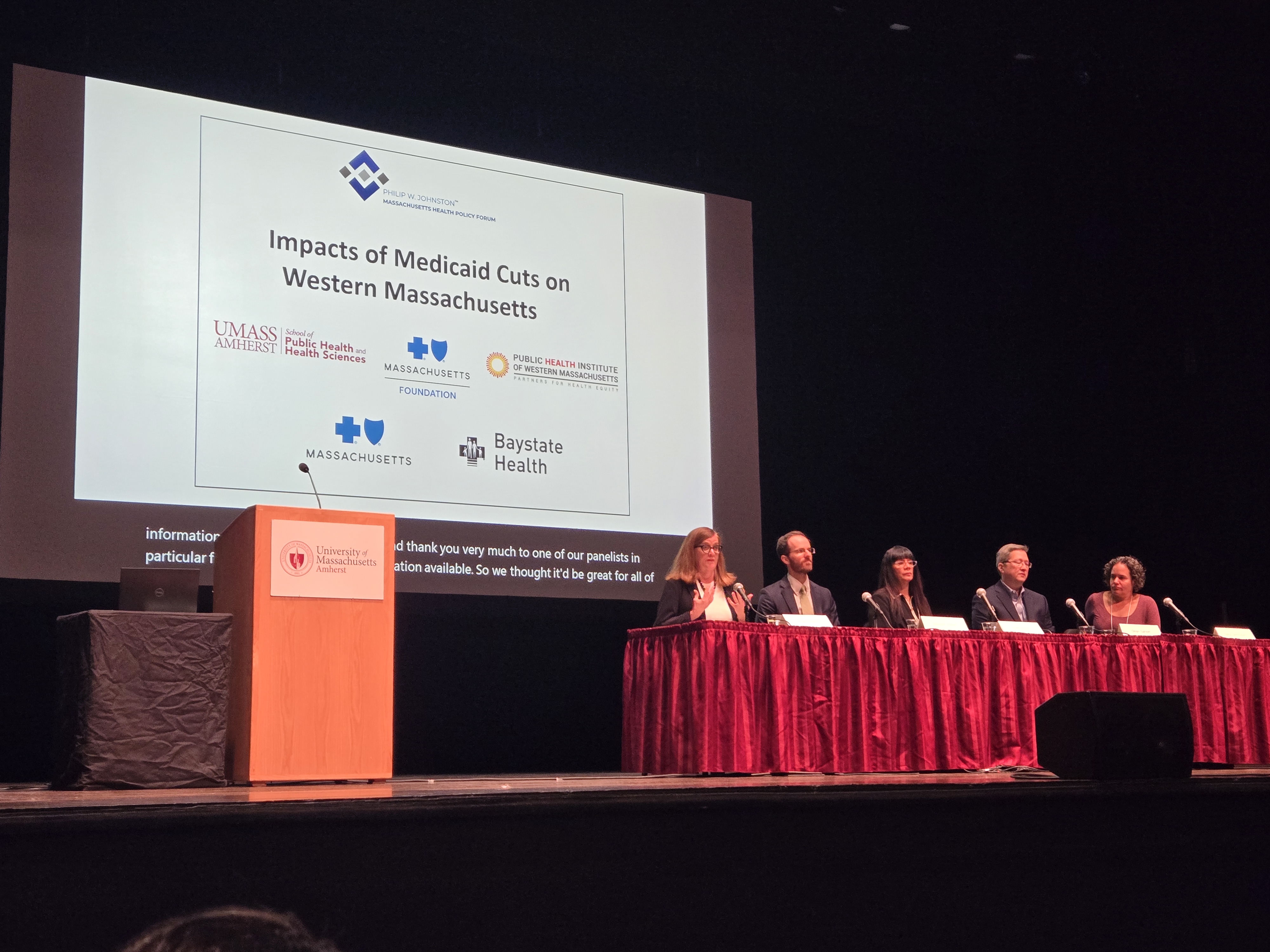
AMHERST – Healthcare and public policy experts gathered at the UMass Amherst Fine Arts Center on Tuesday to discuss how new restrictions on federal health insurance programs will likely impact healthcare in western Massachusetts.
The presentation and panel discussion was convened by the Philip W. Johnston Massachusetts Health Policy Forum, and featured speakers from the Blue Cross Blue Shield of Massachusetts Foundation (BCBSMF), Baystate Health, and community healthcare organizations as well as MassHealth, the state’s public health insurance provider.
“We are seeing healthcare costs grow at a rate that far exceeds the resources available to the state, to employers who are trying to pay premiums, to families who are trying to pay out of pocket,” said Michael Levine, Undersecretary for MassHealth at the state Executive Office of Health and Human Services. “It is going to drive a lot of innovation, and a lot of hard decisions around how to deliver great care at lower costs.”
About 300,000 low-income Massachusetts residents could lose their health coverage in the next decade as a result of federal policy changes that will impact Medicaid, Medicare, and market-based plans subsidized under the Affordable Care Act. According to an analysis by BCBSMF, the charitable arm of the state’s largest private health insurer, these changes could lead to lower reimbursement rates and higher costs for patients.
Kaitlyn Kenney Walsh, BCBSMF vice president of policy and research, said that increased federal spending on border security, energy, and defense comes largely at the expense of healthcare programs under the One Big Beautiful Bill Act, a wide-ranging piece of legislation promoted by the Trump administration and signed into law in July.
“This will mean really tough choices,” Kenney Walsh said. “Places may have to lay off workers, including clinicians. People may have to choose between paying the real estate to keep the facility open – which could ultimately mean longer wait times for services for all of us – and longer drives to access your care.”
“I just want to reiterate, this is not [just] a Medicaid problem,” she added. “This is an every health insurance coverage, and healthcare delivery system, problem.”
The large auditorium was sparsely filled with what seemed like fewer than 100 attendees, among them social service workers, students, and staff from the offices of US senators Elizabeth Warren and Ed Markey.
“If people really understood what this means, this room would be full, because the impacts are going to be real,” said Baystate Health chief strategy officer Dean Sanpei. “It’s going to impact real people’s lives, and people are going to die. It’s bad.”
Big Bill Act Impacts
Starting next year, the One Big Beautiful Bill Act will strip insurance eligibility from some immigrants, including asylum seekers, people from Afghanistan and Iraq granted special immigrant visas, Native American tribal members born in Canada, and victims of human trafficking. This move is expected to impact about 2,500 MassHealth recipients, and as many as 60,000 recipients of subsidized plans through ConnectorCare, legally residing in Massachusetts.
“These are lawfully present people,” Kenney Walsh said. “These are people who have followed the rules, they’ve submitted their paperwork. They are currently eligible, and this is a shift in terms of eligibility criteria for particular immigration statuses that will lose their coverage.”
The new law also implements work requirements for adults on Medicaid under the age of 65 with no dependent children. Beginning in 2027, applicants will have to submit paperwork verifying employment or enrollment in a job-training program for at least 80 hours per month. Recipients will also have to re-submit their applications every six months instead of once a year.
“We know that people often lose coverage not because they’re not eligible, but because of the administrative barriers and the red tape of proving they’re eligible. It’s a lot of work,” Kenney Walsh said. “More frequent redetermination will just create additional hurdles to people keeping their coverage.”
Massachusetts residents who do not qualify for Medicare or Medicaid, and instead receive subsidized insurance through the Health Connector under the Affordable Care Act, may lose coverage or see their premiums skyrocket as eligibility rules change, she explained.
The law also effectively cuts Medicaid funding by placing restrictions on how much the state may tax healthcare providers to support MassHealth, and how much “state-directed” payments may be spent on additional services or providers.
At the same time, enhanced premium tax credits approved by Congress in 2021 to lower monthly health insurance costs for residents not covered by Medicare or Medicaid are set to expire in December. Unless these credits are extended, an estimated 27,000 additional Health Connector customers could lose their insurance.
One in four Massachusetts residents is insured through MassHealth, a program that brings over $12.3 billion in annual revenue to the state’s economy. According to Kenney Walsh, that amounts to about 86% of the federal money sent to the state. Once all of the Big Beautiful Bill Act’s changes have been implemented, she said, it will translate to an annual loss to the state of about $3.5 billion.
The full effect of the cuts may not be felt until about 2034, she added: “These timelines were sequenced intentionally so that much of the harm happens after key election cycles.”
Community Health
Tania Barber, president of the Springfield-based nonprofit Caring Health Center, said that uninsured residents often delay seeking healthcare until they end up in an emergency room. This places increased costs on already overburdened hospitals, she said, which will also see decreased MassHealth revenue under the new rules.
“People are going to become sicker. Care is going to be delayed,” Barber said. “This is only going backwards from what we achieved, in terms of making sure that people have access to insurance, and making sure that people have access to care.”
Panelists suggested potential solutions to the compounding crises of increasing costs and federal cuts.
Sending community health workers to seniors’ homes for routine check-ups is cheaper and more convenient than meeting with doctors, Barber said. Several other panelists described the ways making wellness programs and preventative care more accessible at the community level can reduce pressure on healthcare workers.
“What are the programs that we have in place now that are actively connecting people to care – keeping them out of the hospital, keeping them out of the emergency department, and ensuring that they’re getting great care at the lowest cost possible?” asked Levine. “It has to be done in really close partnership with the providers locally to understand what works, what doesn’t, and how to keep people engaged.”
Anticipating the federal revenue shortfall, Governor Maura Healey signed a supplemental budget bill last month that provided $234 million to acute care hospitals and community health centers that serve low-income, underinsured, and uninsured patients.
“We have the best hospitals in the world, but with existing strains on our health care system and the harm coming from President Trump’s budget cuts, we need to support our trusted institutions that provide people the care they need,” Healey said in a statement.
Ilana Steinhauer, executive director of the Berkshire County-based nonprofit Volunteers in Medicine, said that retired doctors can volunteer their time to help the uninsured as a form of harm reduction.
“We need to start to disrupt the system,” Steinhauer said. “The cost of everything is skyrocketing, and there has not been a huge amount of discussion within our state about alternative models.”
Steinhauer and Barber both said that if healthcare providers were reimbursed at the same rate by private insurers as by MassHealth, they would have an easier time providing care. Barber suggested that legislation could require insurers to match these rates.
Our Own Footing
“Maybe medical care shouldn’t be a place where people think they go into to make so much money,” an audience member named Marsha Morris, who identified herself as a member of the Northampton Reparations Study Commission, commented during the event’s question-and-answer portion. “Maybe it should be about healthcare.”
This elicited applause from the audience.
“The system is going to break anyway,” Morris continued. “So go ahead and start it – and start trying something new. It seems to me like we spent the whole morning talking about, and reacting to, a system that doesn’t work anyway.”
State senator Jo Comerford attended Tuesday’s forum, and in an interview after the event emphasized the “seismic” impact the federal cuts will have on the region’s healthcare systems.
“We are already in a vulnerable place,” Comerford told the Reporter. “Primary care, specialty care, and elder care – these are deeply compromised, especially in rural areas. So how do we take this moment and make the system stronger, even as we face this attack on healthcare from the federal level?”
Comerford called attention, in particular, to the impacts on residents currently insured under state-subsidized private plans.
“It’s the young carpenter who pays $15 a month, his premium is going to jump to $500,” she said. “Or the couple who pays $30 a month through ConnectorCare, their payments are going to jump to $1,700 a month. Those folks are very vulnerable as well, because they may not be eligible for MassHealth. What happens to these folks?”
Though it was discussed among attendees, nobody on the panel had mentioned the bill to establish a statewide single-payer healthcare system, “An Act Establishing Medicare for All In Massachusetts,” which state senator James Eldridge has filed repeatedly since 2013. In recent years, Comerford has signed on in support of that bill.
“We have to take profit out of healthcare,” Comerford told the Reporter. “It has to be part of what happens. We need a single payer, and that would help align a lot of the expenses that are tacked on in the current system.”
In the meantime, the senator said, the state can help in other ways, including investing in training for community health workers, filling gaps in the emergency medical system, and improving residents’ access to preventative care.
“We have to understand there’s not a simple solution,” Comerford said. “Because the problem is, the federal chaos – the federal wreckage – is affecting numerous types of people and families, so our solutions need to be as nuanced to be effective…. It’s time for Massachusetts to find our own footing.”

Sarah is a print and radio journalist based in western Massachusetts.
- Sarah Robertson
- Sarah Robertson
- Sarah Robertson
- Sarah Robertson
- Sarah Robertson
- Sarah Robertson
- Sarah Robertson
- Sarah Robertson
- Sarah Robertson
- Sarah Robertson
- Sarah Robertson
- Sarah Robertson
- Sarah Robertson
- Sarah Robertson
- Sarah Robertson
- Sarah Robertson
- Sarah Robertson
- Sarah Robertson
- Sarah Robertson
- Sarah Robertson
- Sarah Robertson


