

Editor’s note: This is the second part of a two-part series about police departments’ use of automatic license plate readers in western Massachusetts. Part two focuses on residents and activists who are resisting license plate readers across the region. Part one investigates how local police are using the technology and how out-of-state agencies are accessing local data.
20 minutes.
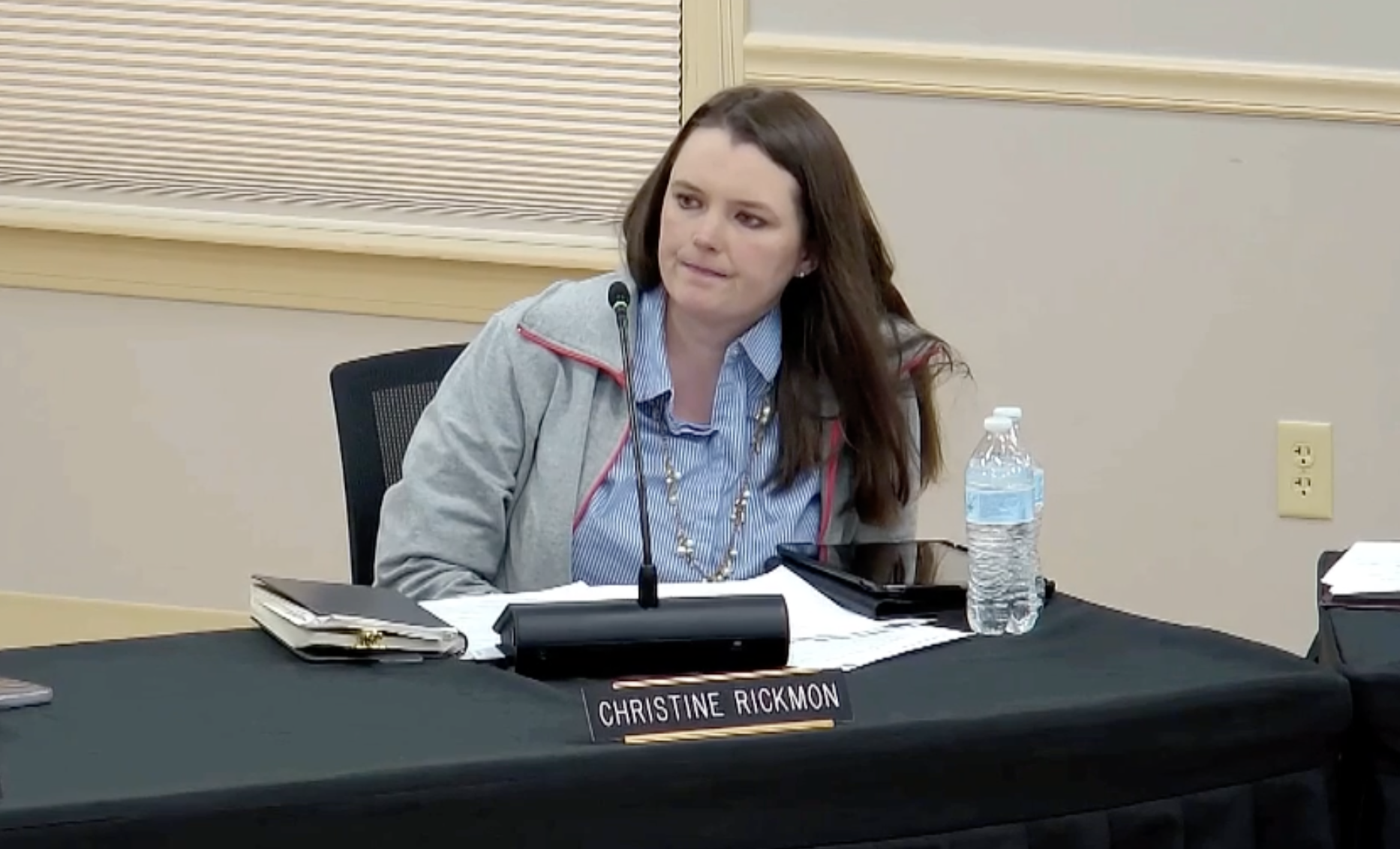
That’s how long Agawam City Councilor Christine Rickmon alleges that her colleague, Council President Anthony Russo, gave her to decide whether or not she was going to apologize to the city’s police chief.
The reason she said she was pressured to say “sorry”? According to Rickmon, it was for asking pointed questions about Agawam’s contract with a controversial surveillance technology firm: Flock Safety, which sells automated license plate readers to police departments nationwide. She said Russo told her the police department had complained that Rickmon’s tone was problematic and that she had been “interrogating” the department’s chief, Eric Gillis.
Rickmon refused to back down. “I’m not apologizing for doing my job,” she told The Shoestring. “I was elected to ask hard questions.” Neither Russo nor Gillis responded to requests for comment.
Across the region and country, elected officials like Rickmon have begun interrogating the role of Flock’s license plate readers, which function like cameras, capturing images of every vehicle that drives past them and then using AI algorithms to store unique data about them. Police often say they love the devices.
“So far, for us, Flock has been a godsend in giving us investigative leads that we otherwise wouldn’t have had,” Gillis told Agawam city councilors during a June meeting. “We’re not tracking everybody. I’m going to be honest with you — we don’t have the time.”
The Shoestring relies on reader support — not corporate owners or paywalls — to make independent news for western Massachusetts possible. If you value independent local journalism, please consider making a tax-deductible donation.
But the devices, which companies like Axon and Motorola Solutions also make, have come under increasing scrutiny from civil libertarians and residents of communities where police are using them. They say they’re concerned about the creeping surveillance they represent. They track and store information about people’s movements, regardless of whether police have a warrant or suspect that person of any wrongdoing. Some reporters have also uncovered police misuse of the technology — to stalk people, for example. And police have searched cameras nationwide, including in western Massachusetts, to assist federal immigration agents.
Amid those concerns, news articles chronicle the growing movement of municipal leaders questioning the technology in places like Tennessee, New Jersey, California, and Ohio, where in the city of Dayton, city workers put plastic bags over them after the city suspended their use. Others have taken a more aggressive approach: vandalizing the cameras in cities nationwide.
In Massachusetts, municipalities in the eastern part of the state like Littleton, New Bedford, Salem, Framingham, and Cambridge have now paused their use of the devices or severed ties with Flock completely amid the controversy.
“It’s a really dangerous idea for police to be sharing this information so widely, because they functionally cannot ensure that the information is not being misused or abused,” said Kade Crockford, the director of the justice and technology program at American Civil Liberties Union of Massachusetts.

A movement has now begun coalescing around the demand to kick Flock out of town. In western Massachusetts, some municipalities have already done that, including Easthampton, where earlier this year city councilors cut funding for the technology as they looked to trim costs amid a budget crunch.
However, a Shoestring investigation has found that at least 10 other western Massachusetts police departments have used Flock’s technology this year: Springfield, West Springfield, Holyoke, Hadley, Ludlow, South Hadley, Greenfield, Agawam, Monson, and Montgomery. The Hampden County Sheriff’s Office and Springfield College Police Department have also made searches of Flock devices, according to data obtained through public records requests.
Amid the technology’s proliferation, activists are organizing to push back. This week, people across the country associated with the organization DeFlock are holding a week of action against automated license plate readers.
In Massachusetts, the effort is being led by the Muslim Justice League, who held an art build for the week of action last Sunday. They also plan on holding a “spy hunt” to train activists on how to identify automated license plate readers, as well as help people map new ones installed by the Boston Regional Intelligence Center.
Fatema Ahmad, organization’s executive director, told The Shoestring that surveillance technologies have been tested on Muslims in the United States for the past quarter century. More recently, those same tactics have been turned on pro-Palestinian activists, protesters against Immigration and Customs Enforcement, and others, she said.
“When the genocide in Gaza started, one of the first things I said is, ‘Now that other people are being treated like terrorists, then they might start to care about what’s been happening to Muslims under the War on Terror,’” she said.
Now, the Trump administration has begun calling others terrorists, too, like trans people. And Flock’s CEO, Garrett Langley, has even referred to groups like DeFlock as “terroristic organizations.” He has since apologized for those remarks.
“The point of that terminology is to crush dissent and to make people seem like they are extreme or violent for responding to the violence of the government,” Ahmad said. “So it’s not surprising to hear the Flock CEO say that because he’s clearly threatened by people who are organizing against this kind of surveillance tech.”
Flock did not respond to The Shoestring’s request for comment for this article.
Ahmad first heard of automated license plate readers in 2018, when the Boston Police Department was found to have them in use. Since then, as the devices have proliferated, the Muslim Justice League has organized events like a bike ride around Cambridge to show people what they look like. She said that under the Trump administration, people concerned about the cameras being used to target immigrants have joined the anti-surveillance movement, too.
Flock cameras have been all over the media and culture in recent months, which Ahmad said has mobilized people to fight back against surveillance tech. But she noted that other major companies sell automated license plate readers, too. .
“If you are just playing whack-a-mole — going after like one piece of technology or one brand — you’re gonna beat your head against a wall,” Ahmad said.
It can be hard to get information about where Flock devices and other license plate readers are located. In Agawam, for example, police have said that revealing the location of the devices would risk public safety. And Rickmon, who was asked to apologize so quickly to the police department, said it took police weeks to respond to her own inquiries.
But some activists think that knowing that information is a fundamental right under the Fourth Amendment, which protects people from unreasonable searches and seizures.
That’s where the organization DeFlock enters the picture. A grassroots, decentralized group, DeFlock seeks to increase awareness about Flock cameras in neighborhoods by allowing its users to crowdsource the locations of those devices.
Tessa Merill is a western Massachusetts resident who is part of the open-source mapping project. She said that police should not have the ability to track and trace people, and that their ability to do so on the level that Flock allows is “unconstitutional.”
“Private businesses shouldn’t be allowed to have that technology. Police shouldn’t be allowed to have that technology,” Merrill said. “People should be allowed to roam freely without being worried about being tracked and being surveilled.”
Merrill first started mapping the cameras nearly a year ago, noticing them as she was driving around the area. Merrill is concerned that Flock cameras can be used to track vulnerable groups, like immigrants and women seeking reproductive care.
DeFlock’s map allows users to see where the devices have been placed in the past.
In Holyoke, for example, most of the Flock camera locations that users crowdsourced on DeFlock were placed around the Holyoke Mall. The Shoestring was able to identify two Flock devices near the mall, though it’s unclear whether they’re the police department’s devices or privately owned. Holyoke police did not respond to an interview request. Flock data obtained through a public records request do show that the Holyoke Police Department made multiple searches of license plate readers in order to look for people alleged to have shoplifted from stores in the mall.
Other license plate readers in the city are set up in Ward 1 and Ward 2, according to the DeFlock map. According to U.S. Census data, those are among the poorest neighborhoods in the city where the vast majority of people identify as Hispanic or Latino.

The ACLU has been at the forefront of activism against Flock in particular. The organization has put out a “Get the Flock Out” toolkit for people wanting to get automatic license plate readers out of their communities, including model legislation and suggestions for activism around the issue.
“Stuff that’s justified under the rubric of fighting terrorism ends up being used by police to engage in routine policing, which historically means targeting people of color,” Crockford, the ACLU of Massachusetts technology expert, told The Shoestring.
Like Ahmad, Crockford drew a connection between the current proliferation of surveillance technology and the War on Terror.
“All of those new powers and tools and technologies and authorities gained during the War on Terror were just used to fight the War on Drugs,” Crockford said. “Because that’s really the bread and butter of American law enforcement. That’s what keeps the lights on. That’s what pays the bills. That’s what drives the vast majority of proactive policing in the United States.”
Regular citizens have found success pushing back against the presence of automated license plate readers in their communities.
Mike Lynch is a resident of Easthampton who was researching the city’s budget earlier this year as voters got ready to vote on a property-tax override to fund essential services. He noticed that the police department’s budget didn’t specify what technology it was spending money on, so he filed a public records request and discovered that the city was paying $6,000 yearly for Flock devices. He had previously read news articles about the license plate readers.
“I thought they were pretty bad,” he said. “It’s pretty invasive and undermines civil liberties, so I was not happy that taxpayer money was going to Flock cameras.”
Lynch isn’t connected to DeFlock or any other groups resisting Flock, and he said he doesn’t interact much with local politics. So he didn’t really know how to go about opposing them. But he believes in open data and transparency, so he requested data from Easthampton police on how they were using the Flock devices and then published the information to a website he created. He found that the department was sharing more data than the city realized — findings he then put in front of elected officials.
“I got kind of lucky because there was a lot of tension on the budget, so even $6,000 … is not nothing,” he said. “They were looking to make cuts wherever they could.”
And that’s what they did. After Lynch’s actions, city councilors voted to cut that $6,000 from the budget. Easthampton’s police chief has since said that the city has ended its contract with Flock and removed the cameras, though Lynch said he’s filed a public records request to confirm that.
“I think people are seeing centralization of power with Big Tech and companies that use AI and I think people find that scary,” he told The Shoestring. “It’s becoming more tangible the ways that surveillance companies can misuse all that data.”
Residents in other communities, like Agawam, are trying to emulate the kind of success Lynch had.
“Flock is not a camera or security company,” Jackson Zampiceni, an Agawam resident who works in cybersecurity, said during a June City Council meeting. “It’s a data company. The product that they are selling, and the product that they need to maintain access to to stay in business, is our data.”

divina is an independent reporter covering labor and social movements, pursuing a degree in journalism and social thought & political economy at UMass Amherst. They have worked for three years in legislation, policy, and research on education, child welfare, and race equity. Reach them at divina.cordeiro@proton.me or on Instagram and Twitter @divi_cordeiro

Dusty Christensen is The Shoestring's investigations editor. Based in western Massachusetts, his award-winning investigative reporting has appeared in newspapers and on radio stations across the region. He has reported for outlets including The Nation magazine, NPR, Haaretz, New England Public Media, The Boston Globe, The Appeal, In These Times, and PBS. He teaches journalism to future muckrakers at Smith College. Send story tips to: dchristensen@theshoestring.org.