


This story was produced with support from the Markham-Nathan Fund for Social Justice.
Earlier this month, when Massachusetts released its latest drought map, the picture was one that has become familiar over the last half year: swaths of the state, including the Connecticut River Valley, colored ominously in dark orange.
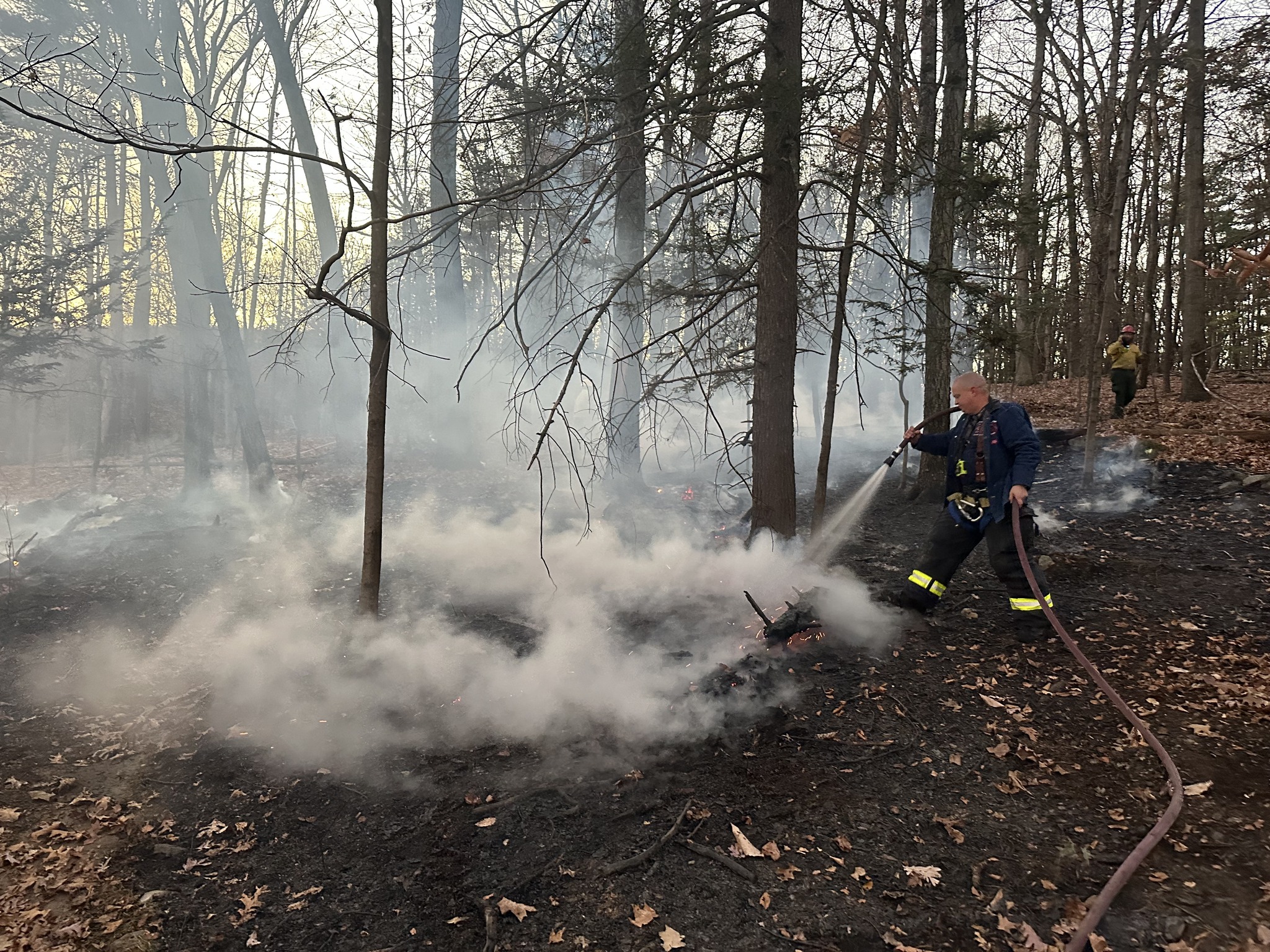
The region is again facing a critical drought as spring approaches, the map warned. That, in turn, raises the risk of wildfires. If that sounds familiar, it’s because the same was true this past fall, when fires raged across drought-stricken Massachusetts in a historically bad fall fire season. As climate change fuels record-breaking heat on a yearly basis — last year was the hottest on record nationwide and the third-warmest in Massachusetts — those conditions have become the new normal.
“Initial projections are certainly showing that there will be a greater likelihood of droughts in the future,” Vandana Rao, the director of water policy at the state’s Executive Office of Energy and Environmental Affairs, said in a March 7 press briefing. She said that seven out of the last nine years have had at least six months of drought. “This is kind of unusual for Massachusetts if we go back and trace hydrological conditions over the last 60, 70, 80 years.”
Despite the rise in drought likelihood, though, climate scientists have said that climate change is expected to bring more, not less, precipitation to the region on average. It was only in 2023 that massive floods swept through western Massachusetts, making it one of the region’s wettest years on record. More than 21 inches of rain dropped on Conway that July, for example, a month in which many local communities set rainfall records. Since 1958, the U.S. northeast has seen around a 60% increase in the number of days with extreme precipitation, according to the Northeast Regional Climate Center. That’s the largest such increase of any region in the country. The storms have become more intense, too.
So what gives? Why the two extremes — heavy rainfall and recurrent droughts — as temperatures in western Massachusetts continue to rise?
Climate scientists say that it’s all part of a pattern of “climate whiplash” directly connected to global heating. And as climate-change denying President Donald Trump and his administration roll back environmental regulations, green energy funding, and support for climate adaptation, those experts fear the whiplash is only going to get worse.
As humanity’s use of fossil fuels continues unabated, experts are documenting what some have called “global weirding” — extreme swings between wet and dry weather. Regions worldwide are seeing increased hydroclimate volatility, as it’s called in the scientific literature. A study published in January in the journal Nature Reviews Earth & Environment found that globally, since the mid-20th century, that kind of whiplash has increased by between 31% and 66%. The researchers found those swings are anticipated to grow even larger as the climate warms.
“Increases in hydroclimate volatility will amplify hazards associated with rapid swings between wet and dry states (including flash floods, wildfires, landslides and disease outbreaks), and could accelerate a water management shift towards co-management of drought and flood risks,” the study says.
Local climate scientists say that those patterns are impacting western Massachusetts, too, creating the conditions for more flooding and, perhaps counterintuitively, more droughts and wildfires, too.
“A warmer atmosphere can hold and release more moisture and that’s what we’ve seen,” University of Massachusetts Amherst climate scientist Michael Rawlins said. “At the same time, everyone must be cautious during these dry stretches because the risk of wildfire is present at times.”
Those conditions pose a big risk for everyone from local farmers to people living in flood zones or environments susceptible to wildfire. However, experts have long warned that socially vulnerable populations such as small-scale farmers, the unhoused, and immigrant workers will bear a disproportionate burden of climate change’s impacts — a phenomenon that was immediately visible during 2023’s floods.
***
Rawlins often finds himself analyzing climate data from the northeast. He said that looking at a century of data for Massachusetts, a trend has begun to emerge of growing whiplash between really dry and really wet weather, particularly in the summer.
“That has really become evident in the last two decades,” he said.
The Shoestring relies on reader support to make independent news for western Massachusetts possible. You can support this kind of labor-intensive reporting by visiting our donate page.
At the moment, that means drought and an increase in wildfire risks. And although the rainfall in recent days was a welcome respite, it likely didn’t wipe away those conditions entirely. Rao, the state water-policy expert, said that since August, water levels in much of Massachusetts were around eight to 12 inches below average.
“When groundwaters and stream flow are so low, and precipitation totals are so low, it really is going to take more than a few small events to start to bring us back to normal,” she said.
The National Weather Service Climate Prediction Center’s eight-to–14 day outlook does predict “good chances for a warmer and wetter weather pattern later in March.”
“This should continue to decrease dryness and improve drought conditions, but it may not completely eliminate the fire risk or water resource challenges for all locations,” the March 14 update said.
Although a warming climate in New England is anticipated to bring more precipitation, a warmer atmosphere is also more “thirsty,” Rawlins explained. The warmer a climate is, the more water it can draw from the soil through evaporation and from plants through what’s known as transpiration. Those two processes are, together, known as evapotranspiration.
A 2018 U.S. Department of Agriculture report assessing New England’s forest ecosystem’s vulnerability in the face of climate change found that “if temperature and evapotranspiration increases overwhelm modest precipitation increases, conditions supporting wildfire may become more frequent.”
“This may be particularly important during the spring and fall where wildfire conditions are more common,” the report said. Climate change’s climate impacts on invasive species and forest pests and diseases could also play a role, the report added. “In addition to the direct effects of temperature and precipitation, increases in fuel loads from pest-induced mortality or blowdown events could increase fire risk, but the relationship between these factors can be complex.”
Dave Celino is the chief fire warden for the state’s Department of Conservation and Recreation. He told The Shoestring that in recent years, fire season has begun to arrive earlier in March than in the past. He said another trend fire experts have noticed is that larger wildfire fuels like big logs, which typically hadn’t been dry enough to burn at this time of year, are now beginning to burn.
“And those are the heavy fuels that carry fires and cause those larger fires to burn on end for days or weeks at a time in the fall,” he said, though he added that springtime fires are easier to contain because of the still cold or frozen ground.
When asked if the trend of drier fuels concerns him, Celino said that the state is working to prepare and adapt.
“It’s intelligence that we use in the fire management business,” he said. “It can be concerning to us but what happens is that it allows us to be ready. We’re not taken by surprise.”
However, climate scientists are concerned that the Trump administration’s policies of climate-change denialism and slashing large parts of the federal government will only accelerate those dangerous trends and leave society ill-prepared to handle the climate’s volatility.
***
The expansion of fire season into earlier in the spring and fall presents a big climate-change adaptation burden for those living in the region, according to Mount Holyoke College climate scientist Shaina Sadai.
“In the fall, with all of the 600+ wildfires that we had in Massachusetts, one of the big things was that the fire departments are much more used to responding to structure fires than wildfires,” Sadai said. “If we’re going to have this trend toward more variability and more seasons with heightened wildfire risks, then part of adaptation measures means we need to have training available for firefighters” to deal with those fires.
Sadai said communities in western Massachusetts and elsewhere also need the work of climate researchers in order to accurately forecast what lies ahead as the region gets hotter.
“We need to have funding for climate research to understand the changes that are happening and the changes that will happen in the future,” she said.
The problem, Sadai said, is that Trump is slashing scientific funding for climate research, dismantling the Environmental Protection Agency, and firing workers at NASA and the National Oceanic and Atmospheric Administration, which forecasts wildfires among other vital climate-related work. As one example, Sadai pointed to the administration’s canceling of National Fire Academy courses as part of its funding freezes and staffing cuts. Last month, ProPublica reported that other federal agencies on the front lines of wildfire prevention and response have been hamstrung by the administration’s cuts.
“The cancellation of these federal training programs is a huge risk for communities that need this training,” Sadai said. “This is an incredibly dangerous situation that works against the adaptation measures that we need.”
Some of Trump’s cuts have already had an immediate impact on western Massachusetts.
Last month, the Ashfield-based Foxtrot Farm posted on social media that the Trump administration had pulled climate-smart farming funding from them and hundreds of other farms in the region. For Foxtrot Farm, that means the loss of $35,000 that would have helped them fund practices like putting up fences to keep out deer, planting perennials to block wind, and maintaining grasses to prevent erosion.
“They are called ‘climate smart’ practices, because they are helpful in adapting to extreme weather events, which — whether or not you believe the widespread scientific consensus around human-caused climate change — any farmer can tell you are getting more and more common and severe every year,” the farm’s post read.
Earlier this month, the Trump administration also named the Natural Resources Conservation Service office in Amherst and the U.S. Fish and Wildlife Northeast office in Hadley as among those it intended to shutter.
“It’s just this perfect storm: the earth is on fire and all of the supports that were in place to ensure farmer viability are getting pulled out from underneath them,” said Erin Ferrentino, the food access manager at Grow Food Northampton.
Ferrentino said that Grow Food Northampton’s 121-acre community farm is in a 100-year floodplain, meaning under previous conditions it should flood only once a century. However, the Mill River has spilled its banks and flooded the farm three times in 18 months, they said. Farming is already an industry with lots of uncertainty, they added, from weather to commodity prices.
“There’s just this deluge of really unpredictable weather events and there’s no government support, subsidies and funding are being cut,” they said. That includes food assistance for low-income families and millions of dollars in U.S. Department of Agriculture awards meant for buying local food from socially disadvantaged farmers.
Sadai said that in addition to adaptation measures, what is needed now is collective resistance to the policies of Trump, his appointees, and his wealthy backers.
“We need people to focus on holding their elected officials accountable,” she said. “We really have not seen enough coordinated resistance from elected Democratic officials.”
In the meantime, the state may still face increased wildfire risks in the coming weeks. Celino, the state fire warden, pointed out that all of the big wildfires in the fall were human-caused. He urged people to pay attention to their surroundings, from how much the wind is blowing to what’s around them.
“If you’re going to be burning brush or you have a camp fire, have a source of water there,” he said. “And then when you go to put it out, make sure it’s completely out to the touch and don’t leave it unattended.”
Looking at the bigger picture, Rawlins, the UMass Amherst climate scientist, said that “it’s important to stay the course in these turbulent times.” He noted that the world’s 10 warmest years have all occurred in the past decade.
“Renewable energy is our future,” he said. “Despite some headwinds that we may experience in the next few years, we need to remain committed to reducing our reliance on fossil fuels and embracing a more sustainable future.”

Dusty Christensen is The Shoestring's investigations editor. Based in western Massachusetts, his award-winning investigative reporting has appeared in newspapers and on radio stations across the region. He has reported for outlets including The Nation magazine, NPR, Haaretz, New England Public Media, The Boston Globe, The Appeal, In These Times, and PBS. He teaches journalism to future muckrakers at Smith College. Send story tips to: dchristensen@theshoestring.org.
- Dusty Christensen
- Dusty Christensen
- Dusty Christensen
- Dusty Christensen
- Dusty Christensen
- Dusty Christensen
- Dusty Christensen
- Dusty Christensen
- Dusty Christensen
- Dusty Christensen
- Dusty Christensen
- Dusty Christensen
- Dusty Christensen
- Dusty Christensen
- Dusty Christensen
- Dusty Christensen
- Dusty Christensen
- Dusty Christensen
- Dusty Christensen
- Dusty Christensen
- Dusty Christensen
- Dusty Christensen
- Dusty Christensen
- Dusty Christensen
- Dusty Christensen
- Dusty Christensen
- Dusty Christensen
- Dusty Christensen
- Dusty Christensen
- Dusty Christensen
- Dusty Christensen
- Dusty Christensen
- Dusty Christensen
- Dusty Christensen
- Dusty Christensen
- Dusty Christensen
- Dusty Christensen
- Dusty Christensen
- Dusty Christensen
- Dusty Christensen
- Dusty Christensen
- Dusty Christensen
- Dusty Christensen
- Dusty Christensen
- Dusty Christensen
- Dusty Christensen
- Dusty Christensen
- Dusty Christensen
- Dusty Christensen
- Dusty Christensen
- Dusty Christensen
- Dusty Christensen
- Dusty Christensen
- Dusty Christensen
- Dusty Christensen
- Dusty Christensen
- Dusty Christensen
- Dusty Christensen
- Dusty Christensen
- Dusty Christensen
- Dusty Christensen
- Dusty Christensen
- Dusty Christensen
- Dusty Christensen
- Dusty Christensen
- Dusty Christensen
- Dusty Christensen
- Dusty Christensen
- Dusty Christensen
- Dusty Christensen
- Dusty Christensen
- Dusty Christensen
- Dusty Christensen
- Dusty Christensen
- Dusty Christensen
- Dusty Christensen
- Dusty Christensen


