

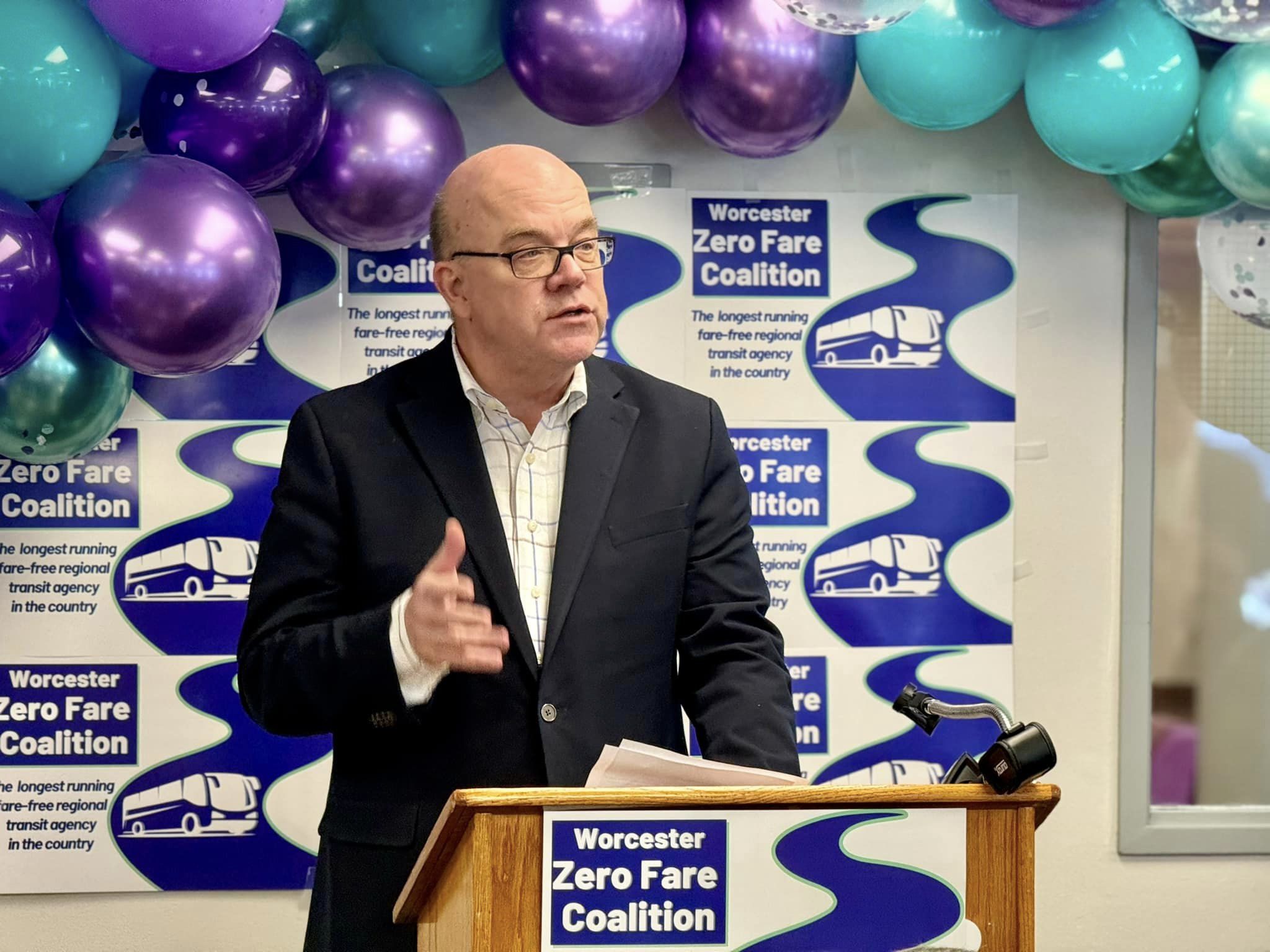
In 2019, U.S. Rep. Jim McGovern made a pledge that made headlines across the region: he was done taking money from corporate political action committees. As the chairman of the influential House Committee on Rules, he became the first committee chair in the U.S. House to make that commitment.
A member of the Congressional Progressive Caucus, McGovern has long spoken out in favor of campaign finance reform. When he made his announcement in 2019, he wrote in a CNN article that one of his first speeches in Congress was about how “unregulated contributions were threatening to undermine our democracy.” Going forward, he said he would still take money from political action committees, or PACs, representing labor unions, but he said at the time that he was done with corporate PAC cash.
“Our system is rigged to favor those at the top,” McGovern wrote. “And I believe the perception of corruption, even where it doesn’t exist, must be addressed if we’re going to restore faith in our government. My constituents want me to lead by example – and I will.”
However, federal records show that while McGovern is keeping to that pledge to avoid corporate PAC money, cash from business interests has continued to trickle into McGovern’s campaign coffers this election cycle. The source? Trade associations and other industry groups representing some of those same special interests. It mirrors a trend that has played out in other states, too, including Vermont and Maine, raising questions about the gaps that exist in the pledges progressive Democrats have made to avoid corporate PAC money.
The vast majority of McGovern’s fundraising continues to come from individuals and PACs associated with labor unions. Of the $900,502 that McGovern raised from the beginning of 2023 through Sept. 14, 2024, 72% of that has come from individual donations. The Shoestring has also identified at least $125,000 in funds from PACs representing organized labor — unions from the National Association of Letter Carriers to the International Brotherhood of Teamsters.
“The first three words of the constitution are ‘we the people’ not ‘we the corporations,’” McGovern told The Shoestring in a phone interview Friday. He said he’s proud of his record on campaign finance reform and representing regular people over business interests. “Unions represent workers, people who are trying to change things. Corporations are just trying to make money for their stakeholders.”
But McGovern is still receiving money from some of the trade associations and other lobbying groups they belong to.
This election cycle, for example, federal campaign finance filings show that McGovern has taken donations from trade-associations, membership organizations, and cooperative PACs representing sugar growers, alcohol manufacturers and distributors, convenience stores, insurance interests, the nursing-home industry, powerful legal and lobbying firms, medical device makers, grocery giants, and others.
One of the special interests that has given to McGovern through its membership associations this election cycle has been the sugar industry.
Federal Election Commission data show that McGovern has received at least $20,000 from out-of-state trade associations representing sugar growers across the country. That includes $10,000 from the American Crystal Sugar Company’s PAC, $2,500 from the Michigan Sugar Company Growers PAC, $2,000 from the American Sugar Cane League PAC, $1,500 from the Amalgamated Sugar Company PAC, and $1,000 each from the PACs representing the Western Sugar Cooperative, Southern Minnesota Beet Sugar Cooperative, Florida Sugar Cane League, and American Sugarbeet Growers Association.
McGovern sits on the House Committee on Agriculture, which has jurisdiction over the federal government’s agriculture policy.
McGovern defended those donations, saying that he has long advocated for more access to locally grown food, better nutrition education, and support for farmers. He said that at a time when the country is importing staples like sugar “from halfway around the world that can be grown halfway down the block,” he welcomes the support of those who agree with his values.
Sugar isn’t the only industry group giving to McGovern, though. He has received $5,000 from the National Beer Wholesalers Association’s PAC, for instance. The NBWA is an organization whose members include beverage giants like Molson Coors Beverage Company and Anheuser-Busch.
McGovern has also pulled in $5,000 from the Council of Insurance Agents and Brokers PAC, whose website boasts that its membership includes “200 of the top commercial insurance and employee benefits brokerages worldwide.” He also received $2,500 each from the PACs associated with the American Property Casualty Insurance Association — representing home, auto, and business insurers — and the American Council of Life Insurers PAC, whose members include that industry’s top players. Among them is the Massachusetts Mutual Life Insurance Company, based in Springfield.
Those organizations are not considered corporate PACs under the Federal Election Commission’s classification, since they represent trade associations, cooperatives, or other membership associations. However, the members and donors to those trade associations are often big corporate interests. The Consumer Brands Association, for example, gave $3,000 to McGovern this election cycle. Its members include companies like Amazon, Nestlé, and Procter & Gamble, to name a few.
When asked whether lawmakers not accepting corporate PAC money should consider including corporate trade associations in that pledge, McGovern instead focused on larger structural changes to campaign financing. He said that the current system, which often requires politicians to spend millions of dollars on their races, undermines democracy and forces lawmakers to spend too much of their time fundraising.
“The ground rules are what they are and I don’t like them,” he said. “But the bottom line is that we need campaign finance reform and I think we ought to talk about how we get that.”
Some of the trade associations that gave to McGovern have come under scrutiny after continuing to give campaign contributions to election deniers in the Republican party, according to research from the campaign finance watchdog organization OpenSecrets. In 2022, for example, the organization Citizens for Responsibility and Ethics in Washington identified American Crystal Sugar as one of the top contributors to members of Congress who refused to certify Donald Trump’s election loss.
Powerful law firms that represent big corporations or lobby on Capitol Hill have also given money to McGovern this election cycle. Those include $3,000 from the PAC of the multinational firm King & Spalding, which has drawn controversy for decisions like representing Trump in 2020 in one of his election lawsuits and initially agreeing to work with Republicans in 2011 to fight against same-sex marriage. The PAC of Squire Patton Boggs, one of the world’s largest law firms, gave McGovern $5,000. Both of those firms have lobbied on behalf of Saudi Arabia’s government, according to reporting by Mother Jones.
McGovern said that those massive law firms take clients across the political spectrum, including those fighting for good causes. He also highlighted his decades-long advocacy for LGBTQ+ issues. McGovern was one of the lawmakers who helped bring forward a bill to overturn the Defense of Marriage Act, which prohibited same-sex marriage. He has also been vocal in condemning insurrectionists in Congress and has worked in the past to prohibit arms sales and military support to Saudi Arabia because of that country’s human-rights abuses.
McGovern is not alone among progressive Democrats who have pledged not to accept corporate PAC money but have continued to take cash from business trade association PACs.
In 2022, VTDigger reported that Vermont’s U.S. Rep. Peter Welch, who was running for the U.S. Senate, had likewise taken campaign contributions from powerful industry groups that lobby Congress. The state’s Lt. Gov. Molly Gray, who had run to replace Welch in the U.S. House, had also taken money from the American Crystal Sugar Company PAC like Welch, the news outlet reported.
“American Crystal Sugar is responsible for contributing to climate change with policy and practices that cause environmental destruction,” one of Gray’s opponents, state Sen. Kesha Ram Hinsdale, wrote in a campaign fundraising email at the time, according to VTDigger.
This year, Maine saw a similar trend. There, the news organization Maine Wire identified similar contributions to U.S. Rep. Jared Golden, who will face Trump-endorsed Republican state Rep. Austin Theriault in November.
McGovern said that instead of focusing on progressive lawmakers like Welch, people should work together to create a system that allows for people-powered elections rather than the corporate-dominated status quo. That means supporting and voting for candidates who want to make change.
“Get with us and let’s get more people to make the no corporate PAC pledge,” he said. “Let’s start building a movement for real honest campaign finance reform in this country.”
McGovern said he’s proud that his campaign is largely funded by individual donors. But money from special interests can also flow into a candidate’s campaign account through individual donations, too. For example, OpenSecrets, which tracks the employers of individuals who donate to political campaigns, found that lobbyists have given $54,450 in individual contributions to McGovern’s campaign this election cycle.
With all that campaign cash, what is McGovern — whose only opponent this election cycle, independent Cornelius Shea, hasn’t reported any fundraising at all — spending it on?
Of the more than $1 million he has spent this cycle, FEC records show he has sent $350,000 of it to the Democratic Congressional Campaign Committee, which works to elect Democrats to the U.S. House. The DCCC has in recent years worked to stifle progressive challenges to incumbent Democrats. In 2019, the organization instituted a blacklist of any vendor who worked for somebody challenging a Democrat incumbent. The DCCC ended that policy in 2021, but this election cycle, high-ranking former DCCC officials have worked for more conservative Democrats that unseated progressive incumbents, according to The American Prospect.
McGovern said that he doesn’t micromanage who the DCCC supports and that he may not always agree with those candidates on every issue. But he said that it is important for Democrats to take back the U.S. House. He noted that when Democrats were last in charge of the House, he was able to use his perch as chairman of the House Committee on Rules to hold the first-ever hearing on Medicare for All. He said he also supports progressive candidates with donations to their individual campaigns.
“If you want change, you have to make sure that you’re electing people who can create an atmosphere where you can actually implement that change,” he said.
McGovern’s campaign has spent $200,675 on solicitation and fundraising expenses this election cycle. Another $186,210 was used for administrative, salary, and overhead, and the campaign spent $178,472 on travel.
When McGovern was first elected to the House in 1996, he said he defeated the state’s last Republican representative and then faced a tough challenge from a Republican the next year. However, since then, McGovern has rarely faced any serious challenge to his incumbency, winning landslide victories in nearly every contested election. Asked why he continues to raise so much campaign cash, he said he doesn’t know when an election cycle starts whether somebody will challenge him or not.
“I’m not universally loved and every couple years there are rumors that very high ranking people in the Republican Party want to take me on,” he said.
McGovern said that Republicans “have no interest at all in campaign finance reform” and that only a Democratic majority can address the Supreme Court’s weakening of democratic elections, for example.
“It’s important that people have confidence in campaigns and in their elections,” he said.
This article is part of U.S. Democracy Day, a nationwide collaborative on Sept. 15, the International Day of Democracy, in which news organizations cover how democracy works and the threats it faces. To learn more, visit usdemocracyday.org.

The Shoestring is committed to bringing you ad-free content. We rely on readers to support our work! You can support independent news for Western Mass by visiting our Donate page.

Dusty Christensen is The Shoestring's investigations editor. Based in western Massachusetts, his award-winning investigative reporting has appeared in newspapers and on radio stations across the region. He has reported for outlets including The Nation magazine, NPR, Haaretz, New England Public Media, The Boston Globe, The Appeal, In These Times, and PBS. He teaches journalism to future muckrakers at Smith College. Send story tips to: dchristensen@theshoestring.org.