


When member owners of the River Valley Co-op convene for a special meeting on Oct. 30, the vote they take will represent a first in the consumer-owned grocery’s history.
At that meeting, and in the weeks leading up to it, the co-op’s 16,500-odd member households will be casting ballots to voice their opinion on whether the store should deshelve products made in Israel because of the country’s invasion, bombardment, and blockade of Gaza. Store officials say it’s the first official, concerted attempt owners have ever made to remove items from the co-op, which first opened in Northampton in 2008 after nearly 10 years of prior organizing.
In its petition, the Campaign for an Apartheid-Free River Valley Co-op has called on the store to align store policies with its collective values by removing “products that support Israeli apartheid and the continued oppression of the Palestinian people.”
“As people of conscience, we have been moved to action by the ongoing violence in Palestine,” the petition says. “Some of us are intimately affected by this violence through our families and loved ones, while others of us are connected through our cultural histories. All of us, however, are united by the understanding that the struggle for justice starts with ourselves.”
However, the co-op’s leadership have come out firmly against the boycott effort. In an email to members, the store emphasized that the vote is a non-binding advisory poll. And while acknowledging that product choices are “highly influenced by customer requests” and purchases, the email states that those choices “are not member decisions and are not eligible for a member vote.”
“This petition has become the most divisive and challenging issue the Co-op has ever faced and is counterproductive to fostering cooperation and peace in our community and our co-op,” the email said.
The campaign comes amid Israel’s continued invasion and bombing campaign in the Gaza Strip in response to a Hamas attack on Israel last October that killed 1,195 people. Palestinian health authorities have found that Israel has directly killed over 41,500 people in the past year, the majority of them women and children. However, some experts say that is likely an undercount. A recent article in the peer-reviewed medical journal The Lancet found that even by conservative estimates, Israel’s campaign may have killed upwards of 186,000 people when indirect causes like disease and lack of food are included in the count. A United Nations’ human-rights official and others have concluded that Israel is engaged in genocidal acts.
Given the United States’ role in providing weaponry and diplomatic support for Israel’s actions, some co-op owners and staffers are calling on the store to join the longstanding, Palestinian-led Boycott, Divestment, and Sanctions movement, or BDS, which seeks to hold Israel accountable for its treatment of Palestinians. The Campaign for an Apartheid-Free River Valley Co-op petition acknowledges the store’s recent statement calling for a ceasefire in the conflict and asks its community to go a step further and boycott Israeli products.
“It’s a time-tested strategy for nonviolent resistance, from the Civil Rights Movement to apartheid South Africa,” said Ian Petty, one of the member-owners organizing the campaign. He said organizers began their BDS campaign at the co-op because of what they saw as its social justice values and democratic nature.
However, the activists said they have been surprised at the amount of pushback from the co-op’s board of directors and management. Online voting on the proposal began on Sept. 30, and soon after, store leadership came out against it. In addition to emailing members calling the campaign “divisive” and urging them to vote against it, the store has set up a weekly reminder for those who haven’t yet voted. Staffers who support the campaign also said that managers have asked them to remove pro-Palestine pins — requests that the unionized workers are able to decline.
“They’re responding to this campaign as if it’s a whole entire separate issue rather than just removing harmful products from the co-op, which in different kinds of frameworks they’ve already done,” said Molly Merrett, a local organizer with Jewish Voice for Peace who has been a member-owner since 2010. She said organizers were taken aback when leadership stressed that the vote was only advisory in nature. “In some ways that took the wind out of our sails a little bit. We thought it was a democratic business and that member owners had a say in certain decisions.”
In a sit-down interview with The Shoestring, co-op General Manager Rochelle Prunty and board President Abby Getman Skillicorn said that they respected individual co-op members’ decisions whether or not to boycott Israeli products. However, they said they were dismayed that the campaign began without prior communication with store leadership and not long after the co-op had signed onto a statement calling for an “immediate and sustained ceasefire, compliance with international humanitarian law, release of all hostages, and an end to the blockade of humanitarian aid to the 2.3 million people living in Gaza.”
“To have some of the response to a statement for peace then be really active organizing critiquing the co-op — that we’re not going far enough, or making demands without engaging — felt like a big challenge,” Getman Skillicorn said. She said that statement came with a $1,000 contribution to the local group Healing Across the Divides, which the National Co+op Grocers matched with a $1,000 to the Gaza Family Relief Society.
Prunty said that the store’s management and its board have a fiduciary responsibility to look after what’s best for the entire organization in an industry that has become even more financially challenging after the COVID-19 pandemic began.
“We’re very fragile as a business, we’re vulnerable to economic downturns,” Prunty said. “But we’re also very powerful in the impact that we can have,” she added. For example, the co-op has a large impact on the local farms and agricultural workers it supports, she said.
However, because of the “deeply personal and painful” nature of the conflict, Prunty said the co-op now finds itself between members lining up on both sides of the issue, even saying they’ll boycott the store if it makes a decision one way or another.
“All of this community hurt and pain is kind of focused on whether we have a few items on our shelves from Israel,” she said. “The board has the responsibility and the role to look at that and say, ‘OK, what’s best for our co-op?’ And make a recommendation and then, through an advisory poll, check in on their recommendation.”
Activists have identified at least six products at the co-op that they said are made in Israel, including four types of tahini, tampons, and bulk Israeli couscous.
Getman Skillicorn said that anti-Semitism has been on the rise nationwide, including in Massachusetts, and that some co-op members have told the board and managers that they view the BDS campaign at the co-op as anti-Semitic. Prunty said that management has a policy against buttons with slogans people “consider offensive,” and for that reason they have disapproved of workers’ Palestine-related buttons.
“Some of those buttons, shoppers were vocalizing they felt them as threatening around Rosh Hashanah,” Getman Skillicorn said.
Campaign organizers say there’s nothing anti-Semitic about wanting Israel to comply with international law and proposing a boycott of the country’s products until it does so. Mona Shadi, an Egyptian-American employee of River Valley Co-op, said it would be “heartbreaking” to her if a customer found the flag of Palestine offensive.
“To me, that is the flag of the indigenous people of Palestine, which are Muslim, Jewish, and Christian,” Shadi said. She added that workers with pro-Palestine pins have had plenty of customers from many different backgrounds express support for their efforts.
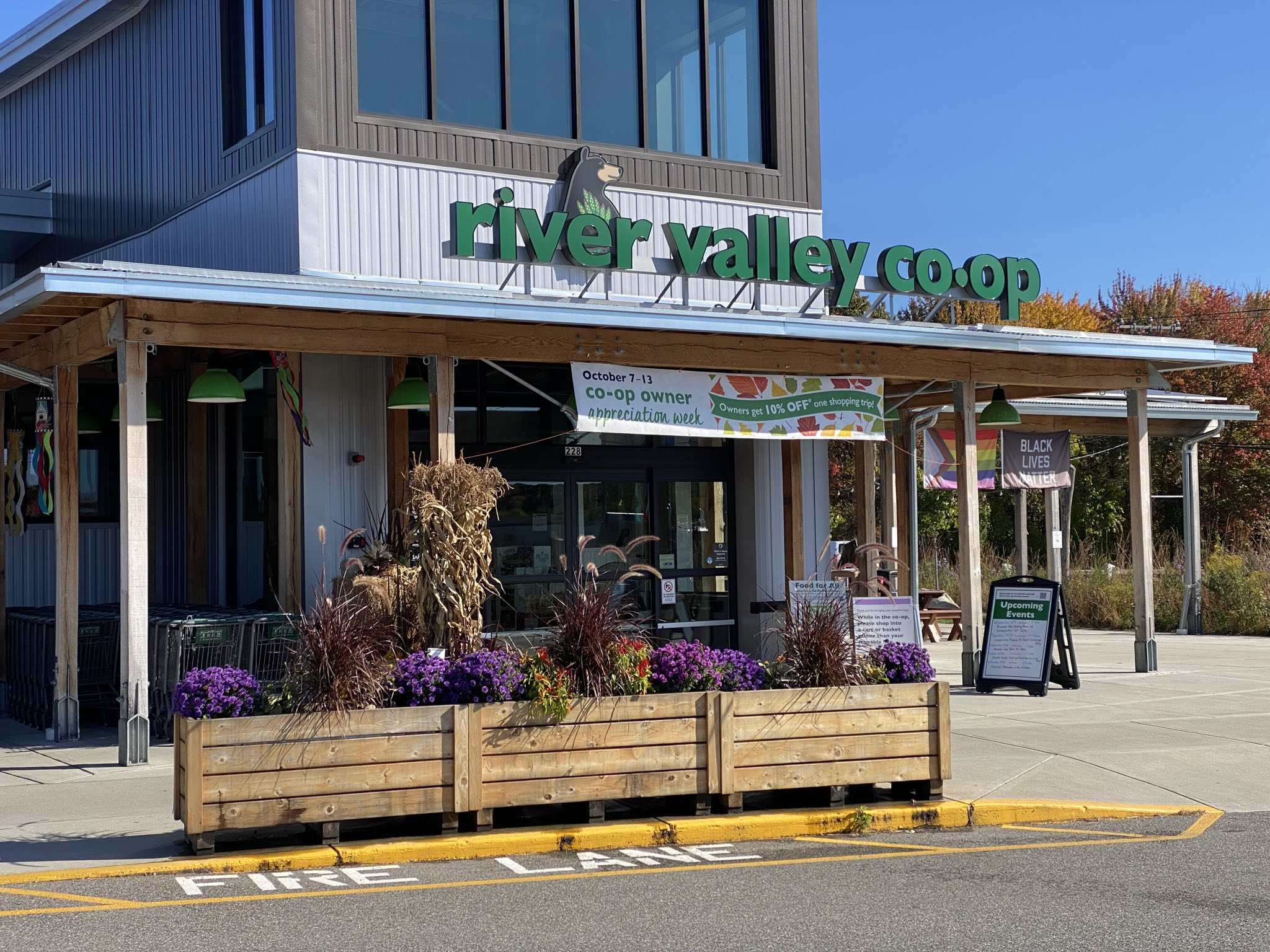
Shadi and other organizers said that they were disappointed to have received such a strong negative reaction to their campaign from the leadership of a store that supports social-justice causes — Black Lives Matter and pride flags fly outside the co-op’s Easthampton location, for example — and often expresses its values through what products it offers on its shelves. Shadi said the store doesn’t sell Pepsi, for example, or other products that may be unhealthy or whose companies exploit workers.
“We don’t carry Gatorade, right?” she said. “We thought, ‘If we don’t carry Gatorade, how can we carry products that are made in a country that commits genocide and apartheid?’”
Katrina Jagelski, another store employee, took issue with the store’s leadership putting their finger on the scale by urging members to vote “no” in an advisory poll.
“They’re showing a clear bias and disdain for their own membership,” she said. “If they’re not even going to take the vote seriously, it’s insulting.”
Organizers said that co-op leadership has refused efforts to meet with the campaign to talk about their proposal.
Both sides of the issue will get to present at the special members’ meeting on Oct. 30. But by then, many will have already voted. For Merrett, that’s disheartening. But as images on the news continue to show Israeli bombings of apartment complexes, hospitals, and tent encampments, she and other organizers said they’ll continue their Palestinian solidarity organizing regardless of the result of the vote.
“Isn’t this a moment where we want to say, ‘We want to do something here’?” she said. “This is part of a bigger struggle that’s just about standing up against injustice.”
Additional reporting was contributed to this story by Melanie Duronio.
The Shoestring is committed to bringing you ad-free content. We rely on readers to support our work! You can support independent news for Western Mass by visiting our Donate page.

Dusty Christensen is The Shoestring's investigations editor. Based in western Massachusetts, his award-winning investigative reporting has appeared in newspapers and on radio stations across the region. He has reported for outlets including The Nation magazine, NPR, Haaretz, New England Public Media, The Boston Globe, The Appeal, In These Times, and PBS. He teaches journalism to future muckrakers at Smith College. Send story tips to: dchristensen@theshoestring.org.
- Dusty Christensen
- Dusty Christensen
- Dusty Christensen
- Dusty Christensen
- Dusty Christensen
- Dusty Christensen
- Dusty Christensen
- Dusty Christensen
- Dusty Christensen
- Dusty Christensen
- Dusty Christensen
- Dusty Christensen
- Dusty Christensen
- Dusty Christensen
- Dusty Christensen
- Dusty Christensen
- Dusty Christensen
- Dusty Christensen
- Dusty Christensen
- Dusty Christensen
- Dusty Christensen
- Dusty Christensen
- Dusty Christensen
- Dusty Christensen
- Dusty Christensen
- Dusty Christensen
- Dusty Christensen
- Dusty Christensen
- Dusty Christensen
- Dusty Christensen
- Dusty Christensen
- Dusty Christensen
- Dusty Christensen
- Dusty Christensen
- Dusty Christensen
- Dusty Christensen
- Dusty Christensen
- Dusty Christensen
- Dusty Christensen
- Dusty Christensen
- Dusty Christensen
- Dusty Christensen
- Dusty Christensen
- Dusty Christensen
- Dusty Christensen
- Dusty Christensen
- Dusty Christensen
- Dusty Christensen
- Dusty Christensen
- Dusty Christensen
- Dusty Christensen
- Dusty Christensen
- Dusty Christensen
- Dusty Christensen
- Dusty Christensen
- Dusty Christensen
- Dusty Christensen
- Dusty Christensen
- Dusty Christensen
- Dusty Christensen
- Dusty Christensen
- Dusty Christensen
- Dusty Christensen
- Dusty Christensen
- Dusty Christensen
- Dusty Christensen
- Dusty Christensen
- Dusty Christensen
- Dusty Christensen
- Dusty Christensen
- Dusty Christensen
- Dusty Christensen
- Dusty Christensen
- Dusty Christensen
- Dusty Christensen
- Dusty Christensen
- Dusty Christensen


