

NORTHAMPTON — Last year, the Connecticut River Valley witnessed massive flooding that destroyed crops, swamped basements and ravaged municipal infrastructure. And as climate change continues to grip the globe, federal climate data now show that 2023 was one of the hottest and wettest ever recorded in the region.
In 2023, Hartford, Connecticut — the nearest of the Northeast’s 35 major climate data-gathering sites — witnessed the second-hottest annual average temperature ever recorded since data collection began there in 1905. The Hartford area also saw the third-most precipitation ever recorded. Similar trends played out in Amherst, where the National Weather Service has run a “cooperative observer program” since 1836. There, volunteer-collected data show that 2023 was the fifth-hottest year ever recorded and the fourth wettest.
Average annual temperature records were broken in locations across New England in 2023, from northern Maine and Burlington, Vermont, down to New Haven, Connecticut. Worcester saw its hottest annual average temperature in 126 years and Boston experienced its third-hottest year in 150 years of data collection.
Those trends are directly related to global warming, according to Michael Rawlins, the associate director of the University of Massachusetts Amherst’s Climate System Research Center.
“The continued rise in temperatures and extreme precipitation events are ever-present reminders that we’re altering the climate in ways that would have been inconceivable decades ago,” Rawlins told The Shoestring.
Rawlins explained that in the Northeast, scientists are projecting wetter weather in the future as greenhouse-gas emissions continue to warm the climate. There will still be occasional droughts, Rawlins said, and there’s some evidence that weather may be becoming more variable at times.
“But in general, precipitation extremes, wet extremes, are becoming more common,” he said. “Mitigation of these extreme weather events can only come from rapid and sustained reductions in our use of carbon-polluting fossil fuels and the subsequent reversal of the increasing atmospheric greenhouse-gas concentrations that are warming our planet.”
In western Massachusetts, many communities experienced the rainiest July in history — a deluge that flooded everything from farm fields to basements. Conway, for example, was hit with more than 21 inches of rain, which was more precipitation than fell anywhere else in the United States and Canada that month. The town suffered some $2.2 million in road damage, according to The Recorder.
December ranked among the five warmest on record for 25 of the Northeast’s 35 major climate sites, according to analysis from the Northeast Regional Climate Center. Rawlins noted that the previous winter was the warmest on record in Massachusetts, with an average temperature of 33.7 degrees — a full 7.9 degrees warmer than the average between 1901 and 2000. It was also the third-wettest December ever recorded in the Hartford area and the wettest-ever in Westfield, where data only goes back 29 years.
“It’s worrying to consider the myriad impacts of unfrozen winters in this region, of thawed conditions during winter,” Rawlins said. To take one example, experts have said that warming New England winters has resulted in a year-round “tick season,” causing an increase in Lyme disease and other tick-borne illnesses.
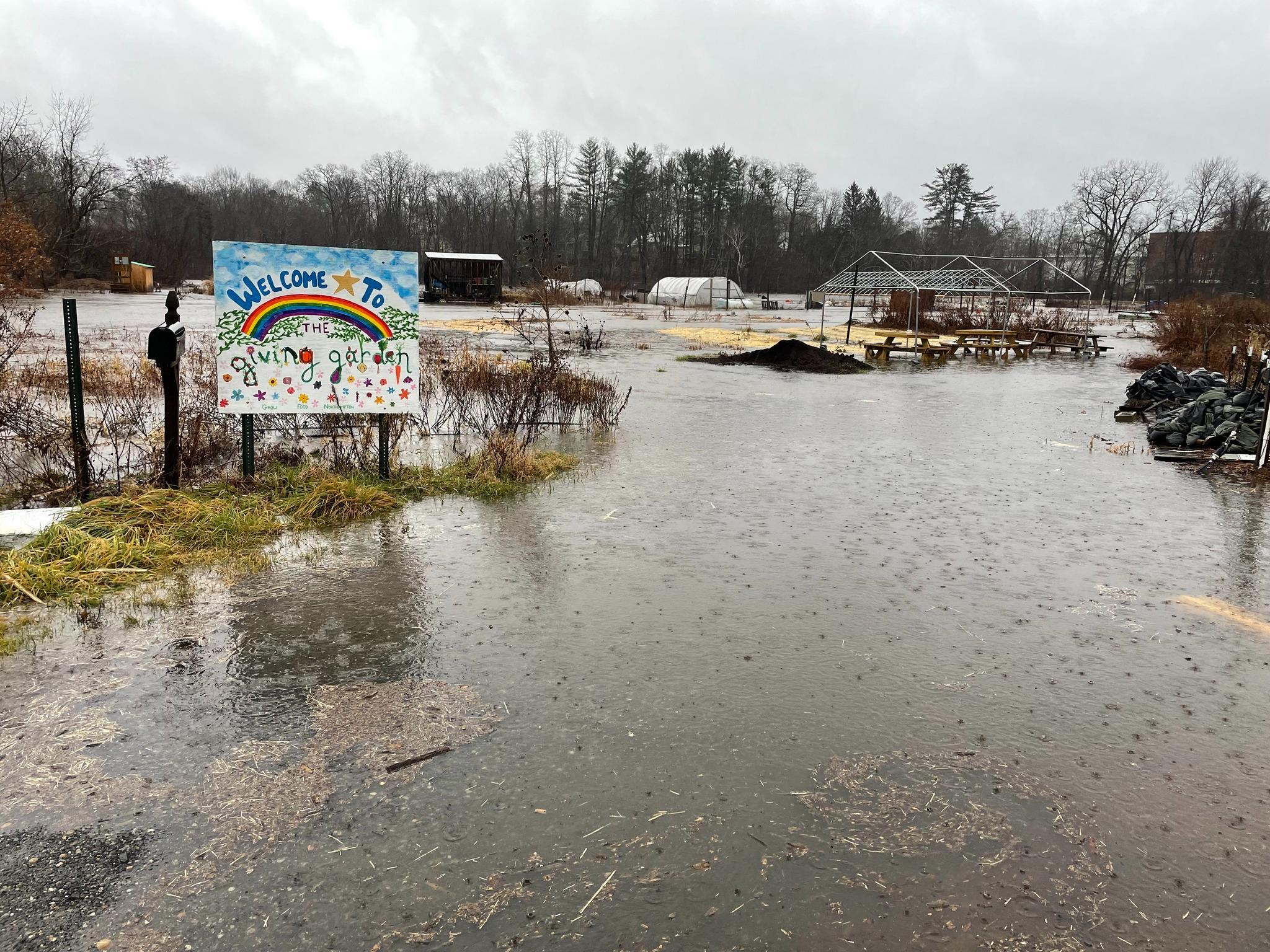
At Grow Food Northampton, the rains in July swamped many of the organization’s small farm plots as well as large swaths of its community garden. Then, in mid-December, heavy rains again flooded many of those areas. Alisa Klein, Grow Food Northampton’s executive director, said that in both cases it was a 100-year flood plain that was inundated. And 2023 wasn’t the only time that has happened in recent years, she said.
“It has been four times in the last 10 years that we’ve had fairly catastrophic flooding,” Klein said. “We are reevaluating our entire land-use plan.”
The farmers on Grow Food Northampton’s 10 small farm plots — four of which are owned and operated by farmers of color, including a collective of Somali Bantu refugees — were able to recover financially from the floods. The organization crowdsourced funding for them, and several state grants also helped to cover the farmers’ losses.
“But the bigger problem is how we move forward in the future with the parcels they are still farming,” Klein said.
Grow Food Northampton is deciding what kinds of farming and gardening can actually be done on its land, and may have to relocate some of its small farmers and gardeners. The organization is also redesigning a portion of its land that’s adjacent to the Mill River to be experimental farm land for academics and other farmers to work on more resilient, climate-adaptive practices.
Klein said that there are many ways that municipalities can help local farmers and other community members prepare for, and adapt to, climate change. In Williamsburg, for example, the town applied for and won a $682,085 “Municipal Vulnerability Preparedness” grant from the state to study the Mill River watershed in order to increase flood resilience in the town, which experienced flooding and storm damage in both July and December of 2023.
Northampton has also taken a proactive approach to climate-change resilience. In February of last year, the City Council passed a proposal by Mayor Gina-Louise Sciarra to create a Climate Action and Project Administration, which now oversees the city’s climate response. Carole Collins, the new department’s director, told The Shoestring that last year’s flooding cost the city some $1.2 million.
Collins noted that the city is working to open a Community Resilience Hub at 298 Main St., which Northampton will use in part to address climate change and the emergencies that come with it. The hub will also provide daily support to those experiencing homelessness and extreme poverty. Experts have long warned that climate change will disproportionately impact socially vulnerable populations such as immigrants, people of color, small-scale farmers and the unhoused.
“We need to be planning to take care of people with all of these different situations that may arise,” Collins said.
Collins said that in Northampton and other municipalities, it will cost “big money” to address some of the infrastructure problems that climate change has exposed. However, she said that lots of mitigation and adaptation can be accomplished through smaller projects that have big impacts, such as the building of “bioswales” — landscaped areas that channel stormwater runoff more efficiently, decreasing the likelihood of flooding.
Collins said that during her time as director of Greenfield’s Department of Energy and Sustainability, the project that she was most proud of came from the smallest grant she ever received. The money was used to turn a parking lot into a little park, complete with a pollinator garden and vegetables growing for nearby community members. The space brought people together and also addressed previous flooding in the area, she said.
At a time when many are experiencing “epic loneliness” and diseases of despair, Collins said that such projects can create stronger communities and repair social disconnect.
“We can accomplish a lot and it doesn’t always take a huge check to do so,” she said.
Dusty Christensen is an independent investigative reporter based in western Massachusetts. He can be reached at dusty.christensen@protonmail.com. Follow him on Twitter: @dustyc123.
The Shoestring is committed to bringing you ad-free content. We rely on readers to support our work! You can support independent news for Western Mass by visiting our Donate page.

Dusty Christensen is The Shoestring's investigations editor. Based in western Massachusetts, his award-winning investigative reporting has appeared in newspapers and on radio stations across the region. He has reported for outlets including The Nation magazine, NPR, Haaretz, New England Public Media, The Boston Globe, The Appeal, In These Times, and PBS. He teaches journalism to future muckrakers at Smith College. Send story tips to: dchristensen@theshoestring.org.
- Dusty Christensen
- Dusty Christensen
- Dusty Christensen
- Dusty Christensen
- Dusty Christensen
- Dusty Christensen
- Dusty Christensen
- Dusty Christensen
- Dusty Christensen
- Dusty Christensen
- Dusty Christensen
- Dusty Christensen
- Dusty Christensen
- Dusty Christensen
- Dusty Christensen
- Dusty Christensen
- Dusty Christensen
- Dusty Christensen
- Dusty Christensen
- Dusty Christensen
- Dusty Christensen
- Dusty Christensen
- Dusty Christensen
- Dusty Christensen
- Dusty Christensen
- Dusty Christensen
- Dusty Christensen
- Dusty Christensen
- Dusty Christensen
- Dusty Christensen
- Dusty Christensen
- Dusty Christensen
- Dusty Christensen
- Dusty Christensen
- Dusty Christensen
- Dusty Christensen
- Dusty Christensen
- Dusty Christensen
- Dusty Christensen
- Dusty Christensen
- Dusty Christensen
- Dusty Christensen
- Dusty Christensen
- Dusty Christensen
- Dusty Christensen
- Dusty Christensen
- Dusty Christensen
- Dusty Christensen
- Dusty Christensen
- Dusty Christensen
- Dusty Christensen
- Dusty Christensen
- Dusty Christensen
- Dusty Christensen
- Dusty Christensen
- Dusty Christensen
- Dusty Christensen
- Dusty Christensen
- Dusty Christensen
- Dusty Christensen
- Dusty Christensen
- Dusty Christensen
- Dusty Christensen
- Dusty Christensen
- Dusty Christensen
- Dusty Christensen
- Dusty Christensen
- Dusty Christensen
- Dusty Christensen
- Dusty Christensen
- Dusty Christensen
- Dusty Christensen
- Dusty Christensen
- Dusty Christensen
- Dusty Christensen
- Dusty Christensen
- Dusty Christensen