


For nearly four years, the Northwestern District Attorney’s Office has declined to release the names of some local police officers accused of criminal offenses. But last week, a judge ruled in favor of an independent journalist who has sought to make that information public.
Reporter Andrew Quemere had filed a public records request in 2022 seeking documents the DA’s office keeps that identify police officers who have been accused of misconduct. District Attorney David Sullivan — the top law enforcement official in Hampshire and Franklin counties — refused to release those records in unredacted form, and so Quemere sued Sullivan’s office in 2023. Known as Brady disclosures, district attorneys keep those records because their offices’ prosecutors are required to turn over potentially exculpatory evidence to defendants in criminal cases.
After Quemere filed his lawsuit, Sullivan’s office did release some of its Brady disclosures — those related to civil misconduct. However, the DA’s office argued that Brady disclosures related to criminal offenses that police committed were protected under the state’s Criminal Offender Record Information law, or CORI, which seeks to prevent the release of criminal records to unauthorized parties.
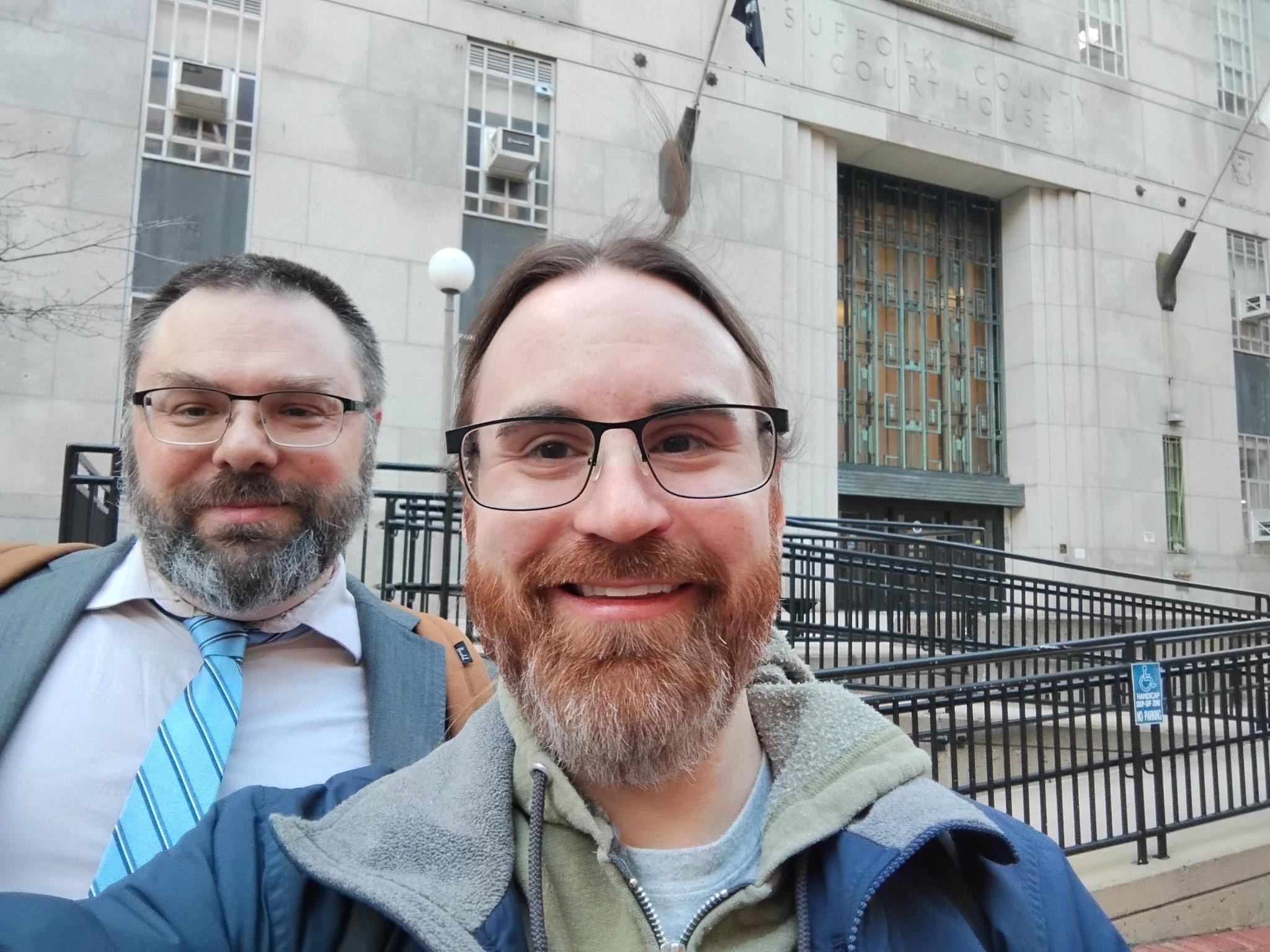
But in a decision last Tuesday, Suffolk County Superior Court Judge Julie Green sided with Quemere, ruling that Sullivan’s office must turn over all of its Brady disclosures in unredacted form.
“After review and a hearing, the Court concludes that the information at issue is a public record and must be produced,” Green wrote.
Green also ruled that the DA’s office has to pay Quemere’s attorney’s fees and costs, though she did not rule that Sullivan acted in bad faith in withholding the documents, which would have allowed her to levy punitive damages against Sullivan’s office.
“CORI protections serve important interests in safeguarding privacy and promoting rehabilitation of criminal defendants,” Green wrote, noting that violations of that law can have serious consequences. “It was not bad faith for the NWDAO to proceed with caution where the confidentiality of potential CORI was at stake.”
Quemere, who writes The Mass Dump newsletter, told The Shoestring that the decision marks a “total victory” in his pursuit of transparency. He said he was heartened that the judge found no legal merit to the arguments Sullivan’s office made in court.
“What this ruling does is it basically vindicates what I have been saying this whole time: people have a right to know when police officers have been accused of misconduct and crimes,” he said.
It’s unclear whether Sullivan intends to appeal the decision.
“We continue to review the Court’s decision to determine whether to pursue an appeal,” a spokesperson for the Northwestern District Attorney’s Office, Melissa Sippel, said in an emailed statement. “Given the pending litigation, we cannot comment further at this time.”
Sippel said that the DA’s office was “pleased the Court found that we acted in good faith in attempting to prevent the unlawful disclosure of Criminal Offender Record Information.”
In a 2024 interview with radio hosts Bill Newman and Buz Eisenberg, Sullivan hinted at the possibility of appealing the case.
“I think the public records law could be clearer as to whether these specific records are available,” Sullivan said. “If it’s got to go up to the supreme court for them to make that decision whether the public records law overrides the CORI law, then we’ll let the supreme court decide — or some maybe lesser court, maybe appellate court or maybe even a superior court justice.”
Sullivan’s office also weighed in on another public records case elsewhere in the state in 2023, making a legal argument that, if accepted, would have significantly restricted the public’s access to records about police misconduct statewide.
In that case, which involved the Bristol County district attorney, Sullivan’s office filed an amicus brief that argued that only the state’s Peace Officer Standards and Training Commission — an agency created in the wake of the 2020 racial justice uprisings — should be authorized to release records of police misconduct. The state’s Supreme Judicial Court rejected that logic the following year.
Quemere said he hopes Sullivan’s office turns over the records, as the judge ordered. If Sullivan does plan to appeal, he has to file notice within 30 days of the court’s decision, which is dated Dec. 30, 2025.
“The DA’s office has been wasting public money to keep the public in the dark, using taxpayer money to prevent taxpayers from seeing what their tax dollars are being spent on,” he said. “I think that’s very unfortunate.”
Sippel, the Northwestern District Attorney’s Office spokesperson, did not answer The Shoestring’s inquiry about how much Sullivan has spent litigating the case since the lawsuit was filed.
Quemere, however, says he’s used public records requests to obtain invoices that show the office has spent at least $16,000 on outside legal counsel. And that’s not including charges from December, he said, when both sides presented oral arguments before the court.
Quemere said it was obvious from the beginning that the Brady disclosures were public records. And he said that although the DA’s office argued that it wasn’t giving special treatment to police officers by protecting information about their criminal offenses, he found that hard to believe. He said that the office often issues public press releases about civilians with the same kind of information contained in the Brady disclosures.
Quemere said the case showed how public entities like Sullivan’s office can use the weakness of Massachusetts’ public records law, which gives no ability to the state’s supervisor of records to enforce her decisions about what records should be public. That leaves journalists like Quemere with two choices: drop their pursuit of public records or sue for them.
“I think part of the problem with our state’s public records law is that it doesn’t serve as a very good deterrent of obstructing the release of information that everyone knows should be public,” he said.

Dusty Christensen is The Shoestring's investigations editor. Based in western Massachusetts, his award-winning investigative reporting has appeared in newspapers and on radio stations across the region. He has reported for outlets including The Nation magazine, NPR, Haaretz, New England Public Media, The Boston Globe, The Appeal, In These Times, and PBS. He teaches journalism to future muckrakers at both the University of Massachusetts Amherst and Smith College. Send story tips to: dchristensen@theshoestring.org.
- Dusty Christensen
- Dusty Christensen
- Dusty Christensen
- Dusty Christensen
- Dusty Christensen
- Dusty Christensen
- Dusty Christensen
- Dusty Christensen
- Dusty Christensen
- Dusty Christensen
- Dusty Christensen
- Dusty Christensen
- Dusty Christensen
- Dusty Christensen
- Dusty Christensen
- Dusty Christensen
- Dusty Christensen
- Dusty Christensen
- Dusty Christensen
- Dusty Christensen
- Dusty Christensen
- Dusty Christensen
- Dusty Christensen
- Dusty Christensen
- Dusty Christensen
- Dusty Christensen
- Dusty Christensen
- Dusty Christensen
- Dusty Christensen
- Dusty Christensen
- Dusty Christensen
- Dusty Christensen
- Dusty Christensen
- Dusty Christensen
- Dusty Christensen
- Dusty Christensen
- Dusty Christensen
- Dusty Christensen
- Dusty Christensen
- Dusty Christensen
- Dusty Christensen
- Dusty Christensen
- Dusty Christensen
- Dusty Christensen
- Dusty Christensen
- Dusty Christensen
- Dusty Christensen
- Dusty Christensen
- Dusty Christensen
- Dusty Christensen
- Dusty Christensen
- Dusty Christensen
- Dusty Christensen
- Dusty Christensen
- Dusty Christensen
- Dusty Christensen
- Dusty Christensen
- Dusty Christensen
- Dusty Christensen
- Dusty Christensen
- Dusty Christensen
- Dusty Christensen
- Dusty Christensen
- Dusty Christensen
- Dusty Christensen
- Dusty Christensen
- Dusty Christensen
- Dusty Christensen
- Dusty Christensen
- Dusty Christensen
- Dusty Christensen
- Dusty Christensen
- Dusty Christensen


