


President Donald Trump took another major step towards criminalizing dissent in September with a sweeping national security directive that could have implications for Massachusetts residents.
“Countering Domestic Terrorism and Organized Political Violence,” or National Security Presidential Memorandum 7, argues that assassination attempts on right-wing figures and efforts to obstruct the activities of Immigration and Customs Enforcement do not “emerge organically.” Rather, they represent a “culmination of sophisticated, organized campaigns of targeted intimidation, radicalization, threats, and violence,” association with which can be indicated by “anti-Americanism, anti-capitalism, and anti-Christianity; support for the overthrow of the United States Government; extremism on migration, race, and gender; and hostility towards those who hold traditional American views on family, religion, and morality.”
In short, as journalist Ken Klippenstein put it, Trump’s directive means that commonly held beliefs can now be used as evidence to link people living in the United States to a newly broadened definition of “domestic terror.”
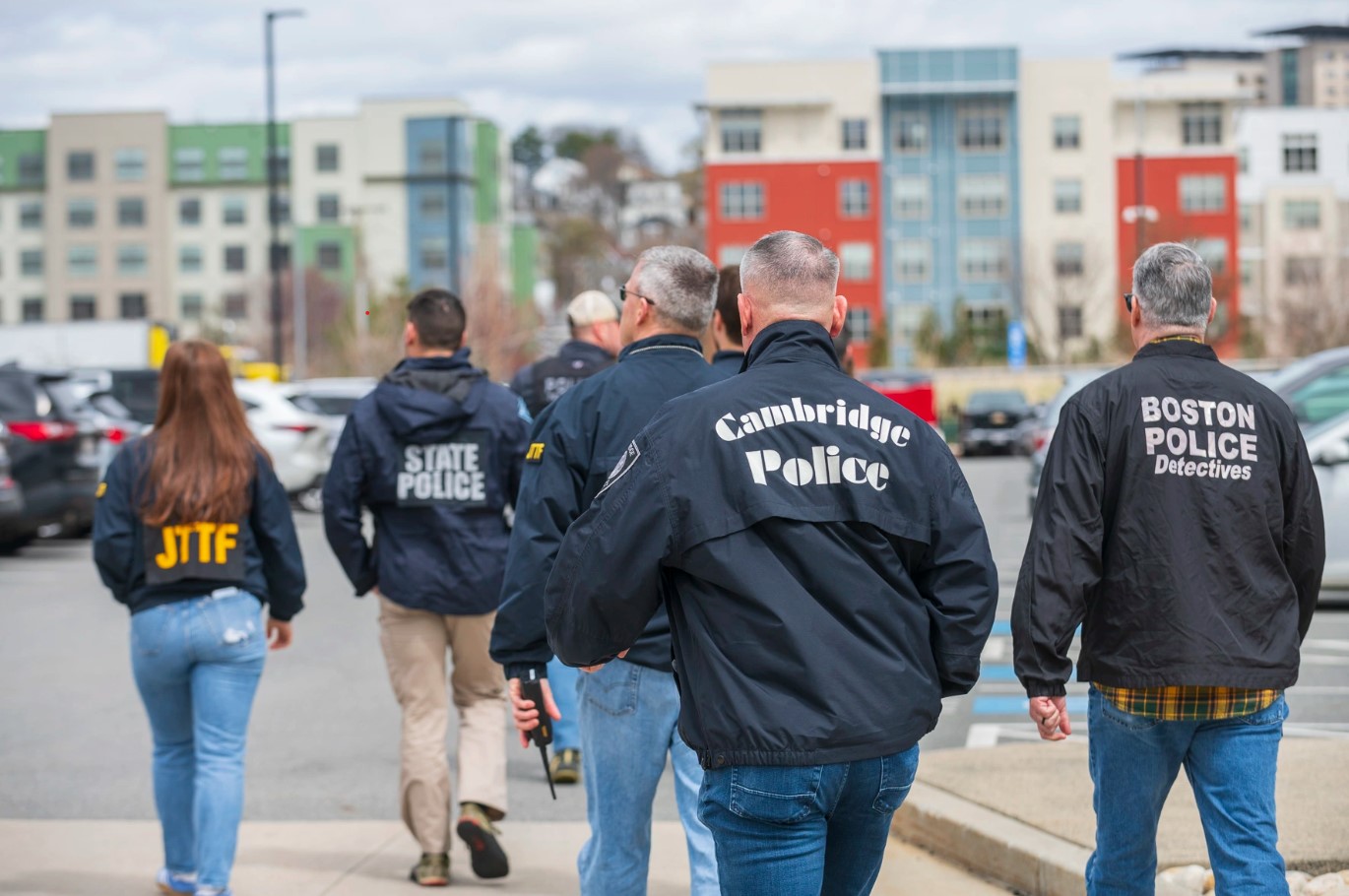
And, The Shoestring has found, Massachusetts State Police actively participate in the federal “Joint Terrorism Task Force” that is guided by that directive, which has become known as NSPM-7. Several local police departments were also members of that task force a decade ago, though all say they have since quit.
National security presidential memoranda can have a broad impact on the operations of federal law enforcement. It was a similar directive under former President George W. Bush, for example, that kickstarted the National Security Agency’s dragnet surveillance in the 2000s, later revealed by NSA whistleblower Edward Snowden. And when local and state law enforcement agencies assign officers to federal task forces, they too become subject to federal directives.
Most immediately, NSPM-7 specifically directs the FBI’s Joint Terrorism Task Forces — of which there are dozens around the country — to “investigate and disrupt networks, entities, and organizations that foment political violence so that law enforcement can intervene in criminal conspiracies before they result in violent political acts.”
In Massachusetts, the state police force participates in the federal Joint Terrorism Task Force overseen by the FBI’s Boston Field Office, meaning that some of those officers are tasked with implementing the Trump administration’s directive.
State police Sgt. Gregory Jones, reached via email, confirmed the agency’s ongoing participation in the task force, but did not respond to any further questions. Gov. Maura Healey’s office did not respond to multiple requests for comment.
For Kade Crockford, the director of technology and justice programs at the American Civil Liberties Union of Massachusetts, the mobilization of federal law enforcement resources against protected First Amendment activity is not new — but it is more concerning than ever.
“We have seen the FBI target Black Lives Matter and the Water Protectors,” they said. “The risks are much greater now that we have a federal administration that couldn’t be clearer in its absolute disregard for constitutional law.”
Overseen by the FBI, Joint Terrorism Task Forces are law enforcement collaboratives that dedicate state and local resources towards federal anti-terrorism investigations and prevention. The practice came out of efforts to link the work of the New York City Police Department and FBI in the 1980s, and saw a major surge following Bush’s declaration of the Global War on Terror. The FBI’s website states there are “about 200” such task forces active today, including at least one overseen by each of the agency’s 56 field offices.
Though JTTFs occasionally make the news — as in the arrest of a local participant in the Jan. 6, 2021 riot at the U.S. Capitol or when UMass Amherst police assisted in the questioning of an Iraqi professor in 2002 — they typically keep a low profile. The ACLU of Massachusetts had to sue just to get a list of participants in the program run out of the FBI’s Boston office, and was successful in 2014.
The Shoestring wasn’t able to immediately obtain more recent data. Tim Callery, a spokesperson for the FBI, did not provide a list of current participants in Boston’s task force.
Among the police departments the FBI named in 2014 as being active or former participants in the Boston Joint Terrorism Task Force were Amherst, Springfield, Ludlow, Holyoke, West Springfield, Pittsfield, Chicopee, Boston, Worcester, the Massachusetts State Police, and the UMass Amherst Police Department.
Of those, Amherst, Ludlow, Holyoke, Springfield, West Springfield, Pittsfield, Chicopee, and UMass Amherst all said they no longer participate in the task force. (Notably, UMass Amherst’s current police chief is an alum of the FBI’s national Joint Terrorism Task Force.)
Boston’s police department confirmed that it does still participate in the task force. Mayor Michelle Wu’s office did not return a request for comment.
Several calls to the Worcester Police Department resulted in transfers to dead-end voicemail boxes that could not accept new messages. The one officer that did answer The Shoestring’s phone call immediately hung up.
It would appear, then, that western Massachusetts police departments made a quiet exodus from the federal partnership within the last 10 years, in contrast to much more public fights over local participation in places like San Francisco and Portland, Oregon. This means that few, if any, local resources will be used towards the ends of the Trump administration’s new directive.
But Massachusetts residents from anywhere in the state could still be subject to federal surveillance for non-state sanctioned opinions. Both departments that confirmed to The Shoestring that they still participate in the regional Joint Terrorism Task Force — Boston and the state police — have histories of apparent or confirmed surveillance of activist groups, including in western Mass.
For Crockford, NSPM-7 hearkens back to an earlier era in the FBI’s history. The agency regularly conducted surveillance against political dissidents like Civil Rights Movement organizers until the scope of that spying was revealed in the 1970s. For about 25 years after that, Crockford said, guidelines for the FBI required investigations to be tied to reasonable criminal suspicion, until post-9/11 reforms removed that requirement and resulted in broad surveillance of Muslim Americans for reasons that weren’t criminal in nature.
Now, an agency with unfettered access to 21st century surveillance technology “is being explicitly directed to wield its institutional authority and power to go after the enemies of the president,” Crockford said.
“It is exactly the type of abuse of power that critics of the FBI and post 9/11 surveillance authority have warned about for years,” they said.
Additional reporting was contributed by Jonathan Gerhardson.

Brian Zayatz is the managing editor of The Shoestring. Since moving to western Mass from Cape Cod in 2014, Brian has been The Shoestring's Northampton city council beat reporter, co-founded Amherst Cinema Workers United, and been named one of Tomorrow's News Trailblazers by Editor & Publisher magazine. Find Brian's additional writing at Teen Vogue, DigBoston, Popula, Shadowproof and the Montague Reporter, or reach out at bzayatz@theshoestring.org.
- Brian Zayatz
- Brian Zayatz
- Brian Zayatz
- Brian Zayatz
- Brian Zayatz
- Brian Zayatz
- Brian Zayatz
- Brian Zayatz
- Brian Zayatz
- Brian Zayatz
- Brian Zayatz
- Brian Zayatz
- Brian Zayatz
- Brian Zayatz
- Brian Zayatz
- Brian Zayatz
- Brian Zayatz
- Brian Zayatz
- Brian Zayatz
- Brian Zayatz


