

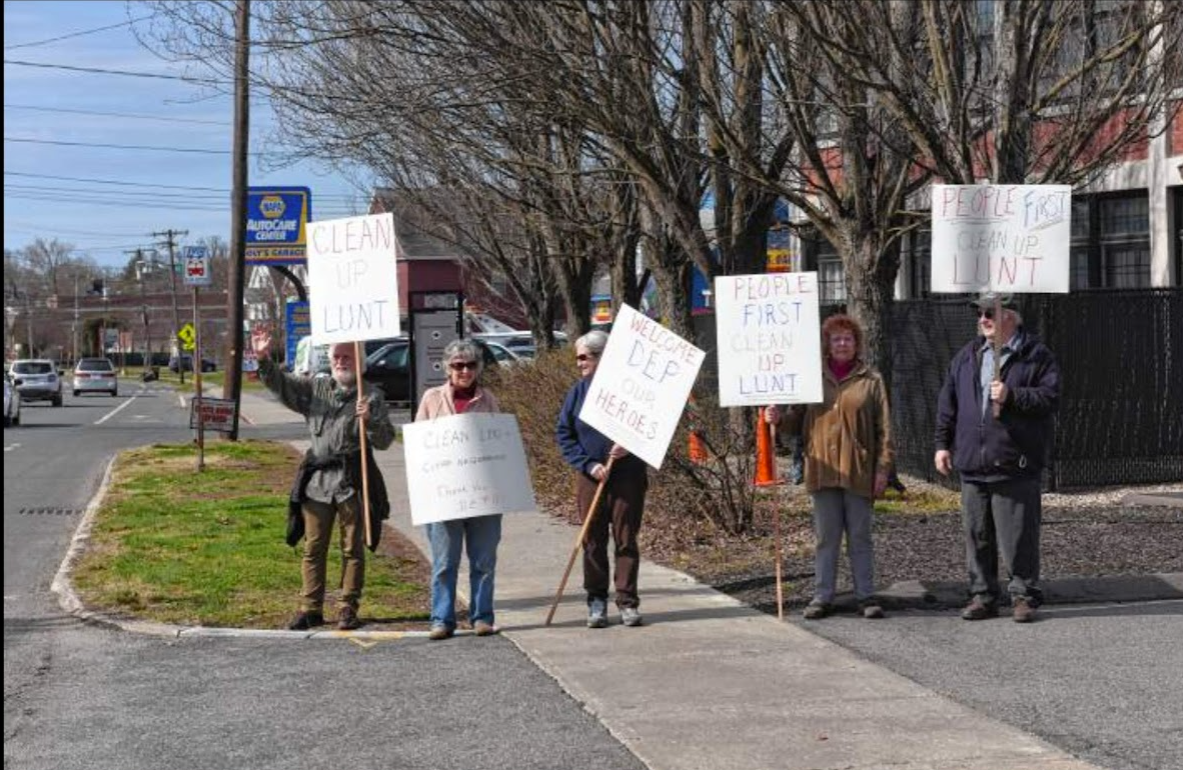
For years now, Susan Worgaftik and her neighbors have been fighting for the cleanup of a toxic chemical plume in Greenfield and grappling with the monstrous uncertainty it has created for them.
L-shaped, with discolored patches of red brick, evenly spaced rows of glass windows on all sides, and a jutting industrial smokestack, the now-converted Lunt Silversmiths factory in Greenfield has become the site of a years-long battle over serious health risks — and who bears responsibility for putting the community in danger.
“We even did a tree planting and people after it were like, ‘Are we safe or are we contaminated?” one of the neighbors, John Bottomley, told The Shoestring.
Both Worgaftik and Bottomley are members of the Lunt Neighborhood Action Group, which has been advocating for the cleanup of a decades-old plume of trichloroethylene, or TCE — an industrial solvent that the International Agency for Research on Cancer, the U.S. Department of Health and Human Services, and the U.S. Environmental Protection Agency have all determined can cause cancer. As early as 2009, records show that TCE has been contaminating soil and groundwater beneath the 4.72-acre property.
A prolonged remediation effort, which began in 2012 and has cost millions of dollars, has still not met the Massachusetts Department of Environmental Protection’s cleanup standards, according to their records.
The neighborhood group formed in 2022 as an advisory body to the effort. Worgaftik, who is also vice president of the group, said they’ve been pushing for assurance that the contamination isn’t causing long-term health issues, particularly for those who live on-site.
After Lunt shut down in 2009 and ownership was transferred to the city, Greenfield leased it to 401 Liberty Street, a company that redeveloped the property in 2016 into a behavioral health treatment campus, including a detox where residents with addiction and mental health issues stay an average of 30 days.
“This is a place where people spend a significant amount of time,” Worgaftik said. “We just want verification that the air in there is clean enough so that, at some point later in their lives, they’re not going to be sick because they were in that building.”
Vapor intrusion, which occurs when TCE in soil or groundwater is released into indoor air, can have serious consequences. According to MassDEP, this process can cause fetal harm in pregnant women as well as cancer and nervous system damage to anyone experiencing long-term exposure.
MassDEP’s acting section chief of the bureau of waste site cleanup, Caprice Shaw, and the agency’s deputy regional director, Tamara Cardona-Marek, both declined an interview, deferring to the records.
The action group also worries that the contamination may have sunk deep underground, but because deep groundwater testing can be costly, what will effectively repair the damage is unpaid for and unclear.
Since the city’s proposed sale of the Lunt property in late 2021, which Lunt Neighborhood Action Group members feared would have ended the remediation effort, the group has been calling for a more comprehensive cleanup.

In early 2022, residents petitioned MassDEP to designate Lunt as a public involvement plan site, mandating official public meetings among residents, the property’s leaseholders, and the environmental experts overseeing the cleanup. Action group members have held demonstrations outside the property, knocked on neighbors’ doors, and written urgent letters to local government officials and MassDEP. The 125-member group was eventually incorporated as a nonprofit so members could apply for state funding to hire their own environmental expert and cleanup advisor.
“We’re not necessarily accusing anyone of anything as much as we are saying we need data, we need facts, and then we need a plan to deal with what we learn,” Worgaftik said.
But five years of community-level organizing has only moved the needle so far.
The Lunt Neighborhood Action Group says it has faced pushback from the property’s redeveloper, 401 Liberty, and its owner, Springfield attorney Raipher Pellegrino, who group members say has withheld important site assessment reports and been uncooperative in appeals for further environmental testing on the property.
Pellegrino and his company, however, have disputed that characterization.
After multiple phone messages left for Pellegrino at his law office went unanswered, The Shoestring was able to reach him late last week by email. In response to a detailed list of questions, Pellegrino sent answers through his legal assistant, Nicole Eaton.
“Since 2015 we have invested millions of dollars of our own funds to secure, renovate, and remediate the property,” reads the unsigned statement, which Eaton attributed to 401 Liberty. “Today the buildings house addiction treatment and recovery services that serve people across Franklin County and a mini Fenway Park for little league. We are proud of that outcome, and we also understand why neighbors want certainty about the remaining environmental work. We share that goal.”
The neighbors concerned about the property disagree. Bottomley, who is also a Greenfield city councilor, told The Shoestring that the group’s interactions with 401 Liberty reveal a significant imbalance: “One wealthy lawyer and his LLC have more power and influence than all the people of Greenfield.”
“It’s really depressing,” Bottomley said.
***
It’s possible the contamination began as early as 1902, when George Lunt founded Lunt Silversmiths at its principal location, the Lunt factory at 298 Federal St. in Greenfield.
Business boomed. The company primarily manufactured sterling silverware, including forks and spoons, as well as cups and even airplane parts under government contract during WWII. The factory, which employed 800 workers at its peak, had more than 150 employees in 2007.
According to MassDEP records, the agency first suspected contamination during a routine inspection in May 2009, which revealed hazardous waste stored on the property, including barrels of TCE and other volatile compounds.
Soon after, Lunt Silversmiths sold its name and inventory and shut down operations in Greenfield. Then-owner James Lunt filed for bankruptcy that December.
In early 2010, MassDEP sent a “notice of responsibility” to Lunt, who said he was unable to conduct an initial investigation due to his bankruptcy, according to MassDEP records.
Subsequent reports identified that the contamination had originated from vapor degreasing — stripping manufactured silverware of oils and polishing compounds with powerful solvents like TCE. It was a common practice that the U.S. Environmental Protection Agency banned only last year.
Environmental site assessments in 2012 confirmed TCE and other heavy metals were contaminating the soil and groundwater beneath the property and migrating downslope underneath nearby residential streets and towards the Green River.
***
When responsibility for the property was left in the hands of the city following Lunt’s bankruptcy, in 2010 Greenfield issued a request for proposals on what to do with the now-defunct factory. The only developers to respond were the Pellegrinos — former Springfield City Councilor Raipher Pellegrino and his brother Joseph, both attorneys.
The brothers, owners of 401 Liberty, began leasing the property from the city in 2015 on the condition that they complete the necessary environmental remediation. Action group members speculate that the impetus for the agreement was to shift responsibility for the cleanup and get the property back on city tax rolls. Following a year of refurbishment, 401 Liberty began subleasing buildings to the Behavioral Health Network to run brand-new drug and alcohol treatment facilities serving Franklin County.
The Pellegrino brothers’ proposal was particularly salient because there were no local treatment facilities in the wake of the ongoing opioid epidemic. And their relationship with the Behavioral Health Network was not new. The two entities began working together prior to 2009, when 401 Liberty redeveloped a former Springfield wire factory to house BHN’s corporate offices and a men’s residential treatment facility. The address of both buildings is 401 Liberty St.
In response to questions about the Pellegrinos’ established relationship with BHN, 401 Liberty wrote that the company has more than 25 years of experience redeveloping properties with “environmental conditions” in Massachusetts and beyond.
“The Lunt property was a fit for that experience,” the company’s statement says. “At the time, it was abandoned and unsecured and [due to] trespassing and drug use there was a constant concern for neighbors and the city.”
***
In 2021, a proposal by then-Mayor Roxann Wedegartner to sell the Lunt properties outright to 401 Liberty spurred the neighborhood group into action, Worgaftik said. Residents and City Council members, led by then city councilor and the city’s current mayor, Virginia “Ginny” Desorgher, wanted assurance that the property was free of contamination before it could be written off.
During a 15-minute phone call with The Shoestring, Desorgher, joined by her communications director Jonathon Weber, said that she had dug into past site reports and found elevated TCE levels in indoor air samples from several buildings on the property.
“After the remediation, some of [the levels] were worse,” she said.
While forthcoming about this point, the mayor ultimately muted the call three times and said that she could not answer some of The Shoestring’s questions, including whether the city has made efforts to ensure safe airborne conditions for current patients and workers, or to inform them of the ongoing contamination.
In response to neighborhood pushback, Wedegartner withdrew the proposal to sell the property to 401 Liberty.
“Initially, it was easier for them to just say we’re crazies and that everything has been done perfectly,” Bottomley said. “But I think time has proven that there are a lot of questions that haven’t been answered.”
Months of community organizing paid off when MassDEP announced it would launch a full audit of the cleanup process in March 2022. Based on the agency’s findings, the city was issued a notice of noncompliance two months later.
In its statement to The Shoestring, 401 Liberty’s owners wrote that they had requested the MassDEP audit, adding that they “take its findings seriously.”
“MassDEP identified and requested additional delineation of areas of contamination,” the company said. “We will continue to comply with MassDEP requests and work cooperatively with MassDEP moving forward as we have over the past decade.”
The company added that since 2015, “without being forced by anyone,” it has funded and conducted “extensive remediation and regulatory work while working cooperatively with the two prior mayoral administrations and MassDEP, most of it before any public involvement process was requested.”
Based on the 2022 audit, MassDEP ordered the licensed site professionals hired by 401 Liberty, the firm O’Reilly, Talbot & Okun Associates, to revise their most recent site report from 2020, citing deficiencies. Lori McCarthy, the firm’s current licensed site professional, did not respond to a request for an interview.
MassDEP’s noncompliance notice prompted the Greenfield City Council to vote “no confidence” in O’Reilly, Talbot & Okun in June 2022. Bottomley said the situation raised questions about a potential conflict of interest, given that the site’s developers were paying the firm.
“It’s very, very difficult when a private company is hired by another private entity to do public work,” he told The Shoestring.
***
Lunt Neighborhood Action Group members blame much of the drawn-out cleanup on what they describe as a lack of cooperation from Raipher Pellegrino.
According to Worgaftik, Pellegrino refused further air testing on the property last year, despite a determination by the Greenfield Board of Health and letters from the city urging the company to cooperate. Worgaftik said there’s been no air testing since 2019, and that doing so would have addressed some of the data gaps in previous reports, potentially easing the group’s concerns about the health of patients and workers at BHN.
“Raipher has made it very clear to us on many occasions that he will not do anything unless he’s forced to,” Worgaftik said.
In response to this allegation, 401 Liberty wrote The Shoestring that the company has not refused air testing.
“Our concern last December was about process: the City arranged activity at the property and contacted our tenants without notifying us first, as the lease requires,” the statement reads. “We support testing that is in accordance with MassDEP requirements and coordinated with us. Just because an individual or organization outside of MassDEP would like additional testing does not make it warranted or necessary.”
When The Shoestring asked Desorgher why further indoor air testing hasn’t happened, she said that “indoor air testing cannot happen without the cooperation of the tenant.”
Growing distrust in O’Reilly, Talbot & Okun and 401 Liberty eventually led community organizers to hire their own licensed site professional, Dan Felten, whose primary role has been to help the group review incoming findings. The city also hired its own overseer, Lyons Witten, to work alongside Felten as a secondary verifier of the cleanup. Witten has since retired, and Desorgher said the city has not yet hired a replacement.
In an interview with The Shoestring, Felten said a large part of his work has been helping to draft public involvement questions in response to what action group members described as insufficient, often-delayed reports by O’Reilly, Talbot & Okun.
“They have concluded based on the data they have that there’s no significant risk,” Felten said. “We’re pushing for a little more.”
Felten said that the type of contamination at the property requires an assessment of foreseeable future risk, since chlorinated contaminants such as TCE degrade slowly, and the contamination at Lunt is already more than two decades old. And since much of the groundwater contamination is being captured by the city’s storm drainage system, Felten said that more TCE could be released if the city decides to revamp its sewer system.
A lack of responsibility has only complicated matters, he said.
“The original owners, the people responsible for the contamination, folded up shop and left,” Felten said. “So that has put the burden onto the city and, by extension, 401 Liberty.”
***
Today, 401 Liberty continues to sublease the Lunt building to BHN. According to BHN’s website, it’s now home to the Greenfield Medication Treatment & Recovery Program; Connections, a residential rehabilitation service for men over 18; and New View, a 30-bed acute treatment service for women over 18. There are approximately 70 beds in the building.
A variety of addiction treatment programs have come and gone at the Lunt property over the past decade, beginning with the Franklin Recovery Center’s opening in 2016.
In 2015, MassDEP and the EPA led a million-dollar cleanup of exposed hazardous waste and excavation of arsenic- and lead-contaminated surface soil at the property. However, remediation wasn’t complete, and the recovery center was fully operational after just one year of refurbishment by developers. According to MassDEP’s 2022 audit, patients were moved into the building before completing necessary air quality monitoring.
Action group members call it one of 401 Liberty’s most egregious examples of negligence.
“That kind of destroyed our confidence,” Bottomley said.
In the audit, MassDEP noted that “testing of indoor air did not occur until after occupancy of the building despite the knowledge of TCE in indoor air prior to reconstruction,” adding that their recommended approach is to “avoid potential exposure to human receptors for even short periods of time.”
The Shoestring asked Pellegrino if he’s concerned for patients’ or workers’ safety related to TCE exposure. In response, 401 Liberty wrote that “patient and worker safety is our priority.
“Before anyone occupied the buildings, we met the regulatory requirements for occupancy,” the company said. “Many properties in Massachusetts with a history of TCE are safely occupied while site-wide cleanup continues, because the regulations focus on whether people inside the buildings are protected.”
According to Steven Winn, BHN’s president and CEO, the organization was immediately made aware of the contamination during redevelopment and was assured that the building was safe before admitting patients.
Since then, Winn told The Shoestring, Pellegrino and MassDEP have only reiterated that workers and clients have nothing to worry about.
“There’s been no concern about the building for years,” Winn said.
Winn told The Shoestring that BHN has consistently shared information about the contamination with employees. “Over 10 years, we’ve put out multiple communications to them to assure them [the building is safe],” he said.
But when asked to respond to the experience of employees who told The Shoestring that they never received any such communications between 2017 and 2021, Winn said he couldn’t comment on messages to staff during that time, “as that is now six to nine years ago.”
Winn did share excerpts from a memo to employees dated Aug. 20, 2023 that began, “There was an article late last week in the Greenfield Recorder detailing how some of our neighbors are concerned that there may be outstanding environmental issues around the former Lundt [sic] property. Specifically, they are concerned that there may still be ground contaminants that leach into the stormwater and then possibly into homes in the Kenwood St. neighborhood.”
But the article in question, which was not linked to in the excerpts shared with The Shoestring, is titled “Greenfield residents, councilors: Lunt cleanup transparency ‘completely absent.’” The Recorder outlines constituents’ concerns with the oversight of O’Reilly, Talbot & Okun, the firm hired by 401 Liberty whose work MassDEP deemed deficient.
In the 2023 memo, Winn assured employees he had met with then-Mayor Wedegartner and MassDEP’s John Ziegler, now the statewide PFAS coordinator but formerly the audit section chief at the organization’s western regional office, when he “first learned about this issue late last winter.”
“Because we have people sleeping in the building, DEP uses a standard for our facilities that assumes a person is in the space 24 hours per day, 365 days per year,” Winn continued. “Even with those strict standards, [Ziegler] told me that the [airborne TCE] readings had indicated the environment in the building was safe. He said this had been the case consistently since before we moved into the buildings.”
But, according to the Lunt Neighborhood Action Group, site reports prepared by O’Reilly, Talbot & Okun have consistently used MassDEP’s commercial-use standards rather than residential standards to meet legally safe air conditions on the property. Members call it a massive oversight, given how much time patients and workers spend there.
The Shoestring reached out to Ziegler to clarify the difference between the two standards. In response, MassDEP’s communications director, Lauren Moreschi, wrote that Ziegler “has taken a different position at DEP and is no longer involved in the site you inquired about.” She confirmed that MassDEP had spoken to Winn in 2023 and determined indoor air sampling “met applicable standards.”
Under site remediation guidelines, MassDEP permits residential indoor TCE concentrations of no more than 0.4 micrograms per cubic meter, while the commercial indoor threshold is 1.8 micrograms per cubic meter, according to state criteria.
MassDEP deputy press secretary Fabienne Alexis told The Shoestring that state regulations define a residential dwelling as “a structure used or occupied, or intended to be used or occupied, in whole or in part, as the home or residence of one or more persons, including, but not limited, to single or multi-unit housing, a dormitory, or a retirement or continuing care facility.”
“Residential dwelling does not mean a structure with transient use, such as a hotel or hospital,” the statement said.
In the 2023 memo, which assured BHN employees that the organization had consulted with its own environmental experts in addition to MassDEP, Winn wrote, “Based on all of the data we reviewed,” he and the BHN board “felt that there was not a problem within the buildings we lease, and that working and treatment environments were as safe as any could be.”
***
One former employee, who said they worked 40 to 60 hours a week at the Franklin Recovery Center between 2017 and 2020 and requested anonymity for fear of retaliation, recalled that people in hazmat suits entered the building every month to conduct air quality testing, mostly in the basement. The employee, who worked as a detox counselor, said their supervisor called it “standard protocol.”
Air quality testers initially came in, according to the employee, because sensors in the treatment unit wouldn’t shut off – and they’d return anytime the sensors “would go crazy.”
Ultimately, though, they said staff were unaware of any TCE contamination or ongoing remediation efforts in the building. Jody Pelletier, a detox counselor employed by BHN from 2020 to 2021, said she also had no idea she could be in danger.
The anonymous employee, who first found out about the contamination a year after leaving BHN through a Greenfield Recorder article, said the organization’s lack of communication didn’t surprise them, owing to what they called a “toxic environment” at the facility.
“None of us felt heard by the higher-ups,” the former employee said. “Their primary goal is meant to be community-based and to really help people, but at the end of the day, that’s not what BHN is about. Everything came down to the money, sadly.”
Both Pelletier and the anonymous employee, whose identities The Shoestring independently verified, alleged that they witnessed multiple situations of medical mismanagement, including alleged overmedication and multiple in-unit overdoses.
“They’re irresponsible all over the place,” Pelletier said. “They cover their own ass all the time.”
Winn said he remains “confident in the ability of our staff to treat our clients effectively and with the utmost care, safety, and respect.”
The anonymous employee also said that since departing BHN, they have developed multiple tumors on their bladder that have been deemed benign. Their doctor told them that while it’s impossible to know the tumors’ cause, she ultimately could not rule out the worker’s three years of exposure to the contamination.
An article in the International Journal of Cancer, a peer-reviewed medical periodical, states that there is evidence of an association between high levels of TCE exposure and bladder cancer.
Pelletier said she’s experienced short-term memory loss that started right after she left the facility, but that she never considered attributing it to the contamination. According to the federal Agency for Toxic Substances and Disease Registry, TCE exposure is linked to several neurological effects, including problems with short-term memory loss, attention, and delayed recall.
In 401 Liberty’s statement to The Shoestring, they wrote, “The current data for the occupied buildings does not suggest that the presence of TCE has any adverse impact on occupant safety.”
They continued, “To date, neither our tenants nor their staff or patients have raised concerns with us about air quality.”
***
According to MassDEP reports, in 2016, a month after BHN began admitting patients, O’Reilly, Talbot & Okun notified MassDEP of a potential imminent hazard at the property: indoor air testing detected TCE concentrations above what’s considered safe for long-term residential exposure. Due to high demand, the detox had been at max capacity.
In a 2024 draft of the public involvement plan spurred by the Lunt Neighborhood Action Group, 401 Liberty responded to two pointed questions from the public about what information BHN had had about the contamination.
Q: “Were staff and residents notified of exposure risk?”
A: “BHN was notified and the results were provided to them.”
Q: “Were staff and residents notified of imminent hazard alert?”
A: “BHN was notified and the results were provided to them.”
Worgaftik said the group had spoken to some staff members during public demonstrations outside the former Lunt factory, but otherwise has had little success reaching workers and patients. Before The Shoestring was able to reach Winn, this Q&A was the only assurance the group had that BHN was aware of the contamination, members said.
In the same draft of the public involvement plan, 401 Liberty said the 2016 alert was issued under “an abundance of caution” and that indoor air concentrations were “ultimately found to not represent an Imminent Hazard.”
But when The Shoestring asked what was done in response to the imminent hazard alert, 401 Liberty wrote, “Our review of the MassDEP file does not show an imminent hazard condition declared at this property. If you have a document indicating otherwise, please share it so we may respond.”
When The Shoestring provided documentation by email late last week, including the 2024 draft of the public involvement plan featuring 401 Liberty’s Q&A, Eaton, Pellegrino’s legal assistant, responded, “Raipher is traveling today and is flying. He is unavailable and cannot be reached at this time.”
Pellegrino did not respond to the follow-up question.
According to site reports, the original remediation plan involved installing an active fanning system beneath four of the buildings to vent out TCE vapor. Instead, following the imminent hazard alert, developers installed what’s known as a passive system.
“What that means is that there is some venting, but there’s no effort to move the gas that TCE produces out of the building,” Worgaftik said, adding that the passive system is still in place today.
In the Q&A, 401 Liberty said it installed the passive system because it was “deemed a better fit under the conditions” and that it still successfully reduced indoor TCE to safe levels.
In an email sent in June of this year to all responsible parties, including Pellegrino, MassDEP wrote that “the data does not clearly demonstrate if the passive exposure pathway mitigation measures are effective in preventing exposures to trichloroethene in indoor air at the former Lunt facility.”
In its statement to The Shoestring, though, 401 Liberty said, “we respectfully disagree with the characterization that MassDEP found it ineffective and in fact believe MassDEP never determined it was ineffective or that an active system is needed.”
MassDEP’s June email also cited outstanding concerns regarding TCE exposure for “women of childbearing age at the Behavior Health Treatment Center and potential utility worker exposures.”
Action group members said these conclusions – by the state organization tasked with protecting the health of Massachusetts residents – have been particularly worrisome.
“People being treated are subject to the chemicals that are there,” Matt Perry, the action group’s sitting president, told The Shoestring. “Until there’s a clear understanding of what is in the ground, what is in the air, it concerns me that people are being exposed and are at risk.”
When asked specifically about unresolved concerns laid out at the June meeting with MassDEP, 401 Liberty wrote, “We will let MassDEP speak for itself. The MassDEP record is publicly available, and we encourage you to review it.”
***
Nearly five years since Greenfield neighbors first began organizing for neighborhood health, the Lunt Neighborhood Action Group has yet to turn down the heat.
According to the group, support and attention to the cause have only continued to grow over the years, and the case represents a broader battle against TCE contamination in the region.
“We have had communication with other communities that are kind of watching this and saying, ‘Let us know how this goes, because we’d like to clean up our site as well,’” Worgaftik said.
The group has also been backed by state Sen. Jo Comerford, D-Northampton, and Rep. Susannah Whipps, I-Franklin, who members said have attended multiple community meetings regarding the Lunt cleanup.
In an interview with The Shoestring, Comerford said the group’s progress has been “an inspiring community-led effort.”
“It’s because of them that this issue has gone as far as it has,” she said. “I have confidence that we’ll be able to get this done.”
And while the action group has previously criticized the city, members say the current mayor has also been on board, so they are optimistic.
“I think there is a lot of hope that it can be fixed,” Desorgher said of the situation, noting that recent hearings with MassDEP have made it clear the organization is still not satisfied with the remediation effort. “They’ll be insistent,” she said of MassDEP, “which is what we want.”
And with support from local and state government officials, the group is looking toward the latest Massachusetts environmental bond bill to fund a future Lunt cleanup.
Better known as the MassReady Act, the bill would direct $27 million toward funding brownfield remediation projects, or abandoned industrial properties like the one at Lunt.
Worgaftik said last year’s estimate was $4 million for a complete clean-up at the Lunt property, and that shrinking federal funds and a tight city budget have forced members to look to the state for help.
In April, the bond bill was referred to a House-Senate conference committee. Comerford, a major advocate of the legislation, said she has “reason to be confident” that it will pass. When that happens, Lunt Neighborhood Action Group members said they’ll be ready to go.
“Luckily, we have persistent people,” Bottomley said. “Greenfield is a little bit scrappy — we don’t really give up.”

Dylan Vrins is an independent reporter and recent graduate of Amherst College with a B.A. in environmental studies. Reach him at dylanvrins@gmail.com or on Instagram @dylan.vrins