

Managers began doling out disciplinary notices to employees at River Valley Co-op this week, following an announcement of enforcement of an existing ban on almost all non-co-op issued buttons and pins, employees said.
The ramped-up enforcement comes on the heels of the co-op’s 16,500-odd member households casting ballots on an advisory poll on a member-led proposal to deshelve products made in Israel over the country’s violations of international law. The resulting membership vote, following repeated messaging from the co-op leadership to reject the deshelving, did not support the proposal.
Employees who spoke with The Shoestring said they were prohibited from sharing the dress code policy statement that they received this past week via the company’s internal communication platform, Beekeeper.
Chuck Hurley, a co-op employee for over two years who works at the Easthampton location, spoke with The Shoestring about the pin policy. He said this past week the co-op management rolled out a ban on Palestine-related pins, which later broadened to any pin at all, including requiring transgender employees to remove their pronoun pins.
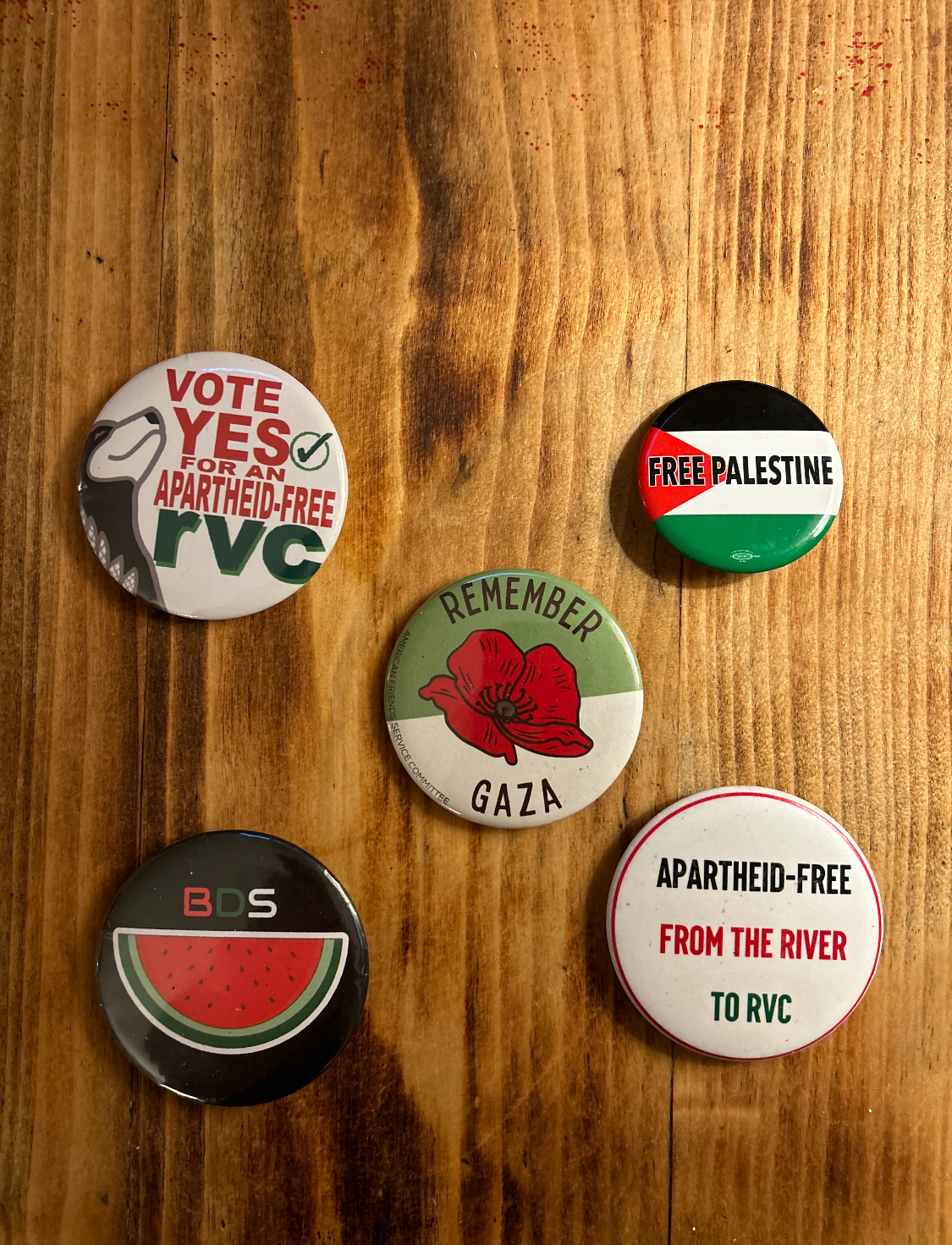
Hurley received a disciplinary action on Thursday for wearing a watermelon pin and a Palestine button. He said the policy as written forbids any pin that is not co-op issued, but he had never seen this enforced during his time at the co-op until this last week, during which time he reportedly saw employees asked to remove a pride flag pin, pronoun buttons, and a Bart Simpson button.
On Thursday, management softened on pronoun pin enforcement. Hurley said management had promised to provide co-op branded pronoun pins, and that in the meantime, employees were welcome to put their personal pronoun pins back on.
“Our nametags do have our pronouns on them in small font, but in reality how many trans employees want people staring at their chest to see their pronouns,” Hurley said in a phone interview with The Shoestring. “A button is bigger and can be placed up higher on the shoulder.”
On Friday afternoon, employees received another communication walking back stricter enforcement of dress code as it relates to pins and buttons, but this message was short on specifics of how management would approach Palestine-related items.
“What I’m gathering is that we are all supposed to assume and know what is ‘harmful’ by their definitions, which I think would include ‘free gaza,’ but I don’t really know for certain,” Gabe Baillargeon, a three-year employee of the co-op, told The Shoestring about the enforcement rollback notice.
Baillargeon and Mona Shadi, an Arab Muslim employee, both told The Shoestring they received disciplinary notice for wearing pins in the past week. Baillargeon said he tested the button policy by wearing a “world’s greatest dad” button. He says a manager on duty at the time told him he could remove the button or receive a disciplinary action.
“There’s no comparison here,” Baillargeon said of a conversation with superiors in which they told him customers were feeling hurt or unsafe over button-wearing.
“We’re talking about buttons versus people being bombed. It bothered me that this is the conversation.”
The Shoestring reached out to co-op management on both Thursday and Friday regarding the dress code policy, but received no response.
In a sit-down interview with The Shoestring for a previous story, co-op board president Abby Getman Skillicorn and General Manager Rochelle Prunty spoke with The Shoestring about the co-op’s official disapproval of employees’ pro-Palestine buttons, because of a policy against buttons with slogans people “consider offensive.” Getman Skillicorn did not respond to an email from The Shoestring requesting the policy and examples of the slogans customers had found objectionable.
Eon Fontes, a regular customer of the co-op, emailed co-op leadership about his concerns that they were retaliating against employees with the crackdown on personalized pins and buttons in the wake of the vote on the Apartheid-Free Coop proposal.
“I have now learned that you are retaliating against workers and they will no longer be allowed to wear BLM or Pride pins,” Fontes said in his email, which he shared with The Shoestring. “It seems as though the coop is trying to intentionally alienate its customers instead of letting this issue drop.”
Prunty responded to Fontes saying that this was not retaliatory to employees but enforcement of “longstanding” policies “designed to help maintain an environment of inclusivity.”
“Upholding our existing policies will support that healing process and give us the opportunity to reset our priorities for a welcoming environment in the co-ops stores. That is all we are asking of our employees, there is no retaliation,” Prunty said in the email to Fontes.
Co-op member Matt Spurlock shared Fontes’ views.
“Issuing disciplinary notices to employees for wearing buttons a day after the national elections is a disappointing act of cowardice,” he said in a phone interview.
But dress code enforcement is not the only shift at the co-op drawing members’ attention.
Spurlock told The Shoestring that the co-op’s eight member board is seeking to ratify a by-law change that would increase the threshold of member-owners required to call a “special membership meeting.”
A special membership meeting was previously triggered by member-owner organizing efforts after the co-op’s board of directors initially rejected the proposal to remove Israeli products from the store. This then required a vote by member-owners on the proposal, which would serve as an advisory poll for the board. This meeting took place on October 30th, with voting taking place remotely in the weeks leading up to it.
A press release from the consulting firm Anthony L. Cignoli Associates, Inc. — whose previous clients include the campaign of Hampden County Sheriff Nick Cocchi and corporate clients like Verizon, Tennessee Gas, and AT&T — announced the results of the vote to the public: 78% of respondents disapproved of the boycott, they said. Co-op leadership only shared the results with membership following the announcement to the press.
Leading up to the conclusion of the month-long member-voting period, co-op messaging to member-owners encouraged them to vote against the proposal. Leadership sent numerous emails to members arguing that “one group of co-op owners does not have the right to force this action on others.”
Shortly after the October vote, River Valley Co-op emailed members notifying them of the vote on the by-law change and the upcoming 2024 board election. Spurlock provided member-owner ballot language for the election to The Shoestring.
“Having just experienced the amount of organizational effort and level of expense required to pull together a special membership meeting this year, we saw that we needed to update this section of bylaws to require a more reasonable number of members to call a special membership meeting,” the ballot read.
“The best practice for this in food co-ops is 15% of the membership,” it continued. “This change protects the co-op from the potential of being required to undertake substantial efforts and expenses for special membership meetings by petitions from a small number of members.”
According to the polling data released by Anthony L. Cignoli Associates and the co-op, a “record high level” of voters participated in the October vote triggered by member-owner organizing. That “record high” represented only about 21% of membership, raising concerns, Spurlock said, about the achievability of a 15% threshold for future member-led initiatives.
The proposed bylaw change will require 66% approval from co-op member-owners. Voting members of the co-op — only one per member household — have until Dec. 4 at 10pm to vote on ratification of the bylaw.
Shifts in the co-op board of directors’ personnel have begun taking shape, as well.
The co-op board is typically composed of nine co-op owners, according to the company’s website. On October 29th, Angela D’Souza emailed member-owner and contact for the apartheid-free co-op campaign Molly Merrett disclosing resignation from her role on the River Valley Co-op Board of Directors. Her resignation came ahead of the Oct. 30 special meeting.
“I will no longer be able to correspond with you as a director, since I have, today, resigned from the River Valley Co-op Board. I hope to be of better service, as a member owner, in working towards our shared liberation,” D’Souza wrote in her email, provided to The Shoestring by Merrett.
D’Souza said in an email to The Shoestring that she was unable to say much about her resignation or her time on the board. She told The Shoestring that board members are required to adhere to confidentiality regulations even after they resign.
Four candidates are running for three seats in the 2024 co-op board election, currently taking place on a rolling basis until Dec. 4. However, only three of these candidates were nominated by the current board members.
Henry Morgan, the candidate not selected by the board, was added to the roster of candidates by a petition of members.
“The recent challenges I faced in getting on the ballot highlight why we need renewed focus on democratic participation,” Morgan told The Shoestring in an email. He said he continued to face administrative barriers in his campaign despite collecting more than double the required number of member signatures.
“The nominations committee initially rejected my candidacy, citing a ‘conflict of interest’ between human rights advocacy and fiduciary duty. This reasoning reveals a troubling perspective that pits ethical considerations against financial interests.”
Morgan said the strong member support behind his candidacy petition reflected a desire from members for more democratic engagement in decision making and co-op governance.
“We need leadership that views member engagement not as a challenge to be managed, but as the cooperative’s greatest strength. Member-led democracy isn’t just about voting—it’s about fostering ongoing dialogue about our values and how we put them into practice.”
For Spurlock, recent messaging and actions from co-op leadership has not lived up to the coop’s stated ideals.
The board’s actions and words, he said, “are a morally bankrupt response to Israeli apartheid. And they are inconsistent with the justice, human rights, and anti-racism values that many Board members claim to champion.”
Spurlock added that the recent messaging from the co-op around the boycott would have also disallowed the South African goods boycott and Driscoll berries boycott.
“It bears notice that the first policy… of the River Valley Food Co-op is to be a ‘just marketplace.’”
The Shoestring is committed to bringing you ad-free content. We rely on readers to support our work! You can support independent news for Western Mass by visiting our Donate page.

Tommy Lee is a writer, investigative journalist, and audio video producer for community television based in Western Massachusetts.


