


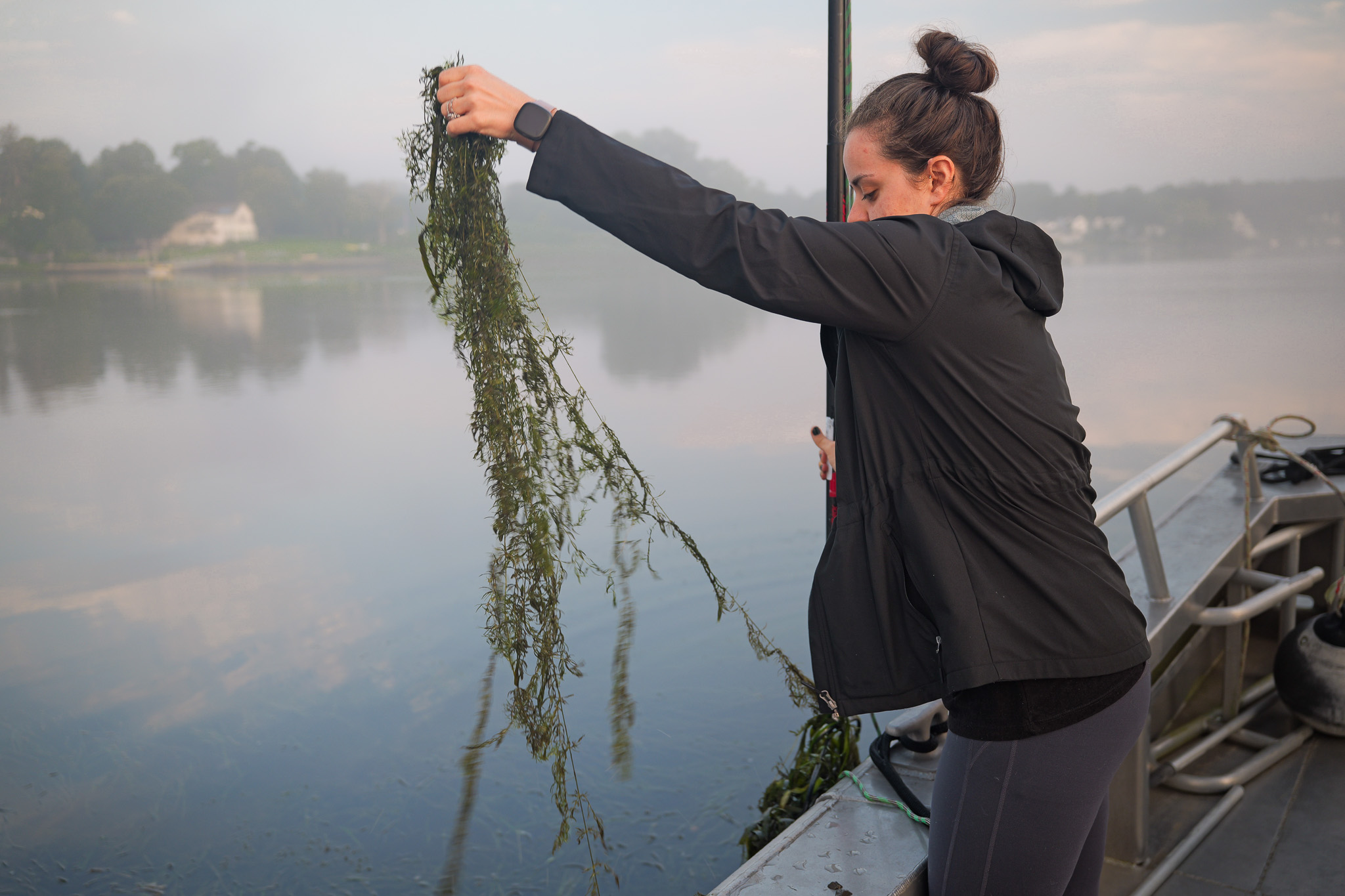
It’s often referred to as “the perfect weed.” And experts say it is choking out large swaths of the Connecticut River and its tributaries.
Last week, the U.S. Army Corps of Engineers and the Massachusetts Department of Conservation & Recreation held a hybrid public stakeholder meeting at Longmeadow High School to provide details about a proposed research and demonstration project in an area of the river between Longmeadow and Agawam.
The target of their efforts: the invasive, noxious aquatic plant hydrilla.
The project, which will begin with rhodamine dye studies this summer, aims to further research addressing the aggressive invasive aquatic plant that is compromising vast sections of the river and its tributaries. However, the Trump administration’s slashing of federal funding may present prohibitive barriers to the completion of the demonstration and research study, which would have a handful of stages. The two most visible stages to the public will be the dye study, and an herbicide application the following year.
Hydrilla (hydrilla verticillata), which spreads across bodies of water in dense, thick mats, has been found in areas of the river from Agawam to the Long Island Sound. The plant is common in aquariums and has been introduced to bodies of water when people dump it into watersheds. It has earned its “perfect weed” nickname, as Army Corps of Engineers project manager Keith Hannon puts it, “because it tolerates a wide range of water conditions, easily reproduces, spreads by multiple methods, and is difficult to control.”
This hydrilla infestation is threatening both the ecologic and economic viability along the Connecticut River, according to private and public groups involved in managing and assessing the problem. It is harming aquatic wildlife, impeding recreation activities like boating and fishing, slowing business at marinas, reducing waterfront property values, and can have far-reaching impacts on tourism markets along the river.
Hydrilla, which is able to spread through a variety of means — including fragmentation, and hitching rides on wildlife and boats — is quickly outcompeting its native counterparts that aquatic wildlife rely on for food, shelter, and breeding. First identified in the Connecticut River in 2016, the aquatic plant, which was previously considered rare in the river, has now been confirmed to be established in 842 acres of the river, according to collaborative research surveys.
“It’s problematic for a lot of the native plants, it blocks light, and absorbs a lot of the dissolved oxygen which can have an effect on aquatic wildlife like fish,” Hannon told stakeholders. “It is somewhat salt tolerant, it is also adapted to grow in very low light and low C02 conditions. Generally it can double in biomass every two weeks during the growing season.”
Hydrilla can grow to twenty five feet, completely filling water columns. This not only creates navigational challenges from humans and aquatic wildlife but also raises concerns among researchers studying the river’s watershed about slowing water flow and potentially increasing flooding risks along the river. Reduced water flow also increases breeding sites for mosquitos, which can spread diseases in humans and animals.
In addition to the Connecticut River, researchers have recently confirmed the hydrilla presence in isolated lakes and ponds, some quite far from the river including the north west corner of Connecticut in the East Twin Lake.
“It is finding ways to spread and be carried from its source in the river to these isolated locations, so that has a lot of people concerned,” Hannon said. “In 2023, there were six confirmed isolated lakes or ponds and last year in 2024 it was up to 10, so it seems to be increasing.”
Climate change may also be a driving factor behind the spread of hydrilla, and other invasive species, as warming water conditions expand habitable zones for the plant to thrive.
The Shoestring relies on reader support to make independent news for western Massachusetts possible. You can support this kind of labor-intensive reporting by visiting our donate page.
Health impacts to humans and wildlife from the plant’s success in and around the river are also wide reaching.
Cyanobacteria, which are naturally occurring microorganisms, can produce powerful toxins and have been linked to hydrilla. Not all cyanobacteria produce toxins, and even the types that do are only problematic under the right conditions. Those conditions, however, tend to include warm, slow-moving water, which is an associated effect of hydrilla infestation. Human exposure to toxic blooms can cause skin and eye irritation and ingestion can cause gastrointestinal issues. In more significant quantities, it can cause liver or neurological damage.
Neurological disease in wildlife has also been linked to a type of cyanobacterium growing on hydrilla, affecting bald eagles, other predatory birds and waterfowl, fish, reptiles, and amphibians. This hydrilla cyanobacterium neurologic-disease relationship, however, appears to require a source of bromide to create the lethal combination that leads to the fatal neurologic disease in wildlife. Bromide can come from natural geologic sources and human driven sources like water treatment plants and even aquatic herbicides. This presents further challenges in invasive species management approaches and limits some chemical options.
Ben Sperry, a research biologist and engineer with the Army Corps of Engineers who is the technical lead for this Massachusetts demonstration project, also leads the corps’ aquatic plant management research team. He explained their role in identifying management strategies with state agencies.
“We are called in quite often to serve as subject matter experts not only for aquatic plant control but for various regulatory pieces related to aquatic herbicides or biological control agents. “We also collaborate with many universities … We are just one piece of the broader R&D network that is focused on this project.”
Sperry said that there had been minimal applied research conducted until the Army Corps of Engineers “got the project off the ground,” and that understanding the genetics of the Connecticut River hydrilla strain is still a challenge.
“We’re still trying to figure out all of the details about it, but we do know since it invaded the Connecticut River, it rapidly spread and started causing issues with all of the uses of this system,” Sperry said. “Common sense tells us if we have a problem like hydrilla spreading in these systems we do need to manage those problems to maintain the uses and local economies that are dependent on it.”
Some of the data gaps researchers are still evaluating are details of growth and reproduction cycles of the Connecticut River hydrilla strain, water exchange dynamics in the river and other infested sites, critical management timing in relation the the plants life cycle, and identifying the most effective selective chemical control strategies.
Lakes and Ponds Program Manager Kara Sliwoski of the Massachusetts Department of Conservation and Recreation told stakeholders during Tuesday night’s meeting that DCR has been collaborating and coordinating throughout the northeast to track and manage hydrilla among other issues.
Massachusetts, Sliwoski said, was a member state of the Northeast Aquatic Species Nuisance Panel, and since the initial discovery of the Connecticut River strain of hydrilla during 2015 and 2016, all of the states surrounding the river were notified and began to coordinate efforts to survey the river annually.
“Everyone has a preference for obviously early detection and rapid response to any new aquatic invasive species because that’s when you have the best chance at successful management,” Sliwoski said.
A 2018 river survey identified the hydrilla in the river near Agawam — covering a half acre at that time and now covering more than 16 acres — and later this same hydrilla strain was found in one other area outside the river in Southwick’s Lake Congomond.
“To the best of our knowledge right now, this is the only site outside of the river in Massachusetts that does have this Connecticut River strain of hydrilla,” Sliwoski said.
A full river study was completed in 2024, identifying the Agawam area to still be the only hydrilla concentration in the river in Massachusetts. Depending on future funding, “we will consider either additional surveys of the tributaries coming into the river,” among other research options, Sliwoski said.
There are generally a handful of methods of aquatic invasive management tools available to the Army Corps of Engineers and other management partners. Those were described as selective herbicides approved by the Environmental Protection Agency, non-selective bio-control like fish that eat the plants, mechanical harvesting, benthic barriers to block out the sun and try to snuff the plant out, or selective bio-controls if they exist.
Many of those tools are not effective for rapid management use, giving the plants time to spread, or have additional risk considerations. Benthic barriers, for example, which are installed on the bottom of a water body, require significant planning and careful removal of other aquatic wildlife species in the area like muscles.
“Other methods used like mechanical harvesting, they are very expensive, only minimally effective, and actually cause the plant to spread further, which is an unanticipated result,” Hannon said. “Chemical herbicides are the most effective and selective way to control hydrilla. Selective means it can actually preserve some plants and just target the hydrilla.”
The plan for the Agawam site — depending on the flow of federal funding — has six prongs. The first prong is the dye study this summer to better understand the water exchange dynamics of the site and inform herbicide application and exposure time for the target plants. Sperry said the dye moves through the water column in a very similar way that herbicide moves. The second prong is to study the growth and reproduction cycle of the hydrilla at the site to find points in the plant’s cycle when it is most susceptible to herbicide treatment. The third prong is the herbicide application and observation of effects on the target species and non-target native and non-native species.
“We don’t just spray and walk away,” Sperry said.
When asked about the potential of plants developing herbicide resistance to partial or unsuccessful treatments, Sperry said that there had been some resistance development observed in hydrilla in Florida, and because of that they have been studying and testing a variety of EPA-approved herbicides. When questioned about effects on wildlife, or accumulation or transference in wildlife — also called bioaccumulation and biomagnification — Sperry said EPA testing had determined the aquatic herbicides to be safe, and that the Army Corps of Engineers had not observed any direct negative wildlife impacts in their prescribed applications.
The fourth prong of the Agawam site plan is post-herbicide application observation for a period of at least one year.
“We are very detailed in the amount of data that we collect post treatment. And in that process, we’re measuring things like the herbicide concentration over time,” Sperry said. “In most cases, to understand what is the restoration process looking like initially after these treatments.”
Sperry noted that in past studies, researchers have seen a reduction in other invasive species, like water chestnut, and sometimes unexpected reductions in native species like Ceratophyllum demersum, also referred to as coontail.
The fifth prong of the plan would be further background study biology and ecology of the plant, including cross pollination potential with other strains of hydrilla and methods of potential spread in the environment and in more northern reaches of the river. The sixth and final prong is to develop and disperse guidance to other agencies. This includes “master guidance documents, resource management workshops, and management protocols for various entities,” Sperry told stakeholders.
Realistic goals for hydrilla management were also important. According to Sperry, “eradication is not a reality right now, based on resources and just the magnitude of infestation.” With more work on developing management strategies, Sperry hopes that down the line, maybe eradication will be a possibility.
In recent years, the Army Corps of Engineers has conducted similar demonstration studies in the lower Connecticut River with various partner organizations. One of those organizations is the Connecticut River Conservancy.
Rhea Drozdenko, the conservancy’s river steward in Connecticut, who is familiar with the demonstration projects, told The Shoestring in a phone interview about a dye study she had previously observed. Drozdenko also explained that the rhodamine dye is inert, or not chemically reactive, does not harm plant life or wildlife, and dissipates fairly quickly.
“Honestly, I couldn’t actually really tell, without putting polarized glasses on. It wasn’t as dramatic as I had feared it would be,” Drozdenko said. “It was kind of a little bit pinkish in my view and I could just kind of see it when there was a motorboat waking a little bit. But it wasn’t that dramatic, and again, it is totally safe for the environment and has no adverse effects, and it does dissipate very quickly.”
Drozdenko also highlighted the challenges of understanding the water dynamics in specific sites and aquatic plant management with herbicide.
“Doing any sort of herbicide management in a pond, for example, is different than doing an herbicide management in a moving river,” Drozdenko said. “With the tracer dye being put in the water, we’re gonna see exactly sort of where it ends up, see where the flow goes, see where it might sort of slow or stop in some places.”
Drozdenko said there are a lot of people who are “suspicious of herbicides,” which she said was “reasonable and valid,” but that inaction was not really an alternative.
“If we allow hydrilla to keep taking over or if we let hydrilla take over other watersheds or river systems, we lose so many of the native plants that are really important to our ecosystems,” Drozdenko said. “So, we don’t want to completely give up, right?”
While research and management efforts are taking place from Agawam throughout the southern reaches of the river, experts are advocating for a focus on proactive prevention efforts in the northern reaches of the river and its tributaries.
“It’s really costly and really time consuming to try to remediate and treat hydrilla, but just taking the extra five, 10 minutes to make sure a boat or trailer is cleaned off, make sure it’s dried off, make sure there’s no plant material — that can really help,” Drozdenko said. “Any little chunk on a boat or trailer can become an absolute infestation in another site, so really prevention is key.”
During Tuesday’s meeting, Lou Kornet, a recreational user of the river who said he was “representing one of the marinas” in the area, expressed concern about the hydrilla and asked what recreational users could do to help.
“This is really disturbing news,” Kornet said. “I don’t think the average person here in this area has any idea about the magnitude of the problem, and it seems pretty gloomy. So what can we do as individuals, reaching out to our legislators? Do you have any recommended action plans for us?”
DCR’s Kara Sliwoski reiterated that prevention and information sharing was the best management practice.
“Tell everyone that you know, the more people that are aware of this and can support this and be involved and interested, the better,” Sliwoski said. “Ultimately, because we want everybody to be aware of what’s going on and the work the corps is doing in partnership with us at DCR, and public education and outreach is such a big portion of all work that the board does, or we do at DCR.”
Sliwoski also pointed to additional resources and information to be found on the Army Corps of Engineers’ website, and DCR’s website, including aquatic species identification classes, informational signage that can be provided to be placed at boat ramps and recreational spaces, and booklets and handouts.
“You can reach out and we can coordinate with you. We all, you know, cover the whole state, we’re a small but mighty team,” Sliwoski said. “Whatever you need, we’re here to support you.”

Tommy Lee is a writer, investigative journalist, and audio video producer for community television based in Western Massachusetts.


