

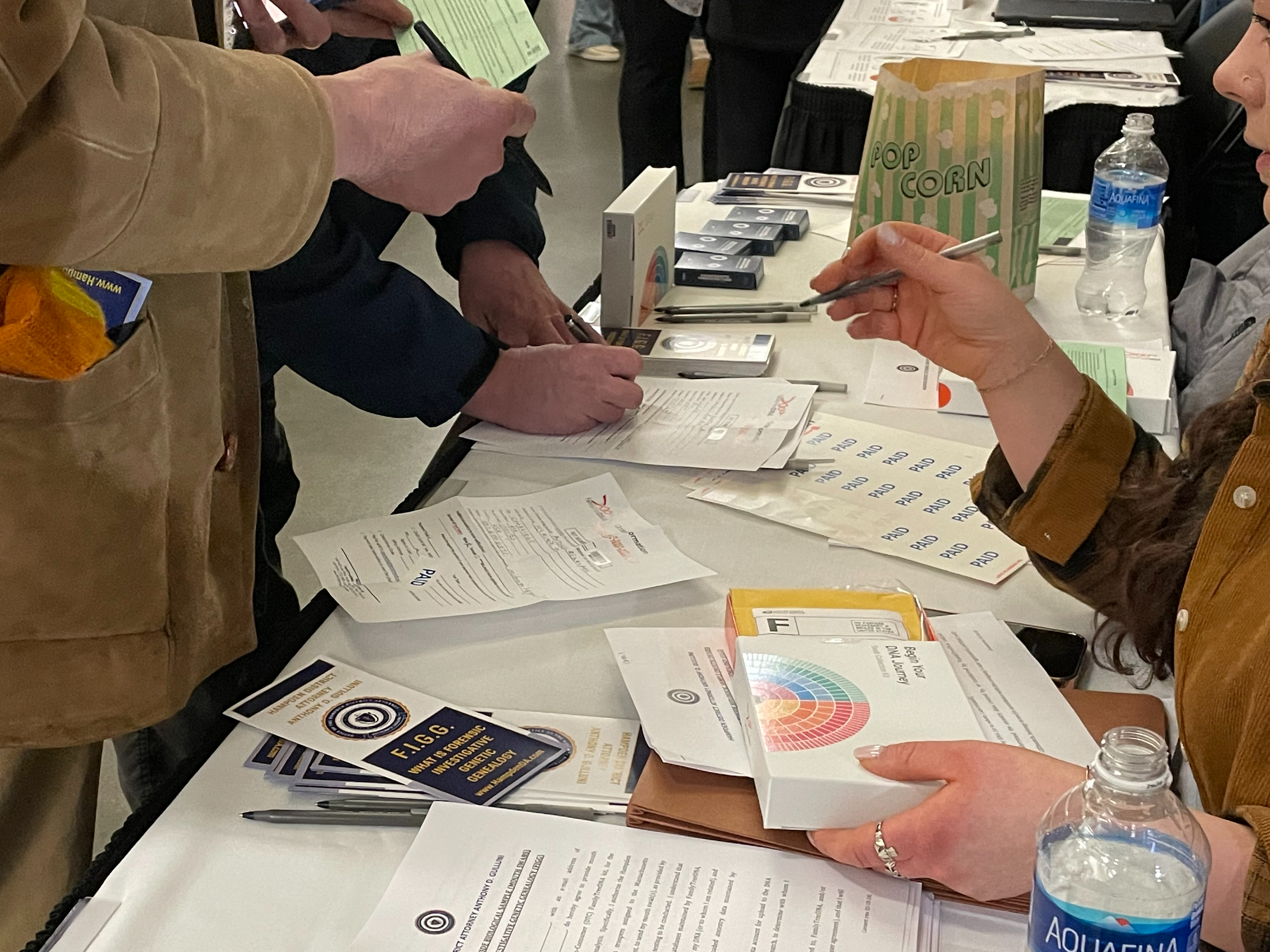
A giant American flag waved outside. Pop music blasted through the overhead speakers and people moved in throngs between tables, concession stands, restrooms, and stadium entrances. Various types of police vehicles danced on ice, their sirens blasting inside the arena.
This was the Springfield Thunderbirds M&T Bank “hometown heroes” hockey game on Jan. 27, and on folding tables among concessions and vendors, the Hampden County District Attorney’s Office was collecting DNA.
“It’s time for you to be a hero,” proclaimed a pamphlet at the DA’s table, urging passersby to contribute their DNA to the agency’s forensic investigative genetic genealogy program in exchange for a free ancestry test. Alongside the pamphlets and FamilyTreeDNA test kits were stacks of consent forms and decks of playing cards featuring photos and information about Massachusetts unresolved cases, produced by the Massachusetts State Police in 2021.
District Attorney Anthony Gulluni claims in the pamphlet and on its website that “forensic investigative genetic genealogy” technology, known as FIGG, “has solved some of the country’s most notorious cold cases” and that “it can do the same” for Hampden County.
“With your help, this DNA based technology will bring overdue justice to homicide victims and their families,” the pamphlets read. “We will pay for the test, and you will get your ancestry history.”
Proponents of FIGG investigative techniques say it can be a vital tool for solving cold cases. Just last week, for example, Gulluni announced “a significant milestone for law enforcement in Hampden County”: the arrest of Jamie Dodge, a 48-year-old Maine resident who prosecutors have alleged was involved in a sexual assault and kidnapping in the town of Holland in 2000.
“For the first time, forensic investigative genetic genealogy has contributed to the arrest of an offender,” Gulluni said.
However, civil liberties advocates, some defense attorneys, and educators have raised privacy and transparency concerns about the technology. As one example, they say it undermines people’s right to genetic privacy, which could also erode confidence in critical public health interventions like the screening of newborns for genetic disorders. Already, the American Civil Liberties Union has criticized police for having subpoenaed newborn blood samples to investigate cold cases.
“Allowing the government to access samples with such sensitive information for reasons other than public health would seriously threaten our privacy — particularly given that our DNA reveals such information not only about us, but also our family members,” the ACLU’s Crystal Grant wrote in 2022.
FIGG technology works by gathering vast amounts of DNA samples from the public to create genetic family trees. These family trees are then used to identify “common ancestors” between sample providers and DNA samples collected from crime scenes, enabling law enforcement to find “additional investigative leads which can identify potential suspects,” according to the Hampden District Attorney’s Office website.
“It is believed that if just 1% of the population’s DNA was available for comparison,” the web page continues, “almost any murder or rape, where there is DNA evidence available, a suspect could be identified.” This would amount to 3.4 million people in the United States.
The website also estimates that the “average person” has 1,500 fourth cousins — people who share a great-great-great-grandparent — which is a genetic relations level that is relevant to the field of their genetic comparison searches in identifying suspects from DNA collected in investigatory efforts.
“Traditional investigative methods are then employed to gather additional evidence and confirm the identity of the person genetically linked to the crime,” the DA’s pamphlets say.
During lulls in table traffic, DA staffers at January’s hockey game called out to people passing by, asking if they were interested in knowing their ancestry or helping to solve cold cases. Most of these people appeared to be men and many were actively drinking alcohol they carried with them from nearby vendors.
While alcohol does not change or alter a person’s DNA from tissue cells, like the ones found on the inside of your cheek, it can affect the quality of the sample provided. The company that provided the sample collection kits – FamilyTreeDNA – “highly recommends” in their instructions that swabs be done first thing in the morning before eating, drinking, or smoking, as do instructions from top competitors in the market, like Ancestry. Plus, there is the question of informed consent for DNA testing.

It was challenging to hear staff responses or hear responses to interview questions from the people being sampled over the volume of the music and stadium noise. Generally, it took between 1-2 minutes for people to sign both required consent forms and be swabbed.
Kirsten Taylor, a participant in the sample collection, said she felt the program was a “good idea if it helps give families some closure.”
“Some families that have been wondering for years,” she said.
Another participant in the sample collection, Antonio Regalado, editor at the for MIT Technology Review, said he drove to this event specifically “to become part of the DNA dragnet” and write a story himself. He told The Shoestring he had never wanted to participate before and that “you never know” what might happen in the future or how the information collected will be used.
“Maybe in the future they can use the DNA to maybe know things about me,” he said with a shrug. “Or maybe I give up my chance to get away with something.”
But whether the technology is as effective and accurate at solving crimes as prosecutors hope remains to be seen.
“The general public has the misconception that DNA is the final word as far as determining guilt,” Creaig Dunton, an associate professor of criminal justice and criminology at Western New England University, told The Shoestring in an email. “But there are always procedural elements in collecting, processing, retaining, etc. This, coupled with familial DNA/genetic genealogy makes it all too possible for prosecutors to make scientifically weak matches seem much more definitive than they are, because many jurors think DNA is always right.”
Overall, Dunton said, FIGG technology “generally leaves a bad taste in my mouth,” for various reasons: systemic inequalities in the ways DNA samples have been collected and from which the resulting database was conceived, for example, as well as issues with technology, resources, and corporate interests. Dunton pointed to the Golden State Killer case, in which the technology was used. He said it revealed some of these overlapping issues, including how stipulations around the use of customer data are potentially subject to change when companies involved are acquired by other organizations.
“There’s concerning overlap with the technology, the resources, and corporate interests,” he said. “Many of these commercial heredity-tracing products may have stipulations about the use of customer data, but of course cannot make any guarantees what would happen should they be acquired by another organization.”
Initially, The Shoestring was not provided or allowed to view the consent forms on the DA’s office’s tables. When we approached the table to pick up a copy of the blank form and read it, staffers put their arms on top of the forms and pulled them towards their bodies.
“No you can’t have these, we don’t think you’re really interested in this,” legal counsel for the DA’s office Elizabeth Dunphy Farris said. Initially, Farris said The Shoestring had to file a records request through the DA’s web portal to view the forms that were being provided to the public, but later told us to handwrite a records request and provided the same forms on the spot and via email the following week.
In front of the collection table, Regalado provided us with his copy of the forms he received. Farris later explained that there were two consent forms people needed to read and understand before being swabbed for sample collection. One consent form was for the Forensic Investigative Genetic Genealogy and one was inside the FamilyTreeDNA kit.
FamilyTreeDNA is owned by biotechnology company Gene by Gene LTD, headquartered in Houston, Texas. Multiple privacy policies apply to FamilyTreeDNA’s products, including those of its parent companies, some of which stipulate ways that the companies “may be required to disclose personal data in response to lawful requests by public authorities.” Gene by Gene’s privacy policy also outlines the many ways users’ information is shared with third party service providers, processors, and agents.
This parent company privacy policy applies in conjunction with FamilyTreeDNA’s privacy policy and terms of service and usage. FamilyTreeDNA’s terms of service encourages users to read all policies as well as their law enforcement guidelines prior to use or purchase of their products. None of these policies were provided to participants during the Hampden DA DNA collection event at the “Hometown Heroes” game.
The Shoestring asked the Hampden DA’s office for records about the DNA program, and how many samples were collected at the hockey game, and for any and all policies regarding the implementation and use of the FIGG. The Shoestring also asked for records relative to the funding sources involved in the project, any successes the program has had so far, and future planned collection events.
In a statement, the DA’s office told The Shoestring it could not provide positive program results or cases resolved by the program, or success of the program, citing multiple exceptions to the public records law related to privacy, police investigatory efforts, and law enforcement techniques.
However, the office said 48 samples were collected at the Jan. 27 hockey game, and that as of March 7, 91 people had signed up online to have their DNA tested and 36 of those online sign-up samples had been collected. The record provided with this statement was 16 pages of completely blacked out digital records said to be representing the office’s processing documentation for the FamilyTreeDNA kits.
In response to the question of funding sources, Assistant District Attorney Cynthia Payne provided an unpaid invoice from Gene by Gene Ltd addressed to the Hampden DA for “forensic autosomal testing.” The invoice is dated July 2023 with a $12,250 total.
The Hampden DA’s office does not have any policies around disclosure of the use of FIGG in cases brought by the Hampden DA. When asked about the scope of FIGG use in cases pursued by the Hampden DA — or other law enforcement agencies — and whether or not any limitations existed for what types of cases FIGG could be used as an investigative tool, Payne said the DA’s office was not legally required to provide a response to the question. Payne gave the same response to a request for clarification around use limitations of DNA samples collected by the DA’s office and whether or not those samples would be accessible to other law enforcement agencies.
“I think that lack of transparency isn’t by accident because law enforcement and prosecutors would likely prefer to maintain that image of DNA being unimpeachable,” Dunton, the Western New England University professor, said. “And the technology is probably not the easiest to explain in a public setting.”
While law enforcement agencies regularly tout the success of these models — by identifying the “Golden State Killer” via familial DNA testing, for example — and applying it to other cases, the chain of evidence is not as clear cut in other applications. In the Idaho case of Bryan Kohberger, his legal defense has argued that the state initially withheld the use of investigative genetic genealogy in their investigation and have refused to provide documents related to the genetic work that led to his arrest, claiming privacy exemptions. Kohberher’s defense team said this has prevented them from being able to see the process used and to ensure that the practices used by law enforcement agencies were legitimate.
Familial DNA has also led to the investigation of innocent people. In 2015, a partial familial DNA match led to the investigation of a New Oreleans filmmaker, Michael Usry, who said he waited in suspense for about a month while the police worked out whether or not they believed he was a viable suspect in a murder case due to the partial match.
In response to past and future planned DNA collection events the HDAO told The Shoestring online testing sign-ups would remain open. One event was previously held in August 2023 at the Brimfield Winery. Seven DNA samples were collected at this event. The event, called “Holly’s Hope DNA Day,” was related to the 1993 murder of Holly Piirainen, whose remains were found in Brimfield nearly three months after she went missing. In February 2023 the Hampden DA revealed what prosecutors said was new evidence related to the case to the public: a T-shirt found in the vicinity where Piirainen’s remains were discovered.
This is not the first time Hampden district attorneys, past and present, have focused their efforts on the Piirainen case. In 2020, Gulluni’s office exhumed an unidentified body from a local grave in connection with the case. Eight years prior, then-District Attorney Mark Mastroianni announced an unspecified “forensic link” to a deceased Springfield man, releasing photos of the man to the public, and in 2018 launched a tip line called “Hope for Holly.”
Promotional flyers for the 2023 Holly’s Hope DNA Day had similar messaging to the Springfield hockey game collection event, calling it a “community effort to assist investigators of violent and unsolved crimes,” and free FamilyTree DNA ancestry kits at no cost.
(Massachusetts district attorneys have tried to stay on the cutting edge in the past to solve children’s disappearance cases. In 1951 in Quincy, District Attorney Edmund Ewing traveled to Virginia and reportedly asked a psychic horse, Lady Wonder, for help in locating missing boy Danny Matson. Police found Matson’s body a week later, basing their search efforts off the response Lady Wonder provided.)
Privacy and consent concerns continue to arise around the FIGG investigative model. A 2023 investigation conducted by The Intercept found that multiple genealogists working with police across the country had been successfully exploiting loopholes of ancestry DNA databases to search the DNA profiles of people who had explicitly opted out of this practice. The investigation also revealed that the DNA testing companies themselves were routinely involved in privacy-rule breaking. In one such example, The Intercept reported a single-handed decision by an ancestry DNA database co-founder to allow police to search the database for a person suspected of assault without notice to its users.
In May, CNN also revealed that police had used DNA databases beyond the disclosed scope of “violent crime” and had used DNA evidence to solve a prison break.
Despite those concerns, some organizations are riding high on the promises of FIGG technology. Franklin County Pride, for example, re-shared a “missing persons event and DNA drive” hosted by the DeKalb County District Attorney in Atlanta via their Instagram account on May 8.
Gulluni’s office also appears to be galloping forward with the technology..
“This technology is a significant investigative tool and it will be utilized with greater frequency,” Gulluni said after announcing the arrest of Dodge last week.
The Shoestring is committed to bringing you ad-free content. We rely on readers to support our work! You can support independent news for Western Mass by visiting our Donate page.

Tommy Lee is a writer, investigative journalist, and audio video producer for community television based in Western Massachusetts.