

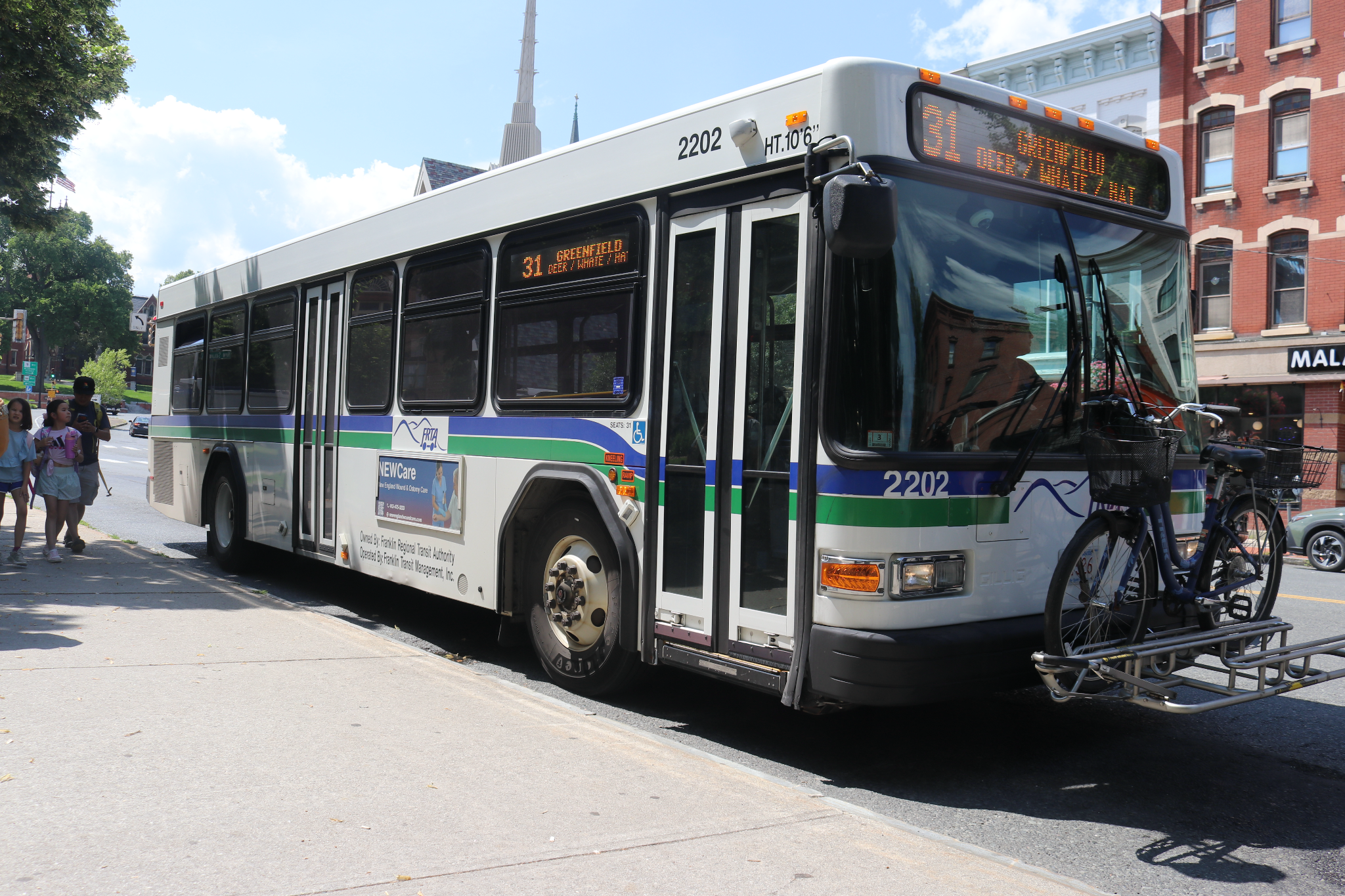
Every weekday morning, Greenfield resident Aeryk Engelbrecht catches a Franklin Regional Transit Authority bus to commute to his job at a local co-op. While waiting at his stop, he often scans the surrounding area for four-leaf clovers. During the ride, he reads, prays, or quietly reflects on the day ahead.
“I don’t have to spend any mental energy or pay attention to the road,” Engelbrecht said. “It gives me that time to think.”
For nearly three years, the Franklin Regional Transit Authority, or FRTA, has been a constant in Engelbrecht’s daily routine. Over time, he has built relationships with FRTA drivers and other regular riders on Route 31, which connects Greenfield and Northampton.
“I know at least half the drivers’ names, pretty much all the drivers’ faces, and at least 80% of the people who ride the bus, at least by face,” he said.
Engelbrecht is one of many riders who rely on the FRTA to commute to work, reach medical appointments, and stay connected across Franklin County and neighboring communities. But unlike larger transit systems in western Massachusetts, the FRTA serves one of the state’s most rural regions, forcing it to balance a vast service area with limited resources.
“We’re a very small organization, but at the same time we’ve got the largest geographic area out of all the transit authorities in the state,” FRTA Administrator Tina Cote said. With a coverage area stretching into Worcester, Hampshire, and Hampden counties, FRTA serves a total of 42 communities over 1,200 square miles.
The FRTA is one of only three rural transit authorities in Massachusetts, relying on Federal Transit Administration Section 5311 funding for rural public transportation rather than the urbanized-area funding available to larger systems.
“Funding is a huge issue,” Cote said. “If you compare the funding levels between the Worcester Regional Transit Authority and the Pioneer Valley Transit Authority with the rurals, you’ll find a huge difference.”
According to the Federal Transit Administration, the FRTA had $4.7 million in operating funds in 2023, compared with $57 million for the PVTA and $32.5 million for the Worcester Regional Transit Authority.
Financial constraints also shaped the FRTA’s approach to fare-free transit. The authority first suspended fares on its fixed-route buses in April 2021 as a pandemic safety measure to reduce contact between riders and drivers. After officials determined that the cost of collecting fares outweighed the revenue they generated, the FRTA Advisory Board continued extending the policy annually before voting to make it permanent in 2025.
“We’re not PVTA, or some of the bigger transit authorities that are collecting hundreds of thousands or even millions of dollars in fare box revenue,” Cote said. “We were collecting a couple hundred thousand dollars at best.”
More recently, state funding through the “Try Transit” initiative — a program backed by $30 million from Gov. Maura Healey’s administration to increase transit access and ridership — allowed the FRTA to expand fare-free service to its Demand Response program, which provides curb-to-curb transportation on request by eligible riders, through June 2027.
Interviews with FRTA riders and officials, along with public records obtained by The Shoestring, reveal that while ridership has rebounded since the pandemic and with the introduction of free fares, the FRTA’s larger challenge is improving connectivity across one of Massachusetts’ most rural service areas. Riders identified gaps in evening, weekend, and geographic service, while officials pointed to financial constraints that continue to shape where routes can be expanded, how frequently buses can run, and whether improvements can become permanent.
Now, FRTA officials are focused on hiring additional staff, increasing outreach and marketing efforts, and improving connections to smaller towns and hilltown communities through projects such as the new G47 route — developed in partnership with the PVTA to connect Northampton, Westfield, and Southwick — and an upcoming pilot program connecting Bernardston and Northfield.
However, officials say the longevity of these efforts will depend on securing additional staffing and funding.
***
The FRTA’s decision to eliminate fares on fixed routes came during the pandemic, when the system was experiencing dramatic declines in ridership. Annual trips fell from 158,000 riders in fiscal year 2019 to roughly 48,000 riders in 2021, marking the FRTA’s lowest ridership level in a decade.

Following the introduction of free fixed-route fares in April 2021, ridership steadily increased. In 2024, it reached its highest level in nearly a decade. With additional funding through the state’s Try Transit initiative, ridership continued to grow in 2025, reaching nearly 193,000 riders.
For the FRTA, the decision to remain fare-free was both an economic choice and a way to reduce barriers for low-income riders.
“What we found in research is the cost to have those fare boxes to print the tickets and count the fares ended up being more than we were collecting,” Cote said.
FRTA Deputy Administrator Michael Perreault added that eliminating fares “helped an already depressed riding population, who’s already struggling, become more mobile in our region.”
Ripley Waters, an Orange resident who relies on biking and the FRTA as their main forms of transportation, said that free fares have made it easier to rely on the system without worrying about added costs.
“It’s very nice to get by without having to pay any kind of fare,” Waters said. “I don’t have a lot of funds to speak of, so it helps a lot.”
While fare-free service initially only applied to fixed-route buses, the FRTA expanded the policy to its Demand Response program in November 2024 after receiving additional funding through the Try Transit initiative. Demand Response provides curb-to-curb, reservation-based transit for adults 60 and older, nursing home residents, and veterans with qualifying disabilities.
***
Even as the FRTA is experiencing historically high ridership, expanding fixed-route service across its large service area remains a challenge. The FRTA currently operates seven fixed routes that connect communities stretching from Orange to Charlemont, and Greenfield to Northampton.
To better understand the reach of FRTA service, The Shoestring mapped routes and stops using General Transit Feed Specification data, an open-source framework used by transit authorities to provide route, schedule, and service information. The analysis overlays member community populations to illustrate density differences across the FRTA’s service area and how these differences shape fixed-route coverage.

While fixed routes extend across much of the region, service is concentrated along several corridors that connect larger population centers. All routes converge in Greenfield, which serves as the FRTA’s central hub and is its most populous member community.
All 42 FRTA member communities have some form of coverage, but many are limited to Demand Response service or microtransit through the FRTA’s Access Program, which was launched in 2019 and allows riders of all ages to schedule on-demand trips either the same day or in advance.
In fiscal year 2025, fixed-route buses accounted for the majority of FRTA trips. However, its two on-demand services — Demand Response and the Access Program — made up nearly 18% of the FRTA’s total ridership, underscoring their importance in transporting riders throughout the area.
“It won’t happen before I retire, but we’d like to have much more expansive service up into the hilltowns and some more of those smaller towns,” Cote said. “When I started, there were maybe six towns that had fixed-route service. Now we’re up to maybe 11.”
For the FRTA, grant-funded pilot programs are often the first step to expanding fixed-route service, as they provide ridership data and feedback that allow officials to evaluate whether a permanent route is viable.
Cote said the FRTA is currently using this approach in Bernardston and Northfield, where residents previously only had access to Demand Response service.
“The general public has not had access to public transportation in those two towns for as long as I’ve been here,” Cote said.
Expanding service into more rural communities, however, remains difficult when new routes must demonstrate enough ridership to justify becoming permanent. In cases where fixed-route service is not feasible, FRTA officials are exploring ways to use microtransit as a bridge between smaller towns and existing routes.
“We’re thinking of adding some stops on our Access Program so people can use microtransit to get to fixed bus route stops,” Cote said. “If we were to put an Access stop in a town like Ashfield that has no service right now — unless you’re over 60 — we’d be able to pick people up and bring them to Shelburne Falls, so that from there they can come into our hub in Greenfield.”
***
While expanding the Access Program could provide another option for communities that lack fixed-route service, the FRTA is already incurring significant costs to provide Demand Response service across its service area.
According to the FRTA’s 2025 Comprehensive Regional Transit Plan, in fiscal year 2024, Demand Response service cost $2.6 million — about half a million more than fixed route service. Broken down, that’s $73 per passenger, the plan reports — higher than the 2024 Massachusetts and national rural average. The service’s per-mile, per-hour, and per-passanger costs are also well above FRTA’s cost-effectiveness targets for that year.
When asked what was driving the increase, FRTA officials pointed to both the expansion of Demand Response service and rising operating costs, including wages, benefits, insurance, and fuel.
“When we started Demand Response in 2020, we were just doing Greenfield and Montague. We’ve expanded into Shutesbury, into South Deerfield, into Whately,” Cote said.
However, officials said they could not quantify how much of the increase was attributable to either factor.
“I just don’t know how to answer that question without making it seem like our costs are just through the roof, and that we should be discontinuing the microtransit,” Cote said.
Unlike a fixed route, Demand Response trips vary significantly depending on where riders live and where they need to go. Perreault, the FRTA’s deputy administrator, said projected miles have increased steadily over the past five years and are one of the service’s largest cost drivers.
The FRTA also does not have a single, straightforward way to determine the full cost of providing Demand Response service. While much of the service is operated by the FRTA’s management company, some communities provide Demand Response through their councils on aging, with different arrangements for staffing and operating costs.
That complexity also extends to the FRTA’s Demand Response cost-effectiveness targets. Perreault said the FRTA generally projects costs about two years in advance using historical data.
“Off the top of my head, I couldn’t tell you where we got the FY24 targets from,” Perreault said. “In terms of the targets, apparently we were off.”
Cote added that the targets are not necessarily benchmarks the transit authority expects to meet.
“I guess the best thing to say is that those were projections based on our best guess,” Cote said. “They’re not anything that we can hold accountable to say that was our actual target that we hit because things just change so much over each month and never mind years.”
Perreault said the FRTA nevertheless looks for ways to reduce costs, including purchasing fuel in bulk and using local partners to house vehicles closer to the communities they serve. He said the FRTA’s approach is ultimately to weigh the costs of providing Demand Response service against residents’ transportation needs.
“Costs are what they are,” Perreault said. “We’re looking at the benefit to the people in the region.”
***
Expanding geographic coverage is only one part of improving access. Interviews with riders highlighted limited weekend and evening service as one of the biggest barriers to relying on the system.
Aeryk Engelbrecht, the Greenfield-based rider, said the FRTA’s recent shift to hourly weekday service on Route 31 has been a significant improvement, but he hopes to see similar expansions on weekends.
“For the weekend schedule, the last bus leaving Northampton back home to Greenfield is at like 2:45 p.m.,” Engelbrecht said. “If you want to do anything on the weekend, you pretty much have to be in Northampton by 2:45 in order to get home.”
While riders highlighted more frequent service as a priority, officials said increasing frequency requires balancing rider demand with the realities of a rural transit system.
“If we put service every hour on the hour and we see that the two o’clock just has had zero people for months, we’re going to know that that really doesn’t make sense for us to run,” Cote said. “We’re always looking for opportunities to expand, but we use the data to make sure those services make economic sense.”
In March 2026, the FRTA expanded Route 31, which connects Greenfield and Northampton, to hourly service in response to demand from public hearings and surveys. Cote said the expansion was made possible “in part due to some of the funding that we received from Link413,” a two-year pilot program launched in January 2026 to improve regional connectivity between the FRTA, PVTA, and Berkshire Regional Transit Authority.
However, the long-term future of services supported by grant funding remains uncertain.
“If it’s a two-year program like Link413, and it’s successful but we can’t find funding to contribute to that service, then it kind of goes away unless participating communities come up with their share, in addition to state and potentially federal funds,” Cote said.
While Massachusetts has expanded transportation funding through the Fair Share Amendment, a tax on income over $1 million passed by voters in a 2022 ballot initiative, transit agencies must still compete for limited state resources.
Funding is only one challenge facing the FRTA. As one of the state’s smallest transit authorities, it also operates with a very limited staff.
“We don’t have an IT department, we don’t have a marketing department, we don’t have a legal department, so it’s just Michael and myself that do the day-to-day,” Cote said.
With only a handful of administrative employees, responsibilities that would typically be delegated across departments fall on just a few people at the FRTA. Implementing service improvements, coordinating outreach, and pursuing grant opportunities are all tasks left competing for limited time.
Perreault said partnerships have been essential as the FRTA navigates staffing constraints.
“We have to rely on a lot of additional partners to help with these types of large, complicated planning activities,” Perreault said. “That includes partnering with other transit authorities, where they have larger staffs that can dedicate more time and resources, and regional planning agencies.”
Those partnerships have allowed the FRTA to pursue projects beyond traditional fixed routes. One example is the new G47 route, which was developed in collaboration with the PVTA and connects Northampton, Southampton, Westfield, and Southwick. The FRTA is providing microtransit connections in Southampton and Southwick, which are a couple of their newer member communities. Early ridership data show the route has seen strong demand so far.
In upcoming years, the FRTA’s goal is not only to expand coverage, but to ensure that new service can be sustained. This will require a combination of long-term funding, increased staffing, and partnerships with other transit agencies, legislators, and community organizations.
“We’re just trying to provide a service to the public that they can rely on and be consistent with,” Cote said. “The last thing we want to do is put service out there and then two years down the road have to yank it.”

Madison Allred
Madison Allred is a recent graduate of Smith College, where she majored in economics and government.

Hayden Steinmann
Hayden Steinmann is a junior at Smith College double majoring in statistical/data sciences and sociology.