


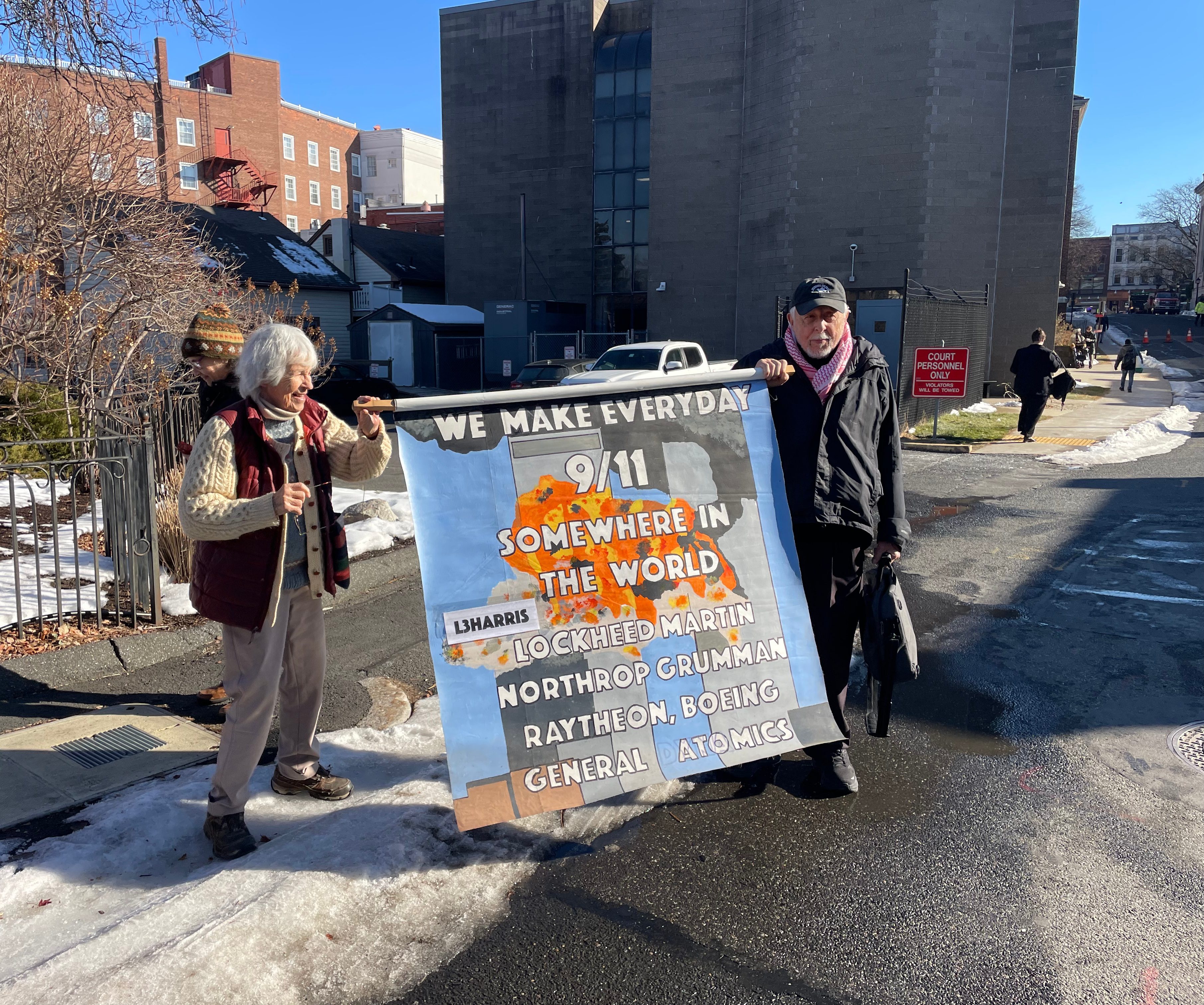
Four protestors charged with trespassing and disturbing the peace for occupying the lobby of defense contractor L3Harris’s Northampton facility appeared again in court on Thursday.
Their defense? That they had broken the law to impede L3Harris’s participation in a greater crime: supplying weapons components used in the ongoing genocide in Gaza.
The defendants — Nicholas Mottern, Paki Wieland, Patricia Gallagher, and Priscilla Lynch — carried out their action on March 19, rolling out yellow “caution tape,” tossing fake $100 bills they called “blood money,” and wearing shirts emblazoned with the words “L3 Kills.” After declining to leave, police arrested the four on charges of trespassing and disturbing the peace.
The protest was not the first, nor the most recent, in the campaign against the arms manufacturer. There have been two blockades of the facility, a “die-in,” and weekly standouts for the past three and a half years intended to remind the company’s workers that their products kill.
Speaking with The Shoestring, defense lawyer Jaime Rogers said that prosecutors had originally charged the defendants with criminal misdemeanors. Rogers said the defendants sought in the intervening eight months to bring their case in front of a jury, but in a final pretrial hearing, the prosecution motioned to convert the matter to a civil case — a motion that the judge at first denied, but later, of her own volition, decided to convert to a civil trial regardless.
“In this case, my clients wanted a jury trial because… they saw it as an extension of their broader outreach efforts,” Rogers said. ”The jury trial was for them a way to not only present their defense, but have the issues be heard and decided by the community — you know, by a jury. I think it connects to the goal that my clients had of trying to increase awareness of what’s going on with this particular corporation and with this particular humanitarian crisis in Gaza.”
While still seeking to influence workers at the plant, Mottern said in his testimony that the activists were also trying to get the attention of L3Harris’ CEO. He accused the company of violating laws set up to prevent the United States from shipping weapons to violators of human rights, including the “Leahy law” — a federal statute prohibiting the Departments of State or Department of Defense from providing military assistance to foreign entities for the violation of human rights.
“So we were trying to bring this forward to the CEO and say, ‘What’s going on?’” Mottern said. “We’re all born with a conscience, so we have to figure, yes, maybe the CEO has a conscience that could be activated by what we did.”
Mottern said that L3Harris CEO Chris Kubasik had not responded to the defendants’ previous attempts to contact him.
The defendants also cited the goal of inspiring more public action and support as reason for their action.
“We wanted to educate the people,” Wieland said in her testimony, “because once you know, you can’t not know.”
The defendants have invoked the necessity defense, which is a criminal defense in Massachusetts that requires a defendant to prove: “(1) a clear and imminent danger, not one which is debatable or speculative; (2) a reasonable expectation that his or her action will be effective as the direct cause of abating the danger; (3) [that] there is no legal alternative which will be effective in abating the danger; and (4) [that] the Legislature has not acted to preclude the defense by a clear and deliberate choice regarding the values at issue.”
As per those requirements, set out in the state’s criminal model jury instructions, the defense sought to point out that the protesters reasonably believed their action could lead to L3Harris’ deciding to stop supplying military equipment to the Israel Defense Forces, or cease producing such equipment altogether.
They also sought to demonstrate that they had exhausted other, legal options. In their testimonies, the defendants pointed to previous meetings with U.S. Rep. Jim McGovern in which they asked him to condemn the government’s ongoing violation of the Leahy law during the Gaza genocide. McGovern didn’t do so until near the end of the Biden administration, and Mottern said that attempts to convince the former U.S. Attorney for Massachusetts Josh Levy to enforce the Leahy law with regard to L3Harris were also unsuccessful.
The defendants submitted to the court a packet containing affidavits, including, including from experts touting the effectiveness of non-violent action for social change. Another was from Josh Paul, a former U.S. State Department staffer who resigned due to what he described as the department’s ongoing violation of the Leahy law in supplying arms to the IDF for use in Gaza.
The prosecution mainly tried to draw attention to the immediate ineffectiveness of this particular action and past ones, under the rubric that the goal was to get the attention of Kubasik and put a swift end to L3Harris’s support for the genocide in Gaza.
Judge Mary Beth Ogulewicz questioned the prosecution’s argument about the immediacy of the action’s effect
“Isn’t all social change incremental?” she asked the prosecution. “In other words, if some told Dr. Martin Luther King, and said, ‘Stop, stop at step one, stop at step two’ — isn’t that the theory of protest and political change?”
This was not the first time activists deployed the necessity defense in the Hampshire County Courthouse.
In 1987, well-known left-wing activist Abbie Hoffman and Amy Carter — the daughter of U.S. president Jimmy Carter — used the same strategy in their trial over their participation in the occupation of two UMass Amherst buildings to protest the CIA’s recruitment on campus. Hoffman, Carter, and their co-defendants won using the defense, arguing that their action was necessary to impede the CIA’s illegal support of the anti-communist Contra death squads in Nicaragua.
Speaking with The Shoestring, Mottern acknowledged that he and his co-defendants are pursuing the necessity defense with self-conscious reference to Hoffman and Carter’s trial. Though Mottern noted that they had originally pursued a jury trial as Hoffman and Carter had in 1987, “just to spread the word,” he said “this [bench trial] was awesome.”
“I think what we accomplished today was essentially a jury trial,” he said.
Ultimately, Ogulewicz did not give a decision, requiring time to review and take under advisement the contents of the packet the defense had tendered. The court will likely present a decision on or by Dec. 31.

Colin Weinstein is a worker-owner, journalist, and organizer living in Western Mass. He can be reached at cweinstein1@proton.me.
- Colin Weinstein


