

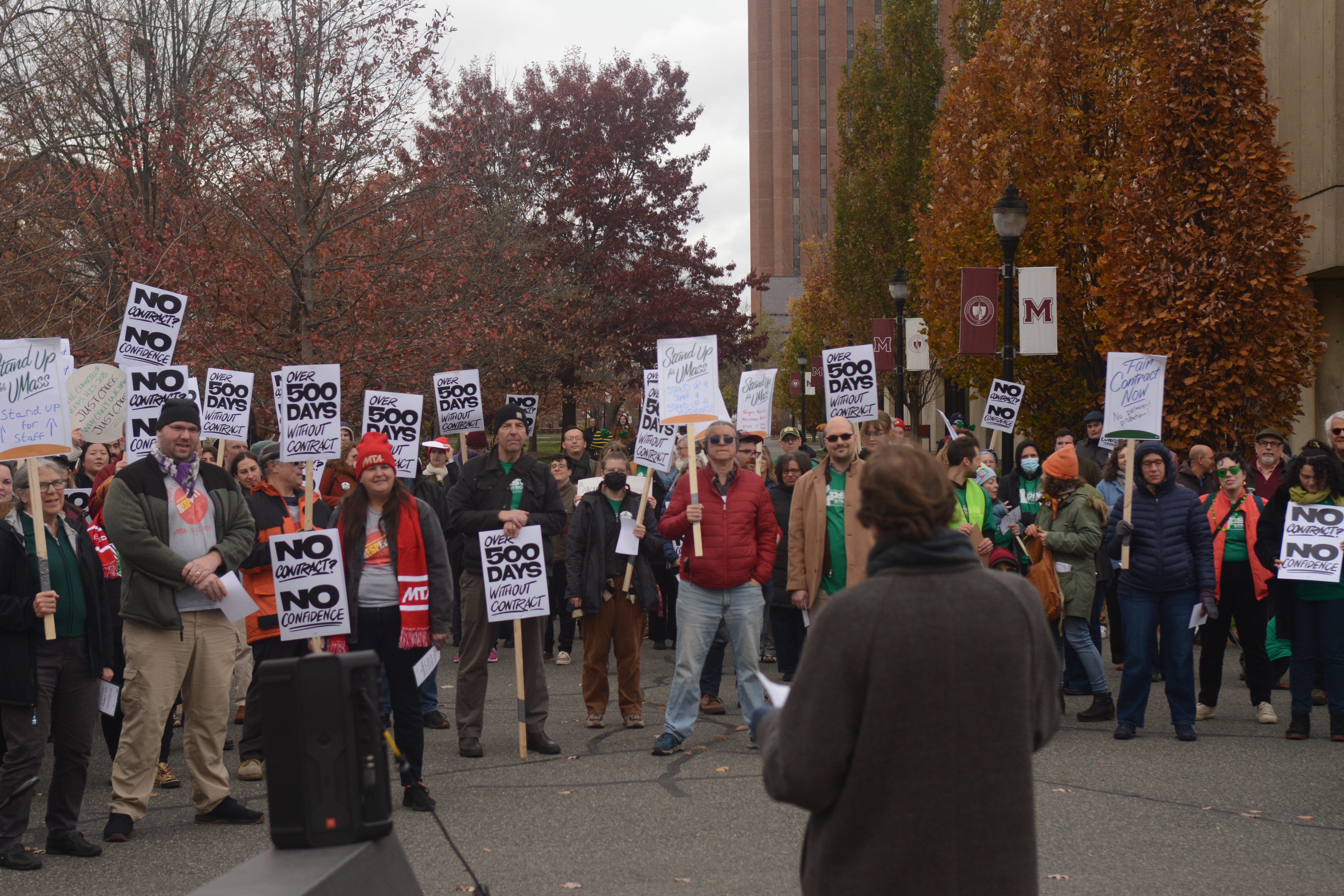
AMHERST – For more than 500 days, unionized staff members working for the University of Massachusetts Amherst have been negotiating a new contract, but disagreements over pay increases and working conditions continue.
As part of a public pressure campaign to bring the university back to the bargaining table, members of the Professional Staff Union organized a rally outside Chancellor Javier Reyes’ office last Thursday. They say that the university has requested a state-appointed mediator — a step that they’ve alleged means school leaders have put forward their final offer and could be preparing to unilaterally impose working conditions union members find unacceptable. The university has rejected that accusation, saying that at “no point has the university positioned our proposals as a final offer” and that mediation is “a standard part of collective bargaining” that it has successfully used with other unions recently.
“There are pervasive problems on this campus that prevent us from being able to give our best to all of our students,” Emmy Cooper, a PSU member and academic advisor at UMass Amherst, shouted through a megaphone. “We have a wages problem on this campus. We have a workload problem on this campus. We have a staff retention problem on this campus.”
More than 100 people stood in the cold wind outside the Whitmore Administration Building, listening to speakers, echoing pro-union chants, and holding signs that read, “No Contract, No Confidence.” Rally organizers distributed flyers styled like wedding invitations inviting Reyes to the union’s Dec. 3 vote on whether members have “no confidence” in his leadership.
“What we need at UMass Amherst is a chancellor who will stand up for all of us, our students, staff and our community. What we have is the exact opposite,” said Andrew Gorry, a co-chair of PSU.
Emily Gest, a spokesperson for the chancellor’s office, said that the protestors’ critiques are misdirected, and said that the university has always bargained in good faith with unions.
“The Chancellor does not serve, and has never served, on the bargaining team,” Gest said in an email to The Shoestring. “For the Chancellor or any party other than those designated as such to directly participate in the bargaining process would be inappropriate and counter to best practice in labor relations. The Chancellor appoints a team of labor relations specialists to serve as the university’s bargaining team.”
Jonah Vorspan-Stein, a PSU staff organizer and office manager, told The Shoestring via email that Reyes is still largely in control of union contract negotiations.
“While Chancellor Reyes has refused to attend any bargaining sessions, we understand that he is personally driving his team’s positions — including their takebacks and hardline strategies at the table,” Vorspan-Stein said. “Chancellor Reyes has spoken publicly and frequently about his desire to see PSU members’ cost-of-living increases tied to supervisor evaluations.”
After 38 bargaining sessions with no agreement, the university filed a petition last month with the Massachusetts Department of Labor Relations requesting a state-appointed mediator. The filing states that the “impasse” exists over issues to do with wages, employee evaluations, sick leave, “anti-privatization,” excessive workloads, non-exempt compensatory time, bias and discipline, and grant-funded employees.
“Requesting the assistance of a mediator is a standard part of collective bargaining, codified in state law, that any party can request after substantive bargaining does not lead to resolution,” Gest said.
To date, 43 bargaining sessions with PSU’s “Unit A” employees have taken place, with four more scheduled through Dec. 4. According to Gest, six other unions have settled contracts in fewer than 20 bargaining sessions.
Some of those unions, though they all have separate contracts, were engaged in putting forward several “joint proposals” during this past round of bargaining. Vorspan-Stein said that the unions saw progress on some of those proposals, including the university committing to build a new childcare facility, which was the multi-union coalition’s central childcare demand.
“The unions also developed a few shared bargaining planks, such as ‘Raising the Floors’ for our lowest-paid members — which remains a key sticking point in PSU bargaining,” Vorspan-Stein said.


“It is becoming increasingly clear to me that Chancellor Reyes is not here for the common good,” Cooper, the PSU member and academic advisor, said to the crowd at last week’s rally. “Over the last 17 months, Chancellor Reyes has directed his team to bully us, stonewall us, delay us, mislead us, lie to us and refuse to actually engage with any of these potential solutions.”
PSU leadership said they’re concerned the university’s filing for mediation means the school has put forward its final offer — a statement the university has disputed. It contains conditions that PSU finds unacceptable, including changing part of employees’ pay increases tied to cost-of-living-adjustment rates, and implementing a “merit pay” system with raises distributed to individuals based on job performance.
“The university is not attempting to replace cost-of-living adjustments (COLAs) with merit pay,” Gest said. “The university’s proposal has been to continue having COLAs as part of the compensation system, but to integrate a performance-based compensation element alongside the COLA. Details on these proposals have been presented multiple times throughout the bargaining process.”
“We are saying no to this Hunger Games university where members have to compete for their basic cost of living increases, and no to a university that’s run like a corporation,” Gorry said to applause at the rally.
After the rally, demonstrators marched into the office building to deliver the “no confidence” vote invitations to Reyes’ office. The university’s faculty senate already voted “no confidence” in Reyes after the university’s mass arrest of anti-war protestors camping on the campus lawn last spring.
The university’s filing for mediation is now before the state Department of Labor Relations, which will assess the negotiations so far, decide whether there is truly no more room for compromise, and potentially force a deal. The threat of impasse has been used in negotiations with several other campus unions, according to PSU.
“This is a legal weapon that has very rarely been used by UMass historically, but under Chancellor Javier Reyes’s short tenure in Amherst, has now either been triggered or threatened at nearly every campus bargaining table,” Vorspan-Stein said. “Our state’s labor laws are unfortunately broken. While a non-binding ‘mediation’ process may sound harmless enough, the threat lies in what comes after: the power for an employer to impose its terms unilaterally — including takebacks — on its workers without any agreement or consent.”
PSU, which operates under the Massachusetts Teachers Association, has about 2,400 members between the university’s Amherst and Boston campuses. Both groups are in negotiations with the university leadership, but Gorry said that Amherst employees are not being offered the same conditions as their Boston counterparts. While UMass employees in Boston are bargaining for a $60,000 annual salary floor and pay increases based on longevity, Gorry said the university has refused to offer Amherst employees the same conditions.
Gorry also said that UMass Amherst employees would be required to work remotely during weather emergencies, whereas Boston employees would not have to work at all.
“You look at the difference in treatment and you have to ask, ‘Why does Javier Reyes hate his employees so much?’ I’m serious. Is this what pride in the flagship university is supposed to look like?” Gorry said. “We don’t believe it’s too late to reset this relationship and turn things around, but that all depends on Chancellor Reyes changing course and treating us with respect.”
Correction: The Shoestring has updated this story to include a UMass spokesperson’s statement that the university has not positioned its contract proposals as a “final offer,” contrary to what union leaders have said. The story has also been updated to correct the faculty organization that previously voted “no confidence” in Chancellor Javier Reyes. It was the faculty senate.

Sarah is a print and radio journalist based in western Massachusetts.