


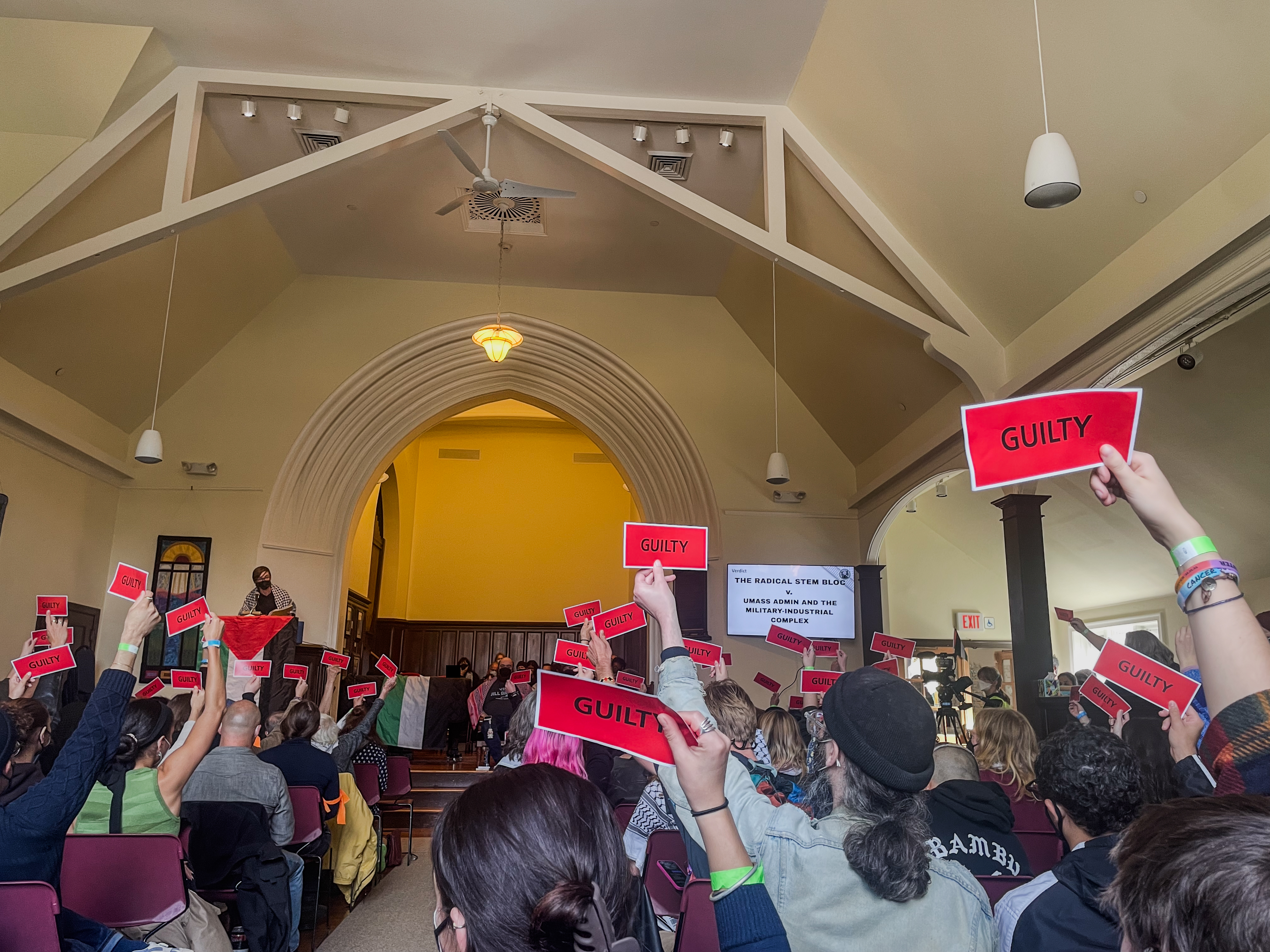
Over 150 attendees gathered at the Unitarian Universalist Society of Amherst on Saturday for the Western Massachusetts People’s Tribunal. Months in the making, the event was organized by a coalition of 11 local pro-Palestine and anti-war groups “to put the institutions of the Connecticut River Valley on trial” for what organizers see as their ties to the genocide in Gaza.
Over the course of the day, six “prosecution” groups argued their cases against local institutions they charged with complicity in genocide: four focused on financial and academic ties between local higher education institutions and complicit companies and industries, as well as Jewish Voice for Peace, which presented on the weaponization of anti-semitism, and Stop L3Harris Northampton, which focused on that city’s ties to its resident military contractor. After the presentations, attendees served as a jury, which elected to “convict” each of the targeted institutions.
For event organizers who spoke to The Shoestring, the tribunal was an attempt to put those institutions on trial through the activists’ own judicial framework after, they say, traditional channels of dissent had failed them and in some cases been violently suppressed. In doing so, they followed in the footsteps of organizers from the University of California system, who held similar tribunals last fall and offered advice to local organizers, they said.
Koby Leff, a member of UMass Amherst’s Professional Staff Union Solidarity Caucus who helped organize the event’s security, saw the tribunal as a culmination of two years of local pro-Palestine and anti-war organizing. Though such efforts were first met with suspicion, Leff said, they considered recent successful votes in Northampton and Montague towards divestment as positive developments.
“As sad as it is that this took a couple of years, it really speaks to the strength of our movement,” they said.
As previously reported by The Shoestring, the People’s Tribunal was originally to be held publicly on the University of Massachusetts campus this spring, but violent threats, some from the far-right Zionist group Betar, pushed organizers to postpone the event due to safety concerns. Student and staff activists who spoke with The Shoestring in June criticized the university’s response to the harassment campaign by pro-Israel groups, describing it as weak, failing to protect students, and politically driven — a characterization the university denied.
As such, attendees were subject to strict security measures for Saturday’s event. In order to get a ticket, attendees submitted to a vetting process, and on site, event organizers forbade photography and audio and video recording, and encouraged all to wear face masks, both to prevent COVID transmission and to conceal identities. A team stationed outside was prepared to deescalate potential disruptors.
“Maybe we accidentally filtered out some thoughtful people, but we ended up ultimately selling out, so better safe than sorry,” Leff told The Shoestring. Leff described a “bi-directional paranoia” resulting from the protocols, as well-meaning applicants tried to submit as little personal information as they could for privacy reasons, and organizers tried to determine if they were an agitator. Leff said the group deleted all of the collected information after the event.
***
When the doors opened at 10:45 a.m., attendees entered and received event programs containing two slips of paper — a red one labeled “GUILTY” and a green one labeled “NOT GUILTY” — to use later when it was time for them, as the jury, to deliver their verdicts.
Local peace activists sat at the church’s altar, many dressed in black, almost all wearing masks or other face coverings. They would act as the prosecution during the tribunal, delivering speeches and presenting evidence.
An unidentified speaker, face wrapped in a keffiyeh, kicked off the event at 11:20 a.m. with a brief rundown of rules and reminders for the event.
She encouraged attendees to wear masks, to “be brave in times of political silencing,” and emphasized what she and other organizers saw as the importance of “rejecting carceral logics” while holding local institutions accountable.
Jewish Voice for Peace was first to present, represented by Jewish UMass student Maya Gonzalez, who charged UMass Amherst with the “weaponization of anti-semitism.”
Gonzalez pointed to emails made public in 2024, showing that UMass administrators were invited to a Zoom meeting by a representative of the Anti-Defamation League, a pro-Israel lobbying group, in October, 2023. The meeting focused on the International Holocaust Remembrance Association’s controversial definition of antisemitism, which many say conflates criticism of Israel with anti-semitism. It is unclear if UMass administrators attended the meeting.
The email, signed by Andrea Silbert of the ADL’s Outreach Committee, explicitly states that a focus of the meeting is “making it clear that anti-Zionism is in fact antisemitism.”
Gonzalez also cited a report commissioned by UMass Amherst to investigate their own response to student encampment protests. The investigation, carried out by law-firm Prince-Lobel Tye, largely exonerated administrators from any wrongdoing and cost $446,000, as previously reported by The Shoestring.
Gonzalez pointed to specific language in the report which referred to “the pain and anxiety experienced by some Jewish students and faculty who felt threatened by the protesters’ chants and slogans seemingly in support of violence against Israelis, if not supporters of Israel generally.”
She argued that the report’s authors “prioritized Jewish feelings” to launder what she and others saw as an unprecedented crackdown on campus free speech.
“Jews are not a monolith,” Gonzalez said. “Jews do not have an inherent, inalienable connection to the state of Israel.”
Gonzalez was followed by activists from Stop L3Harris Northampton, who have been leading protests outside the military contractor’s Northampton facility since 2023. At some of these demonstrations, activists have attempted to block employees’ entry into the building, and have sometimes been arrested for doing so.
The presenters from Stop L3Harris Northampton, including Nick Mottern of Veterans for Peace, spoke to the company’s ties to the Israeli military, calling for Northampton to force the company out of the city.
Mottern expressed excitement about Northampton’s recent vote to divest from companies linked to the genocide in Gaza, including L3Harris, but said the group won’t stop organizing against the military contractor until the city closes the “death factory right in our backyard.”
Next were student and faculty activists from UMass’ Radical STEM Bloc who focus on sustainable alternatives to military research on the UMass campus.
They gave a thorough history of the relationship between technology and military development, citing Operation Paperclip, through which Nazi Germany’s top scientists were given safe passage to the United States to work on its nuclear program. They argued that many of the most significant strides in science and technology in the 20th century were spurred by military research.
They pointed to UMass Amherst’s research ties with the Department of Defense to develop surveillance and war technology, calling on UMass to stop “weaponizing” STEM research and cease all research related to weapons and surveillance technology.
The next two presentations were from Hampshire College students and Smith College students that were focused on their school’s financial ties to companies implicated in war crimes in Gaza and called for endowment restructuring at their respective colleges.
***
Towards the end of the event, a coalition of student, staff and faculty activists from UMass Amherst gave a lengthy presentation, the first half of which detailed the university’s encampment protest response during which over 130 protesters were arrested, some violently, and the school’s broader response to campus activism since October 2023.
Eric Strong, a member of UMass Students for Justice in Palestine led this part of the presentation, which also scrutinized UMass’ research and recruiting ties with arms giant RTX Corporation, of which Raytheon is a subsidiary.
Kevin Young, a professor in UMass’ history department, led the latter half of the presentation and called on UMass to adopt sustainable investment practices for its endowment and divest fully from funds identified in a previous Shoestring investigation to have ties to war companies and fossil fuel giants.
As the presentation from the UMass coalition concluded, deliberations began for attendees to decide on final verdicts for each case presented. Organizers set a timer for ten minutes while attendees discussed their decisions before reconvening and initiating the votes.
In the end, those gathered found UMass Amherst, Hampshire College, Smith College, L3 Harris, and the city of Northampton guilty of complicity in the genocide in Gaza. All votes were unanimous except for Smith College, for which there was one not-guilty vote.
The church erupted in applause following the final verdicts before a brief post-trial panel from the symbolic judges: Palestinian-American author Hannah Moushabeck, UMass professor Isabel Espinal, and Palestinian-American Amherst College professor George Abraham.
Moushabeck spoke to the tribunal’s goal of connecting local institutions to pressing global crises, focusing on local universities and what she sees as their co-opting of progressive politics.
“These guilty institutions pay lip service to the progressive politics they believe people want to hear while empowering warmongers and profiting from a genocide,” Moushabeck told the audience before the event ended.
“When people say that, ‘oh, Palestine is not a local issue,’ I would beg them to listen to the arguments made today, because I think we heard and proved that it should be a concern of every single one of us,” she said.
Recordings of the event will be made available on the tribunal’s webpage and social media accounts on Tuesday, Oct. 28.

Dan McGlynn is an investigative reporter covering social movements and institutional power in western Massachusetts. He can be reached at danmcglynn@protonmail.com. Follow him on Instagram @danmcglynn_ or on X @danmcglynn_.


