


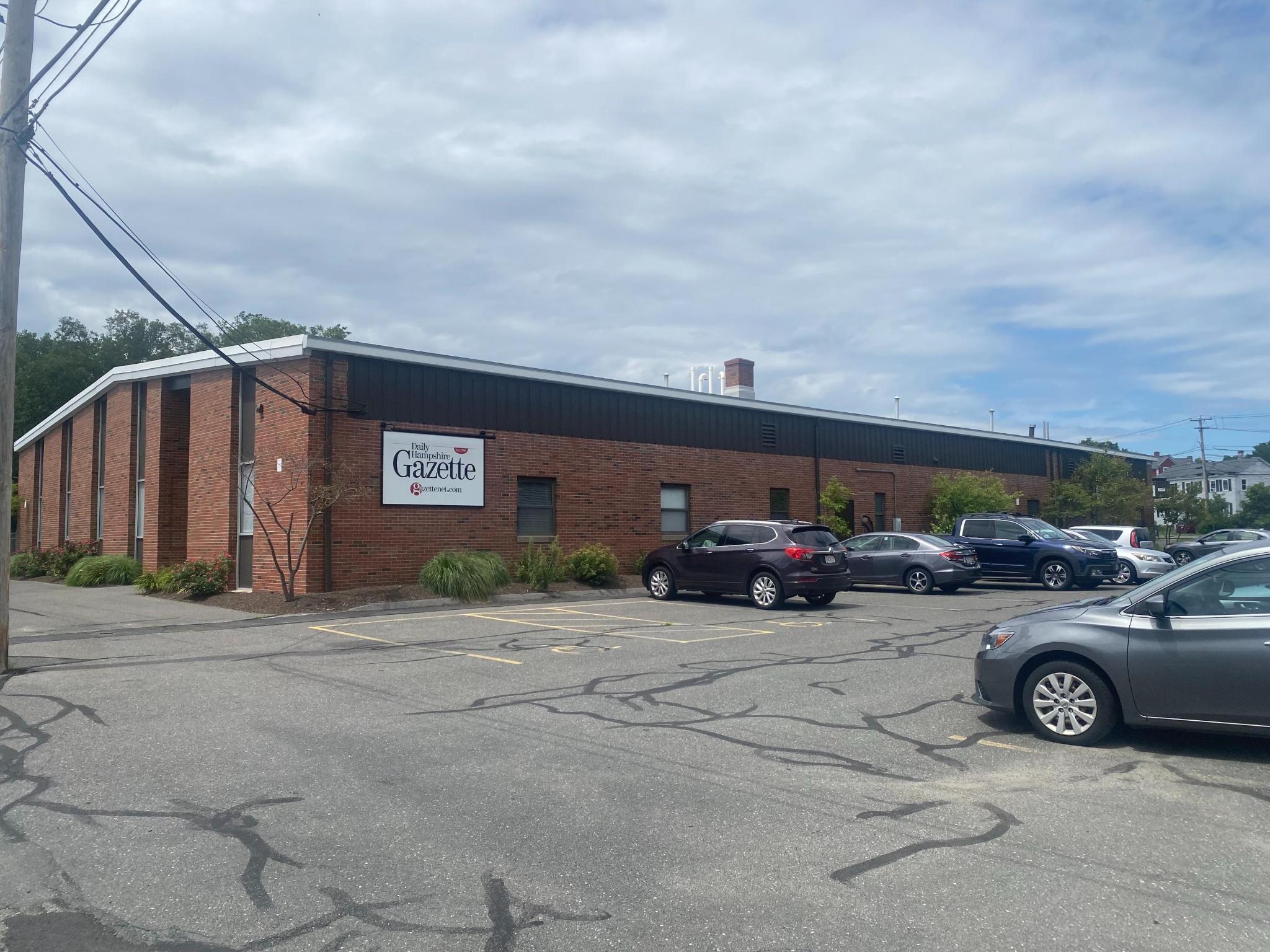
For almost 240 years, the Daily Hampshire Gazette has served as the newspaper of record for Hampshire County, chronicling the lives of its residents and keeping an eye on local government. Just last year, anyone could visit the Gazette’s website and find thousands of those articles available right at their fingertips.
But earlier this year, countless pieces vanished from the Gazette website. Now, it is dominated by articles from only this year and 2023. The same is true for Franklin County’s paper of record, the Greenfield Recorder, which, like the Gazette, is owned by Newspapers of New England.
Publisher of the two papers Shawn Palmer told The Shoestring the loss is “just a temporary situation.” The Gazette switched to a different website provider on Jan. 10 and is working on moving its older content to its new page, he said.
But in the meantime, award-winning works are among those missing from the website: Amanda Drane’s 2016 series “Under the Table,” for example, covering the lives of undocumented local restaurant workers, and Laurie Loisel’s “Life, Death & Lee,” a 2014 series about a 90-year-old woman’s decision to end her life by not eating or drinking. Once bestowed the top award in New England newspaper journalism, their links now return readers to the Gazette’s home page as if they don’t exist.
“We were careful to preserve the old stories and photos and we hope to move everything over later this year,” Palmer said. He said all subscribers can use the papers’ e-edition archives to access articles as far back as September 2012. As a physical newspaper, the Gazette is also preserved in places like Northampton’s Forbes Library, which stores old editions on microfilm dating back from 1786 until the present day.
But, the Gazette’s missing online content is an example of a larger issue: the impermanence of the internet. Experts in this field, such as librarians and digital archivists, use the terms “digital decay” or “link rot” to describe the inaccessibility of links and web pages without proper maintenance. Those are risks that all online news outlets now face — everyone from public media and student newspapers to local access television stations and digital-only publications like The Shoestring.
***
In an increasingly digital age, the loss of print media is accelerating. Last spring, for example, my college newspaper, Mount Holyoke News, unexpectedly lost the funds for its weekly print edition. Up until then, it had been published and delivered diligently across campus for 105 years. Suddenly, everything had to be published fully online for the semester. Today, Mount Holyoke News has reclaimed its funds and will publish its print edition again in September. But other local student publications haven’t been so lucky; the University of Massachusetts Amherst student newspaper ceased its print edition in Sept. 2013, and Smith College’s The Sophian reduced its print schedule from weekly to monthly.
Older online content is most susceptible to link rot. According to a study by the Pew Research Center, 25% of all web pages created between 2013 and 2023 are no longer available, either because an individual link is inaccessible or its host server has been deleted completely. Even newer content from the past few years is at risk of disappearing. Pew found that 20% of web pages from 2021 are no longer accessible. In terms of news webpages, 23% contain at least one broken link, with 32% of said links redirecting to a different URL than originally pointed to.
According to UMass Amherst Copyright and Information Policy Librarian Laura Quilter, this problem is not a new one. Physical media has always risked being lost or damaged over time. But with the addition of the internet and its endless amount of knowledge, the risks of information loss have increased. As Quilter put it, “there is far too much information now to print out and to preserve.”
“Any one single [internet] document actually might be considered more like a collage,” Quilter said. “But it’s a collage where parts of it are constantly disappearing and fraying.”
In an age where physical media is disappearing, the maintenance of these digital “collages” is now more important than ever, she said. Librarians like Quilter encourage creating a permanent place for all online content to be saved.
As a local writer and advocate for veterans in the region, John Paradis agrees.
Paradis began writing a column for the Gazette in 2010. During his time there, he penned around 130 articles. Today, however, he said only six of his pieces are left on the newspaper’s website. Some readers have even reached out to Paradis asking where his articles have gone. Since he already saved them all on a hard drive, he is able to send them over, but his frustration “is that they are not readily available to the public.” And that includes other missing articles he has searched for.
“It is really difficult, near impossible to find,” he said. “It’s like finding a needle in a haystack, if they even still exist at all.”
Paradis added that preserving digital content is a critical function for newspapers and any digital media.
“Good governance relies on good community journalism, investigative in particular, now more than ever,” he said. “There is so much disinformation out there. If there is no record to prove that something happened, then people in power can say it never happened. To me, that is scary.”
Paradis said encountering missing content online is “irksome, it’s depressing, and for me it is frustrating.” Through his own experience with the Gazette’s e-edition, and similar archival sites, he finds it difficult to sift through and said it can “take up an entire afternoon” to find an article in this form.
“I know I’m not the only one who feels that way,” Paradis said.
***
According to Quilter, the nonprofit organization the Internet Archive “is the only entity that is archiving the internet” actively compared to other sites. It uses both its digital library and Wayback Machine feature, which saves snapshots of past versions of websites and other cultural artifacts.
The Internet Archive is also more accessible than other archival sites. All of its books can be read through its online Book Reader, which has text magnification and text-to-speech tools. According to its print disability access page, when a user “checks out” or “borrows” a book, they can view it from a desktop, laptop, or mobile device depending on preference.
On top of all that, Internet Archive is free to use. This makes it one of the “indispensable services” of the internet in Quilter’s eyes.
Quilter’s partner, for example, who became an anti-racist educator during the pandemic, used Internet Archive’s Wayback Machine feature to research how eugenics was taught across various editions of textbooks. With this resource, they were able to see how many years it took for the subject to be modified.
“You couldn’t do that with any other resource in the entire world,” Quilter said. “There’s nobody else who has it.”
However, in March 2023, four publishing houses sued the Internet Archive over copyright infringement for loaning out free digital copies of their books. A federal judge ruled in favor of the publishing companies, resulting in a “significant loss of access to valuable knowledge for the public,” according to Internet Archive.
With litigations such as this added onto the problem of link rot, those researching local issues can be left in the dark.
“I am very worried about this litigation,” Quilter said. “It really undermines the historical record. Which is not just a problem for historians, but for anybody who’s trying to understand things.”
Although the Internet Archive lost the right to loan out most books, all users can still archive online web pages themselves through the Wayback Machine. This form of archiving is the most reliable way to ensure a permanent place for web pages of all kinds, including local politics and journalism, according to Quilter.
However, Quilter said this labor often goes overlooked, and instead falls to one diligent community member — that is, assuming someone even thinks to archive their local articles and history.
The best way for local papers to prevent link rot is to strategize the long-term survival of their online presence, even if one day their websites don’t exist anymore, Quilter said — for example, hiring web experts to preserve old links and archive posts regularly.
Paradis added that if people can’t find something that was once published, “the public doesn’t even know it exists.”
“Make sure to save everything you’ve written,” Paradis advised local writers. “Not only original content online, make sure that you save anything that is published … otherwise, there is nothing else you can do.”
Quilter also encourages people to advocate for local, digital archives in their own communities. Support local historical societies, archivists and librarians, she implored; ask questions like, “What is the future history? What is the stuff being made right now?”; figure out what neighbors and community members are creating right now, and preserve it.
“There is vast numbers of content being generated that is really important to some sets of people,” Quilter said. “We truly do have a renaissance in where so many people are putting out content in so many different ways. And it’s going to be lost if we’re not capturing it. That’s what the people in 100 years are going to be looking at. They’re going to be looking at this moment of transition, when there’s this flowering of creativity from all kinds of people.”
Melanie Duronio is a reporter studying English and Sociology at Mount Holyoke College. She is a summer intern for The Shoestring.
The Shoestring is committed to bringing you ad-free content. We rely on readers to support our work! You can support independent news for Western Mass by visiting our Donate page.

Melanie is a reporter studying English and Sociology at Mount Holyoke College. When she isn't writing, you'll probably find her exploring a bookstore in Amherst or Northampton with an iced coffee in hand. You can reach her on Instagram @mbduronio or on Facebook @melanie.duronio. To view her clips, visit https://www.clippings.me/melanieduronio.
- Melanie Duronio
- Melanie Duronio


