


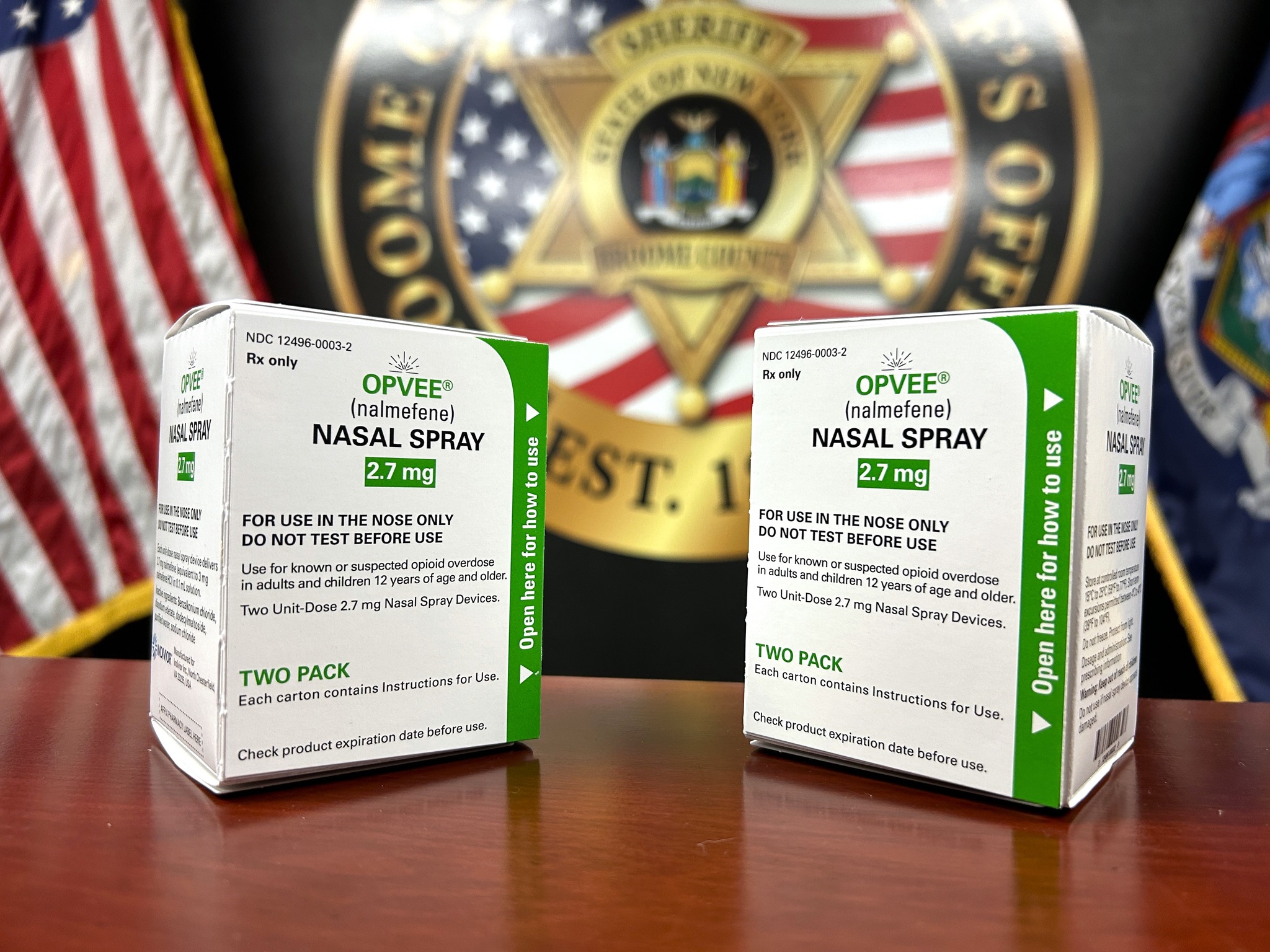
Less than a year after The Shoestring and New England Public Media revealed a pharmaceutical company’s efforts to promote its controversial opioid overdose reversal drug directly to police in Massachusetts, the firm has stopped marketing the medicine nationwide.
The company, Indivior, decided to cease promotion of its product Opvee just days after reaching a settlement with New York’s attorney general over the alleged “misleading promotion” of the drug to sheriffs. In an announcement Tuesday, New York Attorney General Leticia James said that although New York state hadn’t approved Opvee’s use without a prescription, Indivior “tried to position itself as part of the solution while misleading public officials and the communities they serve about which overdose treatments are safe, legal, and effective.”
Earlier this year, The Shoestring and NEPM obtained emails showing Indivior’s efforts to circumvent concerned experts in Massachusetts by promoting Opvee directly to police departments and sheriffs. Those messages included a false claim that the Massachusetts Chiefs of Police Association sent to its members on Indivior’s behalf, saying that Opvee was “the first opioid reversal agent that is effective in dealing with fentanyl.” Naloxone — often known by the brand name Narcan — remains effective against fentanyl, though it is now available as a generic, making it more difficult for pharmaceutical companies to profit from.
In a statement, a spokesperson for the New York state attorney general’s office said its prosecutors also encountered similar language from Indivior. That language, though, was not specifically referenced in the “assurance of discontinuance” prosecutors signed with Indivior, which focused on allegations that the company falsely told a sheriff’s office it could use Opvee despite a lack of state approval.
The office of Massachusetts Attorney General Andrea Campbell won’t say whether its prosecutors are probing any such false statements.
“We are reviewing the settlement and cannot confirm, deny, or comment upon any investigations or potential future action,” a spokesperson for Campbell’s office said.
Indivior did not return emails requesting comment.
The Shoestring relies on reader support to make independent news for western Massachusetts possible. You can support this kind of labor-intensive reporting by visiting our donate page.
Public health experts and harm reduction advocates have long raised concerns about what they describe as dangerous side effects and other risks associated with more powerful reversal drugs like Opvee. They say they can cause excruciating, longer-lasting withdrawals, leading overdose victims to use more opioids to alleviate their discomfort or to use alone in the future — a significant risk factor for fatal overdoses — in order to avoid encountering reversal agents.
Opvee’s active ingredient is a drug called nalmefene, which — like naloxone — is an “opioid antagonist” that blocks the effects of opioids and can put overdose victims into immediate withdrawal. Harm reductionists and health experts have criticized drug companies’ marketing of nalmefene because it is so much more powerful than naloxone. An article published this year in the International Journal of Drug Policy, for example, said that there is “little evidence that adopting nalmefene for community-based overdose response will provide overall benefit, and there are good reasons to expect that it will cause substantial harm.”
That’s a position other experts have taken, too. The American College of Medical Toxicology and American Academy of Clinical Toxicology have said that nalmefene “could result in significant harm if widely utilized.”
Those concerns are why the Massachusetts Department of Public Health has declined to add nalmefene-based drugs or other more potent opioid reversal medications, like higher-dose formulations of naloxone, to what’s known as the state’s “standing order” — a protocol that allows people to receive medications without a patient-specific prescription.
“Studies indicate these agents are more likely to precipitate withdrawal, which can increase mistrust and foster avoidance of overdose reversal assistance among people who use drugs,” a Department of Public Health spokesperson said in a statement last year.
However, emails that The Shoestring and NEPM obtained through public records requests showed that Indivior sought to make allies in the world of law enforcement. Internal communications showed several top police officials suggested they should “nudge,” or even “apply pressure,” to state leaders to add Opvee to the state’s standing order.
Indivior also helped the Berkshire County town of Dalton’s police department obtain Opvee. The company provided the department guidance for getting Opvee added to their own local standing prescription order, helping to make Dalton police the first in the state to carry drug.
Dalton police chief Deanna Strout did not respond to an email Thursday asking whether her officers are still carrying Opvee.
Indivior’s attempts to bypass the state standing order in New York were a central part of the attorney general’s case against the company there. In a statement, James, the attorney general, said that Indivior had “falsely advised” a sheriff’s office that it “could simply write its own standing order for Opvee” despite the fact that the state had not approved it for non-prescription use.
Ultimately, the harm reduction community’s outspoken opposition to Opvee seems to have played a role in preventing the drug from becoming more widespread. In its annual report last year, the company lamented that it wasn’t “further along the adoption curve.”
“We recognized when we launched Opvee that the harm reduction advocates would be vocal, but the voice has been louder than we expected,” the report said.
Indivior isn’t the only company that has received federal approval for a nalmefene-based overdose reversal drug. Last year, Purdue Pharma — the company whose marketing of OxyContin played a central role in fueling the opioid overdose epidemic — received approval from the Food and Drug Administration for its nalmefene auto-injector Zurnai.

Dusty Christensen is The Shoestring's investigations editor. Based in western Massachusetts, his award-winning investigative reporting has appeared in newspapers and on radio stations across the region. He has reported for outlets including The Nation magazine, NPR, Haaretz, New England Public Media, The Boston Globe, The Appeal, In These Times, and PBS. He teaches journalism to future muckrakers at both the University of Massachusetts Amherst and Smith College. Send story tips to: dchristensen@theshoestring.org.


