

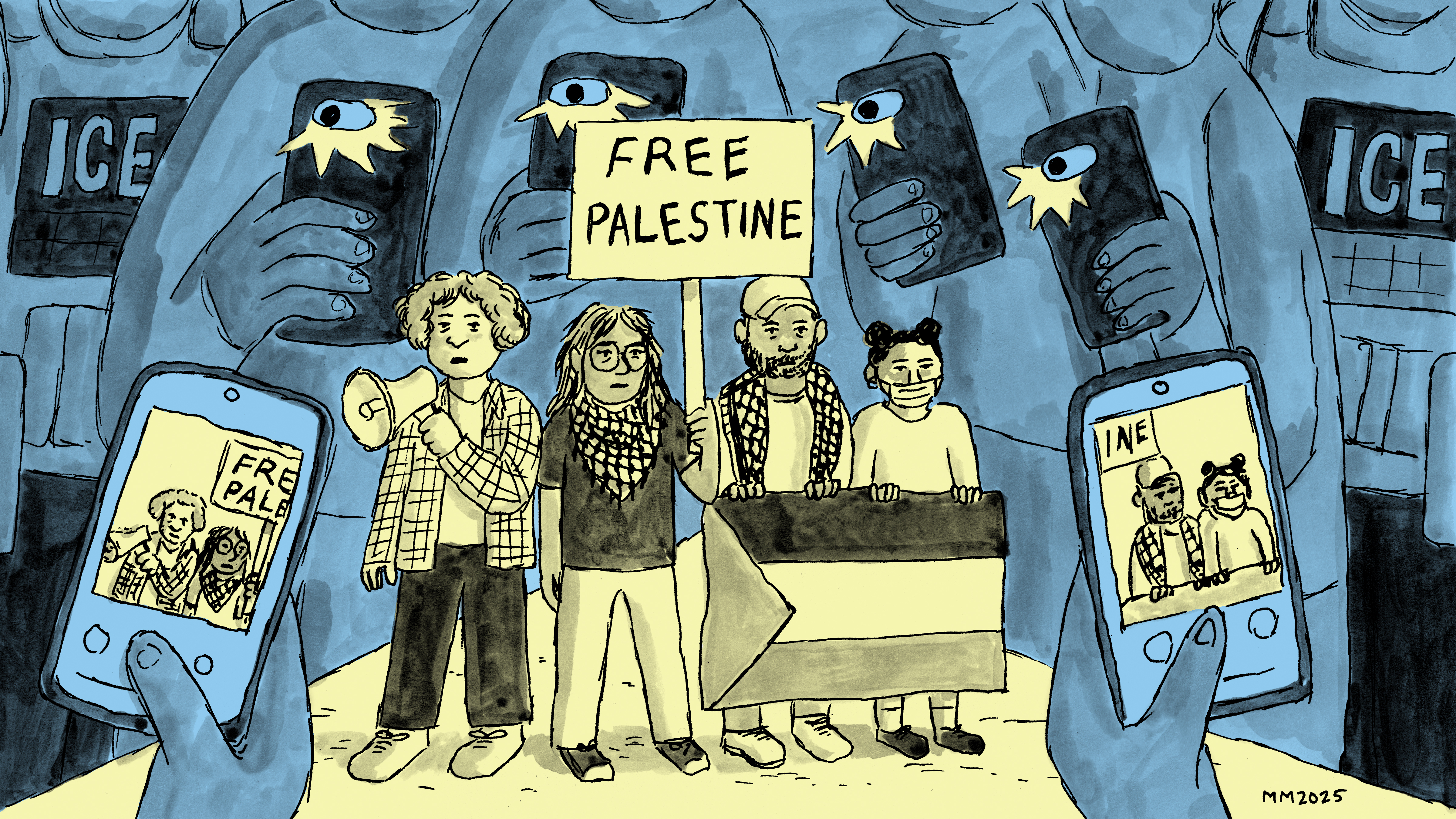
When the right-wing Zionist organization Betar tweeted on April 8, it directly targeted a Hampshire College student from Turkey.
“We identify Efe Ercelik as one here on visa and we have submitted his name for deportation,” the tweet read. “There’s so many of these bastards nationwide he’s an egregious one in Massachusetts, a rotten state.”
The social media post appeared to have an immediate impact.
Just one day later, the federal government silently revoked Ercelik’s student visa, according to court documents — a decision a federal judge would later say was directly because of Betar’s influence. On April 16, federal agents showed up to Ercelik’s home in black, unmarked SUVs with tinted windows. One agent told Ercelik’s lawyer that they intended to arrest him so that they could deport him. Without a judicial warrant, however, they couldn’t enter his apartment, so he spent the next three weeks stuck inside, afraid to leave.
Court documents would later show that even the administrative warrant Immigration and Customs Enforcement agents claimed allowed them to pursue Ercelik was not valid. That administrative warrant, dated April 10, was authorized based on allegations ICE made in a separate document first signed on April 25 — nine days after the feds first showed up at Ercelik’s apartment.
“This cannot be true,” U.S. District Judge Angel Kelley would later find. “In brief, not only was there no charging document when Respondents attempted to detain Petitioner on April 16, agents then misrepresented the date of service, which is no earlier than May 7.”
When the feds began stalking him, Ercelik was facing charges in Eastern Hampshire District Court, including one count of assault and battery with intent to intimidate — a felony hate crime. In November 2023, while he was a student at the University of Massachusetts Amherst, he punched and kicked a Jewish student on campus, and destroyed a palm-sized Israeli flag with a kitchen knife, during a “bring them home” event in support of the hostages Hamas had taken the month prior. A witness also accused him of making antisemitic comments during the assault, according to the police report.
That description of Ercelik as “antisemitic,” however, didn’t match how those who knew him described the young man. In letters sent to the court, supporters described him as a “gentle giant” and a “serious student whose concern for peace, social justice, and diversity have been clear.” His motivations, his lawyer said, were “in opposition to Israel’s treatment of Palestinians.”
“I am Jewish, the daughter of a Holocaust survivor, and deeply committed to my Jewish family and community,” wrote one of those supporters, UMass faculty member Deborah Keisch. “Obviously, I am extremely sensitive to antisemitism and have been the target of it many times throughout my life. I have never experienced one iota of that sentiment while working with Efe, nor have I witnessed it happening with Jewish students in our classroom.”
Ultimately, prosecutors agreed to drop that hate-crime charge and others when Ercelik arrived in court on May 7. Ercelik, in turn, pleaded guilty to two misdemeanor assault charges. It was only then that plainclothes federal agents arrested him inside the courthouse in Belchertown.
In its memo revoking his student visa, the Trump administration explained its reasoning. Ercelik’s “antisemitic activities, his hateful rhetoric against Jewish students, and his violent attack of Jewish student (sic) on campus may indicate support for a designated terrorist organization and undermine U.S. foreign policy by creating a hostile environment for Jewish Students,” the memo claimed.
But in a ruling ordering Ercelik’s release the next day, Kelley said it was his First Amendment activity that proved to be “the substantial or motivating factor for ICE’s pursuit of his detention.”
What’s more, she said, ICE’s actions seemed to have been “almost exclusively triggered by Betar Worldwide.”
The federal government doesn’t appear to have ever confirmed working with Betar. But when reached by The Shoestring, a U.S. Department of State spokesperson wouldn’t deny that the agency acted at Betar’s request.
“Given our commitment to and responsibility for national security, the Department uses all available tools to receive and review concerning information when considering visa revocations about possible ineligibilities,” a spokesperson said in an email.
While Betar and other pro-Israel advocacy groups targeted Ercelik because of his court case, other students have found themselves in these groups’ crosshairs for even less. The doxing website Canary Mission, for example, published a profile on Tufts University student Rümeysa Öztürk because of an op-ed she co-wrote — a profile that Betar boosted shortly before ICE detained her. And the conservative think tank The Heritage Foundation has laid out what it calls “Project Esther,” a broad plan to quash pro-Palestine activism in the United States that includes deportations of foreign students.
The intimidation campaign has reached UMass Amherst, too. There, violent threats from Betar’s supporters led activists to cancel a long-planned “People’s Tribunal” event this spring. Organizers told The Shoestring it’s part of a well-coordinated doxing and harassment effort from groups like Betar and Canary Mission, which have worked with UMass students to surveil pro-Palestine activists for at least a year and a half.
On June 4, the Council on American-Islamic Relations added UMass Amherst to its list of campuses it sees as “hostile” to Muslim students.
“UMass Amherst administration has consistently failed to protect students from doxing, harassment, and widespread Islamophobic and anti-Palestinian hate, fostering a hostile environment where Muslim, Arab, and allied students fear for their safety when expressing their political and religious identities,” the group said in a press release.
In conversations with The Shoestring, student and staff activists detailed months-long efforts demanding that administrators act against the doxing campaign. They said university leaders largely ignored those requests — an allegation UMass Amherst has disputed.
One student doxed by Canary Mission, who requested anonymity due to fears of further harassment, said that university leadership fostered a “climate where criticizing Israel was absolutely not okay and absolutely dangerous, but going after Palestinian and Arab students was not a concern.”
In a statement, UMass Amherst spokesperson Emily Gest said that the university has provided support to students facing targeted harassment. She said that “regretfully, neither individuals nor private and public institutions such as universities have the mechanism or the power to prevent doxxing and/or online harassment.”
“We encourage anyone with information regarding UMass students, faculty or staff who may have engaged in any form of harassment, including online, to come forward to the university and relevant law enforcement authorities so those allegations can be fully investigated and addressed,” Gest said. “If an investigation reveals that a member of the university community has engaged in any form of harassment, including doxxing, that individual would face appropriate disciplinary proceedings.”
***
Betar is a century-old group whose stated mission is “to cultivate a new generation of Jewish leaders who are unapologetically proud and prepared to defend the Jewish people — on campuses, in communities, in the media, and beyond.” Appearing first in Latvia in 1923, Betar was founded by Ze’ev Jabotinsky as a Zionist paramilitary force.
Interest in the militant group has surged recently in the United States, where Betar incorporated as a nonprofit organization last year, according to its tax filing. In social media posts, the group says it has sent dossiers on student activists to contacts in the Trump White House and has claimed responsibility for the detentions of foreign pro-Palestine students.
“Not enough. We demand blood in Gaza!” Betar wrote in a since-deleted tweet responding to a list of infants Israel’s military had killed in Gaza. In another deleted tweet, Betar offered a bounty of $1,800 to hand “a beeper” to the prominent Palestinian-American activist Nerdeen Kiswani — a reference to Israeli intelligence agents’ indiscriminate use of explosive pagers to kill and injure Hezbollah members in Lebanon.

Beyond its online rhetoric, the group does appear to have real influence.
Ross Glick, the former executive director of Betar, was pictured with U.S. Sen. Ted Cruz, R-Texas, days before ICE detained Columbia University activist Mahmoud Kahlil. Glick told The Guardian that he had spoken to Cruz about deporting Kahlil.
The Anti-Defamation League, which praised the Trump administration’s detention of Kahlil and has sought to link pro-Palestinian rhetoric with antisemitic violence, has itself denounced Betar as an extremist hate group. The ADL cited the group’s history of harassing Muslims, its militant focus, association with the far-right Kahanist movement, and its efforts to report pro-Palestine protesters to federal immigration authorities.
In a response to a request for comment, a Betar spokesperson addressed a Shoestring reporter as “jihadi” and said the group “is very active at [the] UMass Amherst campus and throughout western Massachusetts with a network of faculty, community members and students supporting us and providing information.”
“We are Jews who fight back and will continue to be active on providing information and fighting back at UMass and nationwide,” the group said in an unsigned email. “We also confirm we receive information from our European and Israeli Betar branches, including specifically on Massachusetts students.”
In a follow-up email, the Betar spokesperson said that the group has ties to Israeli intelligence. The Shoestring could not independently verify that claim.
***
Betar isn’t the only group targeting local students who say they’re protesting the Israeli government’s genocide of the Palestinian people.
According to eight current and former UMass Amherst student and staff activists who spoke to The Shoestring, students opposed to pro-Palestinian activism on campus have engaged in violent threats, doxing, and stalking since October 2023. University leadership has done little to curtail that behavior, the activists alleged, leading to what organizers describe as an atmosphere of intimidation and fear.
For Rüya Hazeyen, a Palestinian-American student who led the UMass Students for Justice in Palestine chapter last year, it all began when she spoke at a Northampton rally in support of Palestinians on Oct. 9, 2023.
It was there that she and other UMass pro-Palestine activists first encountered Ben Goldstein, then a senior at UMass. According to two activists present at the rally, Goldstein shouted “kill all Arabs” and “level Gaza.” In the following weeks, Goldstein repeatedly appeared at rallies and other demonstrations hosted by UMass SJP, playing sounds of bombs dropping and allegedly attempting to ram protestors with his electric scooter, according to activists present at the rallies.
Around this time, one of the activists who spoke with The Shoestring contacted administrators to report Goldstein’s behavior. She said this was the beginning of a months-long series of email exchanges with administrators that seemed to go nowhere. Gest, the UMass Amherst spokesperson, declined to comment on specific student-conduct complaints.

“Any active or completed investigations, and the outcome of those investigations, are confidential under federal law,” she said.
By November 2023, Hazeyen and several other activists associated with UMass SJP and the anti-militarism group UMass Dissenters had been profiled by Canary Mission, a shadowy online directory that bills itself as a list of “individuals and organizations that promote hatred of the USA, Israel, and Jews on North American college campuses and beyond.”
“I’ve been a Palestinian my whole life,” Hazeyen said. “There was never a moment where I was like, ‘Oh shit, the stakes are really high.’ I’ve always known it. It was just a matter of time [before] I was going to get doxed.”
Critics say Canary Mission attempts to chill free speech by jeopardizing activists’ job prospects through associating them, often unfairly, with antisemitism and terrorism just for being critical of Israel’s government. Canary Mission’s own website says that it aims to prevent “today’s radicals from becoming tomorrow’s employees.”
The detailed profiles of UMass students on Canary Mission’s website — which include photos, students’ majors, and activism affiliations — quickly invited online harassment, including threats of physical and sexual violence, according to student activists.
“Once you’re on Canary Mission, suddenly the entirety of Twitter has access to you and your information and your privacy,” one activist, who requested anonymity due to fears of further harassment, told The Shoestring. “All of these horrifying messages start coming in on your LinkedIn, on your Instagram, on your Facebook. It was like every source where you could Google my name, someone had found it and [were] saying horrible, inflammatory, racist things.”
The students also had reason to believe that fellow UMass students had sent their information to Canary Mission. A November 2023 Instagram post by the account @umass_zionists invited UMass students to surveil pro-Palestine activists. “If you match a UMass name to a face at today’s protest that doesn’t condemn Hamas, then you get a feature, an award, and I will upload them to the Canary Mission database,” the post read. Goldstein ran the account, according to a criminal complaint obtained by The Shoestring. A later post from the account included a screenshot indicating that the account owner had sent information to Canary Mission.
After Canary Mission posted a video on its Instagram targeting one student activist, the @umass_zionists account sent it to the student via Instagram direct message. “Warned you,” an accompanying message said.
Neither Goldstein nor his lawyer responded to requests for comment.
***
After Jason Eaton shot three Palestinian students in Burlington, Vermont, on Nov. 25, 2023, students’ anxieties grew. Three UMass SJP organizers who lived together described the paranoia they felt after the shooting and after their names and addresses were publicly posted on UMPD’s online arrest logs following their arrest at a sit-in protest in October 2023.
“There were a couple times that cars would drive down our driveway that we didn’t recognize. And genuinely, we would all huddle by the window because we were like, ‘It’s happening,’” Emmanuelle Sussman, a former UMass SJP member, said.
In the comment section of Canary Mission posts targeting them, student activists noticed people tagging ICE and other federal agencies, advocating for them to be deported, even though many of the students were U.S. citizens. To the activists, efforts to have students deported in 2023 were evidence of a well planned campaign that would eventually find success when President Donald Trump took office in January 2025.
Sussman said that one investigator from UMass Amherst’s Office of Equal Opportunity and Access was concerned for her and other student activists and expressed frustration with the lack of action from higher-ups. “We were talking to her and she was like, ‘I honestly don’t know why nothing has happened with this,’” Sussman said.
In a response to an inquiry from The Shoestring, Gest wrote in a statement that “UMass has — and continues to — unequivocally condemn harassment, including doxing, and investigates all reported incidents under the Code of Student Conduct.”
“Over the past two years, students who have requested support due to targeted incidents of harassment from individuals unaffiliated with the university have been offered support including, but not limited to, physical and electronic security, housing, and academic accommodations,” Gest said. “Any physical threats of violence are reported to law enforcement.”
The threats students faced were deemed credible enough that a UMPD detective investigating them advised one student to stop attending classes, they said. The student activist requested anonymity due to fears of further harassment.
By the spring, after months of sharing their concerns with administrators, the university granted school-enforced mutual no-contact orders between some student activists and other students whom they say harassed them, including Goldstein. At least one student activist had a mutual no-contact order with Dylan Jacobs, the student Erecelik assaulted, according to documents obtained by The Shoestring.
Efforts to reach Jacobs were unsuccessful.
For some of the UMass SJP organizers who had been raising their concerns for months, the issuing of no-contact orders was “too little, too late,” Sussman said. On top of that, several activists said that the university didn’t enforce their no-contact policy, which the university has denied. This led to some students successfully obtaining separate, court-ordered harassment prevention orders against Goldstein, who was charged for violating one of them last fall, according to a criminal complaint in Eastern Hampshire District Court.
The Shoestring relies on reader support to make independent news for western Massachusetts possible. You can support this kind of labor-intensive reporting by visiting our donate page.
On April 16, 2024, the U.S. Department of Education’s Office of Civil Rights opened an investigation into UMass for allegations of anti-Palestinian and anti-Arab racism on campus after Palestine Legal, a non-profit legal aid organization, filed a complaint with the department.
“Had the University taken prompt and effective action in response to the onslaught of online harassment directed at [name redacted] and SJP in general, it is possible that the students who provided Canary Mission with such detailed information would have been deterred from doing so,” the complaint alleged.
The federal investigation into Palestine Legal’s complaint is still pending as of June 3, according to the U.S. Department of Education’s website.
So, too, is a complaint that the Anti-Defamation League filed on behalf of Jacobs, the student Ercelik pleaded guilty to assaulting. It alleges that UMass “has failed to address the severe discrimination and harassment of Jewish and Israeli students, which fostered a hostile antisemitic environment.”
“Amherst has permitted genocidal chants and rhetoric to permeate campus and allowed certain student groups to halt academic and social activity through their protests,” the complaint reads.
Some of the allegations made in the complaint involve Ercelik’s 2023 assault of Jacobs. It is unclear how Jacobs and the ADL’s complaint will be handled, now that Ercelik has been cleared of hate crime charges in criminal court.
The ADL has not responded to several requests for comment.
***
By the fall of 2024, UMass’ Palestine-solidarity movement had suffered a “crisis in confidence,” in the words of one graduate student who The Shoesting granted anonymity because of their fears of retaliation.
The previous academic year had concluded with a violent police crackdown on an on-campus encampment protest. Senior UMass SJP leadership said they graduated with the feeling that their alma mater hadn’t done enough to protect them from doxing and harassment on top of having them arrested at the encampment. UMass police even pursued felony riot charges against the group’s co-presidents. The university dropped that effort amid backlash from the campus community.

UMass SJP and UMass Dissenters, like many student activist groups across the country, saw a decline in momentum in the wake of mass arrests and a looming second Trump presidency. But activists began to pick up their work again in the spring.
So did Betar.
On April 8, Betar posted about Ercelik on social media, and the next day a senior official in the U.S. Department of State, Stuart Wilson, approved a request from ICE to revoke Ercelik’s student visa.
On April 10, a coalition of campus and community activists announced a “People’s Tribunal,” holding a protest and delivering a symbolic subpoena to UMass Chancellor Javier Reyes. The effort — a mock trial of sorts — was meant to pursue accountability for what they saw as the university’s repression of its peace movement and the school’s ties to weapons manufacturers.
“Pretty quickly after that, Betar seized upon it as their own temporary kind of pet project,” the graduate student told The Shoestring.
On April 12, Betar posted several videos of the event, writing in the caption that “UMass is a very dangerous school for Jews.”
“This week we have documented a number of people who are here on visas and we expect @ICEGOV will take action shortly,” the caption also said.
And take action they did.
On April 16, federal immigration agents showed up to Ercelik’s apartment in at least four unmarked vehicles, according to court documents. Ercelik filed a petition that day to challenge his “constructive detention” inside his apartment; one of the agents, Daniel Yon, told Ercelik’s lawyer they intended to arrest him. In his petition, Ercelik’s lawyer explained that the agents had threatened to detain him “regardless of their lack of a warrant,” and that they would ensure Ercelik would “be charged with a federal hate crime and spend many years in federal prison.”
ICE agents were there daily for the next three weeks, according to court documents. The ICE Boston Field Office did not respond to a request for comment on this story.
In the following weeks, Betar continued to focus on UMass, posting on Instagram nine more times with videos and photos from rallies on campus. Many comments on the posts tagged government agencies, calling for student activists to be deported. Some comments alluded to violence. On one Betar post targeting UMass activists, an anonymous account made a particularly menacing comment: “Live rounds solve this.”
As organizers became concerned about the safety of the People’s Tribunal, they held meetings with high-level administrators to inform them of the threats. Two sources present at the meetings said that administrators acknowledged the danger posed by Betar and its supporters. However, one of them, a staff member who The Shoestring granted anonymity for fear of retaliation, said the administrators “were very insistent that the only thing they can do as upper-level administration is go to UMPD” — a difficult ask to make of activists who didn’t trust the police department following its violent response to the encampment protest the previous year.
Activists also pointed out that the photos, videos, and other information being sent to Betar and Canary Mission were likely originating from people within the campus community, demanding that administrators investigate it.
“They’ve made no commitment to try to find out who was submitting these photos and videos,” the staff activist said. At least one of the videos included grad students’ office door with their full names.
UMass Amherst, for its part, says it investigates all reported incidents of conduct violations such as harassment and doxing.
In these meetings, activists said they put pressure on administrators to make a statement condemning Betar and its supporters’ threats.
On April 17, Marsha McGriff, the school’s vice chancellor for equity and inclusion, and Shelly Perdomo-Ahmed, the vice chancellor for student affairs and campus life, sent an email to the UMass community.
“In recent weeks, we’ve received several deeply concerning and heartbreaking reports of community members — especially students — being harassed through social media accounts not affiliated with the university,” the message read. The administrators condemned the harassment and intimidation of students, but avoided specific references to Betar.
The email also sought to address what the school said were unsubstantiated rumors that ICE agents had been on campus. ICE agents, however, had just begun waiting for Ercelike outside his apartment in Sunderland.
Organizers were frustrated with the email, which they said obfuscated the role that fellow UMass students, staff, or faculty may have played in the targeted harassment and surveillance of activists, despite informing administrators of their suspicions.
As Betar increasingly attracted outside attention to UMass organizing, and violent threats increased, organizers opted to postpone the People’s Tribunal event, which the graduate student organizer described as “devastating.”
“If there’s any other kind of direct assault on or threat of violence against students on this campus, especially, for example, Jewish students, they would have unequivocally named and condemned that, but they didn’t do that for us,” the graduate student, who is Jewish, said.
While he and his fellow organizers were hesitant to give Betar a “win,” as he put it, they concluded that they had to take the threats seriously. Multiple activists expressed fears of a potential ICE presence on campus and a violent counter-protest.
Just a few weeks later, ICE arrested Ercelik.
On May 7, Ercelik had managed to narrowly avoid federal agents as he left his apartment building to go to his court date. He had reached a plea agreement, but his lawyer, Paul Rudof, had failed in his attempts to have Ercelik appear in court via Zoom to avoid ICE detention.
“The prosecutor objected because he did not want federal authorities to perceive him as interfering with them,” Rudof wrote in a court filing. “The judge denied my request with prejudice.”
The Northwestern District Attorney’s Office did not directly answer an inquiry made on May 6, the day before Ercelik’s court date, inquiring as to what precautions prosecutors — who had knowledge of Ercelik’s pending habeas corpus petition — had taken to prevent ICE from illegally detaining Ercelik.
The victims of the assault that Ercelik plead guilty to were able to address the court remotely.
“Efe attacked me just for being Jewish, and I was terrified to know that I was surrounded by large numbers of students and professors who supported targeted violence against Jewish people,” Jacobs said in his victim’s impact statement.
“In my opinion, Efe has not been held accountable for assaulting me,” he said.
Ercelik also plead guilty to assaulting a second person on that day back in 2023: Leah Eve Nelson, a UMass Amherst Hillel staffer who broke up the scuffle between him and Jacobs. Speaking before the court over Zoom, she said the assault left her and others who witnessed it afraid of further violence.
“A hate crime is a hate crime, even if the legal label is dropped for the sake of closing a case,” she said.
For her, she said true justice would involve Ercelik sitting down with a leader in the Jewish community to learn, among other things. But she now felt stuck between wanting to empathize with Ercelik, who she had learned was afraid to leave home for fear of deportation even before his trial, and wanting to do what was best for her community “who have, for the last year and a half, been subjected to violations and abuses of a nature that only seems to be acceptable when the targets are Jews.”
In an interview with The Shoestring, Nelson said that while she “cannot tolerate or stand” what Ercelik did, she would “defend to the death his rights to a hearing.” But because of ICE’s attempts to arrest him without a trial or hearing — something she described as “a great offense to the law” — she said she felt she had been denied her right to justice.
“Rather than focusing on my needs, I felt it was my civic responsibility to defend his rights,” Nelson said. That’s exactly what she did during his hearing. “The idea that the federal government could, using my name, unlawfully remove and expel noncitizens from their homes without a trial or hearing is a violation of every tenet of civilized society,” she told those gathered in the court that day.
Immediately after the proceeding, at the exact moment he was no longer being charged with a hate crime, federal agents arrested Ercelik at the courthouse with the intent to deport him. Lawyers and advocates have long criticized the practice of making such arrests at courthouses because they can make immigrants fearful of taking part in the legal system, including when they’re seeking protection. But the Trump administration has reversed previous ICE policies barring the agency from arresting people at “sensitive locations” like schools and courts.

Ercelik had already purchased a ticket back to Turkey before his arrest — a fact that Kelley, the federal judge, noted in her order to release him from custody later that day.
“To me the process doesn’t make much sense, because you have someone who wants to leave the country, and ICE wants them to leave the country — and to leave as quickly as possible — but the argument seems to fly in the face of the process that’s been identified, which is the prolonging of his detention,” Kelley said, according to a transcript of Ercelik’s court hearing. She also noted that Ercelik was likely to succeed on the merits of his claims that ICE had violated his First- and Fifth-Amendment constitutional rights.
Later that day, the federal government released Ercelik, who soon after boarded a plane home with his mother. After he had landed in Turkey, he declined an interview for this article on the advice of his lawyer. As the only condition of his probation in Massachusetts, he is required not to contact Nelson or Jacobs. His probation explicitly included no travel restrictions or requirements to check in with a probation officer.
On May 27, Laurie Loisel, a spokesperson for the Northwestern District Attorney’s Office, told The Shoestring the DA’s office is “an independent state agency. The office neither assists nor interferes with the actions of ICE.”
***
The postponement of the People’s Tribunal also coincided with Canary Mission and Betar targeting another student activist. Haley Ho, a UMass undergraduate student, said she had realized something was wrong when her X account was flooded by follow requests from accounts with Israeli flags in their handles.
Canary Mission had posted screenshots of some of Ho’s tweets. One included a joke about write-in voting for Yahya Sinwar, the former leader of Hamas, during the 2024 U.S. election. Another read: “my pronouns are ha/mas.”
When asked what she had to say to those offended by her remarks — one tweet included the phrase “death to Israel” — Ho said her statements were “never that serious.” She argued that “the bigger thing to be upset at is the fact that there is a genocide going on in Palestine, not some person’s Twitter profile [which had] like 50 followers.”
The online harassment included crude comments about her appearance and allegations that she was a Chinese agent, despite her not being Chinese, which Ho attributes to the “orientalism” of those targeting her online. But she said that as a pro-Palestine activist, she always knew she could become the target of groups like Canary Mission and Betar. Aside from keeping a low profile online and making sure to travel with a friend when walking on campus last semester, Ho said the effect of the doxing on her daily life has been minimal.
“Repression is a sign that something you’re doing is working,” she said.
What did unsettle Ho was an April 25 Instagram post from Betar that included a photo of her tabling for UMass SJP at an on-campus farmers market.
“I didn’t know who took that photo, so that kind of actually, like, freaked me out a little bit,” she said.
That’s a sentiment other organizers shared. They say fellow students or others are covertly photographing and recording them at protests. They fear that they’ll be the next face on Canary Mission’s directory or Betar’s social media accounts.
Ho said she hasn’t taken “strong initiative in getting UMass to protect [her], because [she’s] not really expecting anything,” but that she wishes the university would “take a more principled stance” against doxing groups.
Another student who Canary Mission doxed in the 2023-2024 academic year didn’t share Ho’s attitude, though.
“Once you’re doxed, you’re doxed,” said the student, who also requested anonymity for fear of further harassment. “I will never be able to escape that. I’ll never be able to apply for a job and not have to say that I’m not a terrorist supporter or sympathizer or all of these other ridiculous scapegoat ideas that people use to just silence Palestinian activism.”

Dan McGlynn is an independent reporter studying journalism at UMass Amherst. He can be reached at danmcglynn@protonmail.com. Follow him on Instagram @danmcglynn_ or on Twitter @danmcglynn_.

Jonathan Gerhardson is a journalist in western Massachusetts.
Email: jon.gerhardson@proton.me