


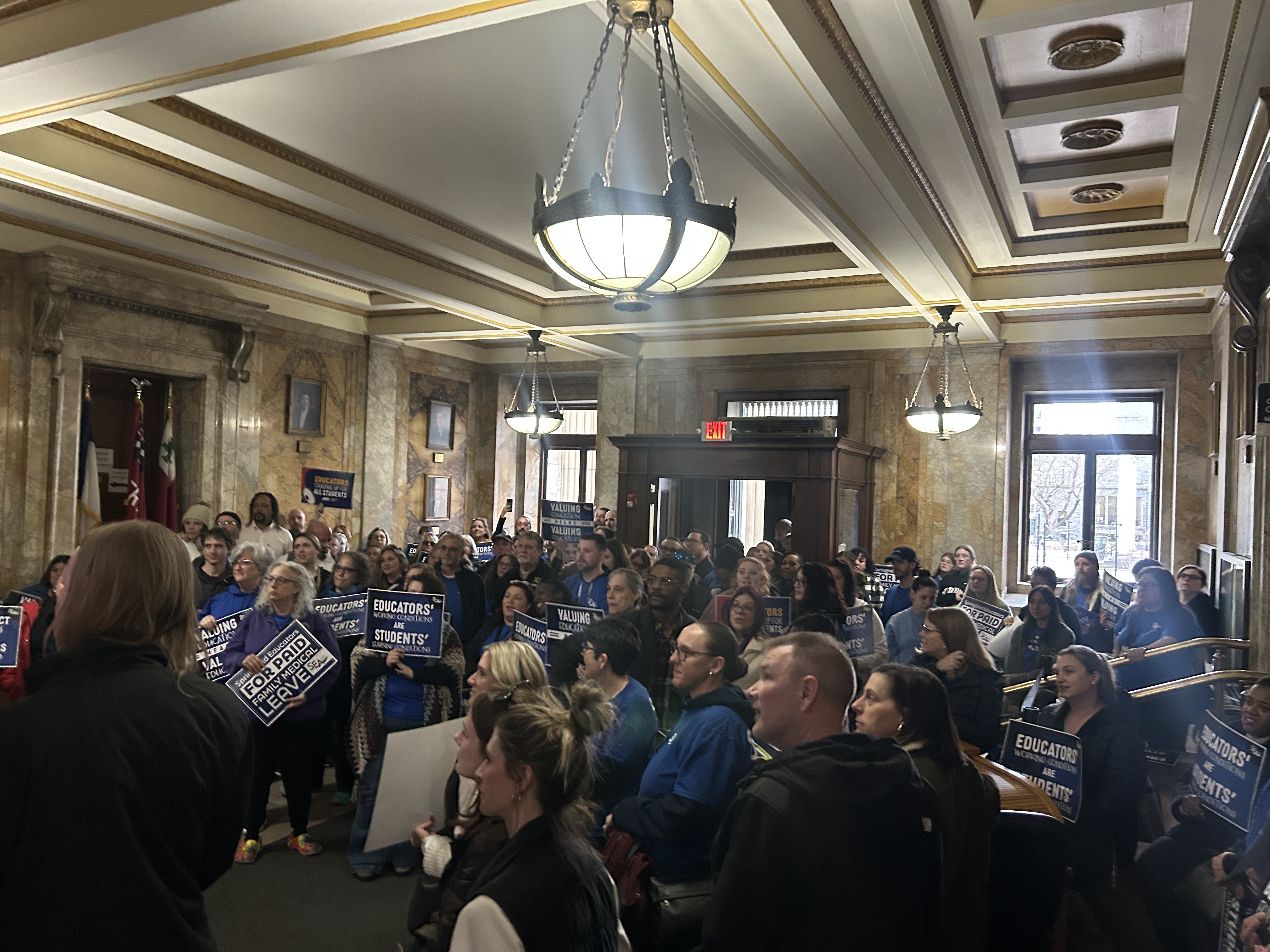
A sea of blue swept through Springfield City Hall on April 10 as a crowd of Springfield Public Schools teachers, deans, and counselors packed into the School Committee’s meeting room. The educators had thrown on their blue union shirts over school-day clothes, having arrived after a day of work to demand improved benefits and compensation from the district.
“Four, eight, four, four!” union members chanted as the school board took a recess. Those numbers represent the raise schedule union organizers say would help close the gap between Springfield educators’ salaries and their statewide counterparts. On average, teachers across the state are better-paid than those in Springfield, they said, despite the fact that the city’s school year is over a week longer than most other schools’.
“We’re behind,” Springfield Central High School teacher Declan Kennon told The Shoestring. “Teachers will leave if this isn’t a good contract … I’ve had people say that point blank to me.”
The stand-in protest, as the teachers called it, was the latest action in a year-long push the district’s teachers union, the Springfield Education Association, has made as its members work to negotiate a new contract for over 2,100 educators. In addition to asking for pay raises, union members said they are also fighting for more sick days and paid parental leave.
Springfield is the third-largest school district in New England, boasting enrollment of over 23,600 children, according to state data, 80% of whom the state classifies as low-income. Union organizers who spoke to The Shoestring said that their efforts are essential for teachers to feel that they have a future in the district, one where their working conditions feel supportive of their teaching principles and their personal ambitions. And as the district reels from the Trump administration stripping $47 million in funding away from Springfield schools, they say it’s more important than ever that their value as educators is enshrined in a better contract.
Springfield Education Association President-elect Riley Hernandez said that this is the most energy he’s seen from union membership since the COVID-19 pandemic. At their most recent open-bargaining session, where rank-and-file members can sit in and observe the 11-person bargaining team that represents them, Kennon said the number of teachers who attended was more than double the historical norm.
The Shoestring relies on reader support to make independent news for western Massachusetts possible. You can support this kind of labor-intensive reporting by visiting our donate page.
Throughout the state, Massachusetts public schools have seen a renaissance of union activity. In the past six years, ten local units of the Massachusetts Teachers Association have gone on strike — something that’s illegal for public-sector workers in Massachusetts — with the support of the MTA’s leadership. Teachers have been advocating for more specialized staff, paid medical leave, and fairer cost of living adjustment schedules like the Springfield Education Association’s “4-8-4-4” campaign.
However, the majority of wins have thus far been restricted to the eastern — and, often, wealthier — parts of the state, where higher property taxes can mean more public education funding. Recent strikes, for example, have happened in Brookline, Malden, Woburn, Newton, Marblehead, Beverly, and Gloucester.
Meanwhile, Springfield Education Association Treasurer Lee Burgess said that his members are still trying to come back from wage freezes implemented over 20 years ago, a process that has been gummed up by a city government that Burgess described as “crony-istic.”
Caity Welz, a social studies teacher at Springfield Central High School who grew up in the district, remembers when the district was unilaterally “gutted” by the state-controlled Springfield Finance Control Board in the early 2000s. The board had taken over Springfield’s finances as the city faced insolvency. During that period, the city reneged on its contracts with employees and saw a mass exodus of teachers, Welz said. The control board handed back power to the city in 2009 after five years in charge.
Since then, Burgess said Springfield officials have been able to “run the government like a business.” Union leaders said the School Committee has refused to bargain with the Springfield Education Association face-to-face, instead sending proxies — lawyers and the teachers’ own supervisors — in their stead. Not only does this slow down the negotiation process, Burgess said, it also mystifies the School Committee’s logic, and makes it so that they don’t have to respond in real time to “the moral argument that what we’re [asking for] is best for the kids.”
In response to an email sent Wednesday Springfield School Committee Vice Chair LaTonia Monroe Naylor declined an interview, saying she needed approval from the district’s lawyers. She did not respond to a follow-up email on Thursday.
One of the union’s core demands is to be granted paid family medical leave, a benefit that was already guaranteed to private sector workers via a Massachusetts law passed in 2018. Massachusetts Teachers Association locals elsewhere have fought for — and, to varying degrees, won — equivalent benefits from their districts. Legally, though, no public-sector employees are covered under the law, which first went into effect in 2021.
“If you want to run this place like a business, run it like a business,” Burgess said. “Give us family medical leave, give us sick time.”
Burgess, Kennon, and Hernandez are all millennials. Many young teachers with aspirations of starting a family, Kennon said, are forced into the impossible situation of choosing between their vocation and a future.
“There are not very many 30 year olds working in schools,” Burgess said, because “the amount of money that it would take to raise a family [and] buy a house” is largely inaccessible to educators.
A win for the union, he said, would mean teachers could have fuller lives, which in turn would ensure the future of Springfield Public Schools.
“I hate perpetuating this narrative, but educators are kind of saints,” Burgess said. “And the reason I hate perpetuating this narrative is because … What did it take to get the point of getting a saint? You had to kill them off.”
In this light, union work is a matter of survival, Kennon said when asked about his role helping to mobilize fellow rank-and-file members.
Union members are also working to change Springfield’s current sick-day system. Teachers’ current contract offers 10 paid sick days per year, which carry over if unused. That’s time that educators have to use for family or medical leave, given that the schools don’t offer paid leave for those purposes.
Union members said that when the Springfield Education Association asked for the number of sick days to be raised to 15, the city proposed a sick-bank system instead. Under that system, the bargaining unit could “earn” 500 sick days to share among themselves, but only after they maintain a 96% attendance rate.
Beyond short-term contract wins, Kennon and Hernandez said they see urgency in the practice of building solidarity through rank-and-file unionism.
The idea that a democratic union is an end in itself undergirds the Massachusetts Teachers Association’s Educators for a Democratic Union caucus — a rank-and-file movement in which Hernandez is active. The vision of a union that models what a worker-led society could look like, as Hernandez put it, has been ascendant largely thanks to the leadership of EDU caucus organizers since 2014.
Educators for a Democratic Union has won the presidency and many of the union’s executive-board seats in recent elections, working to reform hierarchies and cultures of exclusivity within the union in order to build toward full member participation in organizing work.
Hernandez said that rank-and-file mobilization is really about getting people in a room and talking to each other, and added that the past year has been heartening in this regard.
In the fall of 2023, for example, when the American Federation of Labor was drafting a resolution to back a ceasefire in Gaza, there was some discord in the Massachusetts Teachers Association about whether to sign on. Hernandez, Kennon, and Adam Reid, a middle school history teacher, organized a series of conversations in Springfield to talk about the idea of signing on.
The big question was “whether or not we think [the union] should even take up these political endeavors,” Hernandez said. Ultimately, Hernandez and other organizers drafted a letter in support of a ceasefire, which then got passed around their respective schools. By the time it was delivered to the executive board, over 100 rank-and-file signatures appeared at the bottom.
More recently, 88% of the union’s 2,100 teachers signed onto a petition asking the district to bargain with them in good faith, a move that was not procedurally necessary but which aimed to display their organizational strength to the district, according to Hernandez.
Though the district has yet to concede to the Springfield Education Association’s demands, the year-long fight has, by all accounts, only strengthened their collective power. On the morning of April 16, a week after the Schools Committee stand-in, the union staged walk-ins at 17 Springfield schools, rallying in front of students and their parents.
Burgess said union leadership is surveying member attitudes on whether, and how, to up the pressure on the district. It’s unclear whether that would include striking. Lee said the executive board “is not and has taken no steps in preparation for any labor stoppage.”
The district last went on strike 45 years ago, defying the state’s 1973 law barring public-sector strikes. On April 29, 1980, most of the city’s 1,800 teachers headed out to the picket line, where they stayed for 18 days. Some 27 teachers were arrested during the strike and the union faced steep fines, but the teachers won not just pay raises but improved student-teacher ratios in the classroom, more classroom prep time, and a sick-leave bank for members, according to reporting in The Republican.
To Hernandez, the question of whether to strike is about more than just pay raises. “Is [a strike] strictly to gain these economic and material benefits for workers? [Or] is it a tactic, and probably the premier tactic, in building … class consciousness?”
Back in the foyer of Springfield City Hall, a speaker asked the blue-clad crowd, referring to their current cost-of-living adjustment rate, “Are you worth only 3%?” The union members replied “No!” roaring louder with each repetition, undoubtedly audible to the School Committee talking just upstairs.

Sam Spratford
Sam is a writer and editor based in the northeast. They graduated Amherst College in 2024 and are currently the literary editorial fellow at The Common magazine.
- This author does not have any more posts.


