


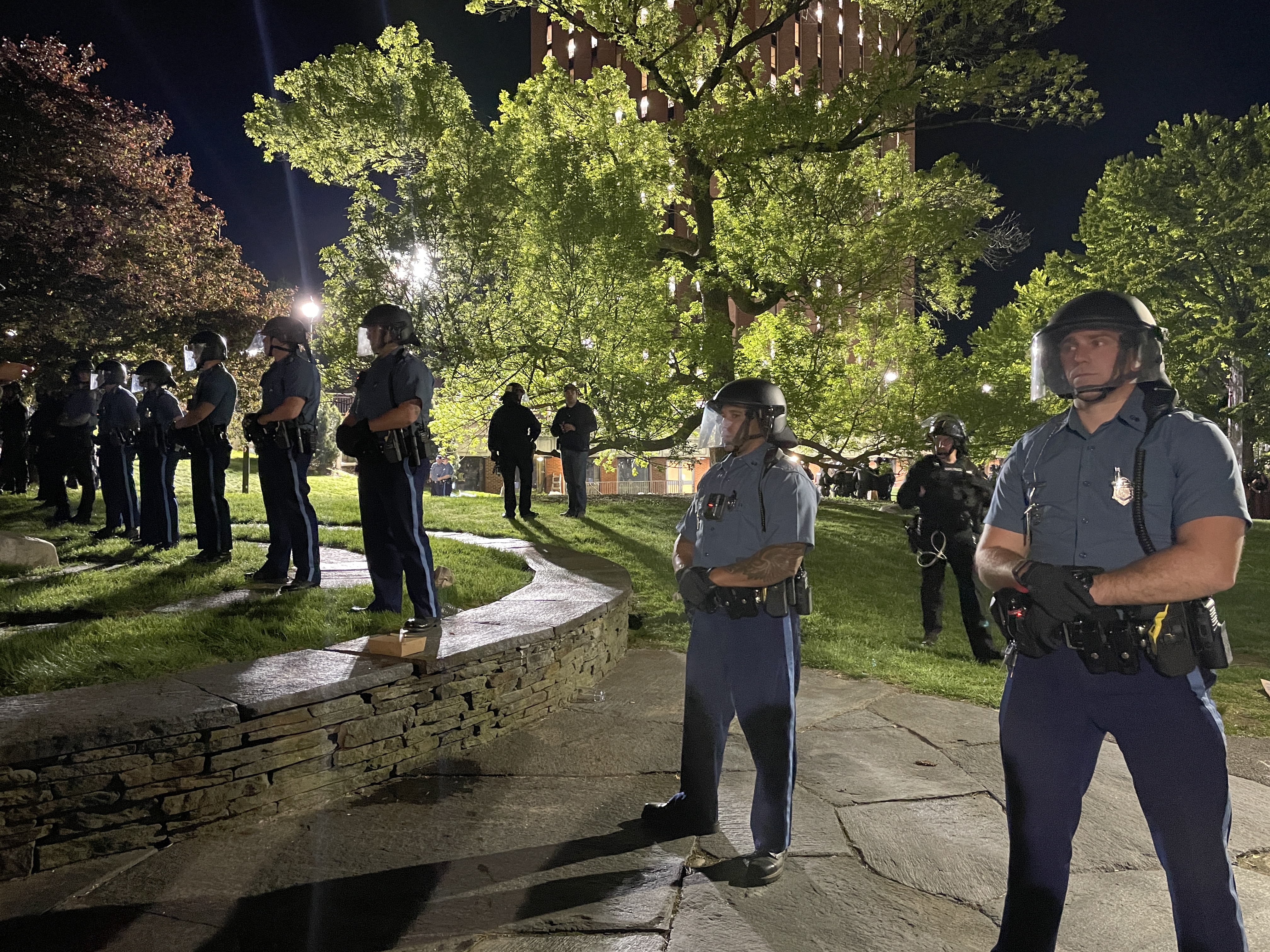
The police crackdown on a pro-Palestinian encampment at the University of Massachusetts Amherst in May cost taxpayers over $100,000, according to public records obtained by The Shoestring.
Previous reporting by The Shoestring revealed that officers from at least six police departments were present at the protest. Officers from Hadley, Amherst, the Hampden County and Hampshire County sheriff’s departments, UMass Amherst police, and the Massachusetts State Police were deployed to campus. Over 200 police officers were on university grounds during the roughly nine-hour encampment response, according to university spokesperson Melinda Rose.
In May, The Shoestring filed public records requests regarding pay data with all six of these departments.
According to documents obtained via these public records requests, UMass Amherst police alone spent over $42,000 on their encampment response, including overtime for their communications staff.
Hadley paid officers almost $1,000 in overtime during the encampment demonstration, though it’s unclear which officers were deployed to campus. Records show that at least one officer from the Hampshire County Sheriff’s Department was on UMass Amherst grounds on May 7 and was paid over $900.
In a statement, the Amherst Police Department said it paid officers for 21 overtime hours during the protest, but didn’t provide the dollar figures that corresponded with these hours.
The Hampden County Sheriff’s Department did not provide pay data. The department’s general counsel, Theresa Finnegan, said in an email that “some transportation vans and officers did assist with transport of arrestees but were not involved in police activities.”
At the time The Shoestring published these findings, the Massachusetts State Police hadn’t responded to a public-records request filed on May 29 despite numerous calls and emails regarding its status.
On Aug, 15, over two months after the request was filed, the state police provided records showing that they paid responding officers over $60,000. (The state’s public records law requires agencies to respond to such requests within 10 business days, though it doesn’t penalize violations of that law.) This puts the cost of the police response to the protest at over $100,000.
This figure doesn’t include other logistical costs, like the university feeding responding officers, UMass custodial services disposing of debris from the dismantled encampment, and transporting arrested demonstrators in Pioneer Valley Transit Authority buses.
Student and faculty activists who spoke with The Shoestring saw the cost to taxpayers from the crackdown as wasteful and unnecessary.
Nat Thompson, a Students for Justice in Palestine member, was at the demonstration. He recalled the police violence he witnessed that evening when reacting to the cost of the crackdown.
“Knowing it cost $100,000 to have three knees on someone’s back doesn’t exactly sit super well with me,” Thompson said. Highlighting the cost to taxpayers, Thompson said UMass is “OK with spending other people’s money. It’s just a matter of not spending their own.”
Kevin Young, a professor in the history department and member of UMass Amherst Faculty for Justice in Palestine, was arrested at the encampment protest. He echoed Thompson, telling The Shoestring that the costs of the police presence were “deeply unsettling.”
Police arrested 134 demonstrators at May’s encampment protest, putting UMass Amherst in the top five universities with the most arrests during the spring’s pro-Palestine encampment wave, according to data from The New York Times. University Chancellor Javier Reyes, who initiated the police response, was subsequently met with no-confidence votes from faculty and students.
On June 17, Reyes announced the formation of a “Campus Demonstration Policy Taskforce.” In an email to the UMass Amherst community, Reyes said the task force was formed to review the university’s demonstration policies and recommend changes “based on best practices in higher education.”
“Caring for our community is done through actions, not statements that some may see as performative or hollow,” Reyes said.
Following the release of the report in September, Young wrote a letter to the members of the Campus Demonstration Policy Task Force and the Student Affairs and University Life Council of the Faculty Senate.
In the letter, which Young provided to The Shoestring, he argues that “Chancellor Reyes created the Taskforce – which was stacked heavily with administrators and included several other members known to be sympathetic to administrators – in hopes of exonerating himself from his misdeeds over the course of last year and to justify repressive decisions in the future.”
In an interview with The Shoestring, Young said that the university’s move to reevaluate its demonstration policies is “premised on this notion that the student demonstrators on May 7 posed a threat to someone on campus, and that claim continues to be completely unsubstantiated by the administration.”
The Professional Staff Union, which represents more than 1,500 employees on campus, also took issue with the way Reyes’ administration put together the task force. In a press release in August, the union accused administrators of deliberately excluding union representation from a body that would “develop policies that will directly affect the workplace safety and free-speech rights of unionized employees.”
“Political expression, including the ability to demonstrate in public spaces, is the bedrock of our union,” PSU member Ari Jewell said in the press release. “If we gather on campus to celebrate or argue for something Chancellor Reyes disagrees with, will we be the next peaceful protestors facing possible felony charges?”
The task force’s report, released on Sept. 4, was drafted with input from students and faculty. In response to students concealing their identities over concerns that those opposed to their protest would post their personal information online — a practice known as doxxing —the report recommends that “production of identification be codified into policy as appropriate” during demonstrations.
In particular, some students have expressed concerns about groups like Canary Mission, which has targeted some students and faculty at UMass Amherst. The organization catalogs pro-Palestine activists in a database — efforts that often lead to harassment against those activists and which critics say chill free speech and criticism of Israel. Canary Mission bills its catalog as a list of “individuals and organizations that promote hatred of the USA, Israel, and Jews on North American college campuses and beyond,” according to their website. Canary Mission has profiled UMass student and faculty activists, publishing photos of them on their website.
Instances of doxxing like these contribute to student organizers’ pushes for face coverings at protests. “People get stalked and harassed online,” Anya Epstein, a UMass Amherst Students for Justice in Palestine leader, told The Shoestring at the student group’s first rally of the fall semester in late September.
In April, the news outlet The Intercept reported that UMass Amherst was under investigation by the Department of Education following a discrimination complaint by advocacy group Palestine Legal for their handling of alleged stalking and harassment of former SJP leaders by pro-Israel students. The investigation is pending as of Oct. 22, according to the Department of Education’s website.
The university’s report also recommends narrowing the definition of a “structure” to include a “platform, bin, fence, sign, flagpole, or the like.” If the recent recommendations are passed, the university could apply this narrower definition of a “structure” to future demonstrations.
The university justified its response to the May encampment by pointing to its land use policy, which prohibits “structures.”
In Young’s letter to members of both the task force and the Faculty Senate, he highlights what he sees as a “broad and inclusive” recommended definition of “structure,” and its potential to be applied to “innocuous forms of speech.”
“Nowhere is it explained why this definition of ‘structure’ makes any logical sense to adopt, or why objects like signs, stands, or small tents pose any harm – in themselves – to the community,” Young’s letter reads.
The recommended changes to the land use policy must pass through the University of Massachusetts Board of Trustees to become official policy for the entire UMass system, according to Rose, the university spokesperson. Other recommended changes must pass only at the administrative level at UMass Amherst.
In an email to The Shoestring, Rose said that “while the specific recommendation regarding the definition of a structure has not yet been implemented, it’s important to note that structures are not banned — they only require, as they always have, approval under long-standing policy.”
Rose did not comment on any possible changes to the university’s budget related to the enforcement of policy around campus demonstrations.
The report also recommended “changes to the operating procedures” of the university’s Demonstration Response and Safety Team. Formed in the 2023-2024 academic year, the DRST is a “cross-functional effort with membership from several administrative areas on campus,” according to Rose.
The report recommends the DRST “develop off-ramps oriented towards de-escalating the potential for conflict, including building up a mediation infrastructure” during protests, though it remains unclear what those changes would look like.
The report says the recommended changes to the operating procedures of the DRST are attached, yet in the “attachments” section of the report it is listed with no hyperlink and a note saying the task force “believes this may be considered an internal document.”
A section of the report dedicated to recommended changes to the university’s land use policy says that the “changes are reflected in the red-lined PDF, attached to this report.” This “red-lined PDF” is not attached to the report and is not included in the “attachments” section.
UMass Amherst provided two of these documents to The Shoestring when asked why they weren’t accessible within the report itself. These documents detailed suggested changes to the UMass system’s land-use policy and the UMass Amherst picketing code. The Shoestring could not find the remaining “attached” documents on the UMass website or in the report. It remains unclear why they weren’t included in the report itself and aren’t publicly available.
The documents provided to The Shoestring are existing copies of the UMass Amherst picketing code and the UMass system’s land use policy, with edits in red text representing recommended changes to the policy’s language. Crossed-out red text represents the language recommended to be removed from these existing policies.
According to these documents, the only recommended change to the university’s picketing code is that the existing definition of disruption to “university business” not be restricted to activity within university buildings. The pro-Palestine encampment in May took place next to the campus pond and the W.E.B DuBois Library.
When announcing the task force, Reyes shared an email address that allowed community members to offer their input for the task force. However, in the final report, the public comments section mentioned that despite receiving over 100 emails, their “subject matter was not within the scope of [the task force’s] charge.
Student activists told The Shoestring that they didn’t have high expectations for the report and weren’t surprised by its recommendations.
Thompson believes the task force was initiated as a face-saving move in the wake of May’s encampment crackdown.
“I think the whole purpose of the task force was to say that [UMass leadership] had looked into it,” he said. Thompson sees the decision to include students and faculty in the task force as an attempt to “make it more conscionable for all parties involved.”
In his letter, Young argues that the task force’s creation and final conclusions were politically motivated, a contradiction of the “institutional neutrality” that is stressed in the report itself.
“Both the content and the timing of the task force’s creation indicates that the administration’s goal is to limit expressions of solidarity with Palestinians and/or criticism of U.S. and Israeli policy toward the Palestinians,” Young wrote.
The Shoestring is committed to bringing you ad-free content. We rely on readers to support our work! You can support independent news for Western Mass by visiting our Donate page.

Dan McGlynn is an investigative reporter covering social movements and institutional power in western Massachusetts. He can be reached at danmcglynn@protonmail.com. Follow him on Instagram @danmcglynn_ or on X @danmcglynn_.


